by Michael Cropper | Jan 14, 2015 | SEO |
Digital is changing faster than ever, yet so many businesses fail to keep ahead of the essential changes required to meet customer demands. 2015 is the year where businesses who take digital seriously are going to thrive and leave their competitors well behind. It’s time to embrace digital and integrate digital technologies throughout your entire business, process and people. Here we are going to look at the priorities for your businesses to utilise digital to grow throughout 2015.
Platform
One of the common challenges for businesses is selecting the right platform for their website. A platform that allows members of the team to easily create, edit and delete pages, images and content throughout the website. A platform that puts you, your staff and your business in control of the direction of your own website. A platform that is capable of scaling as your business grows.

Image source: https://www.flickr.com/photos/ajpscs/
To keep things simple, you really need to be working towards one of the two leading platforms either WordPress or Magento. For most businesses within the SME bracket, one of these two platforms is really the only thing you need to scale your business. There are an awful lot of website platforms available to develop your website on, many of which have a lot of problems with them and are simply not good enough.
This is quite a big topic and is a little outside of the scope of this blog post, so we will cover this a little later down the line in a future blog post. For now, if you have any questions regarding the suitability of the platform you are using, then get in touch and we will be happy to give an honest opinion of the technology you are using and it’s suitability to cope with the growth plans for your business.
The important point around the platform and technology in use on your website is that it needs to be suitable for your business and puts the power in your hands with a Content Management System (CMS). Which brings us nicely onto the next point about ownership.
Ownership
As a business, you need to own your digital assets including your hosting solution and website. What this means is that you need to have access to your own assets and be able to change things as you require. Far too often businesses come to us and tell us the same story (we listen politely every time we hear the story! J), about how another website developer/company owns their website, their hosting and domain name, wants to charge a considerable amount of money for making basic changes on the website, which you should be able to do yourself, the relationship has broken down and they are refusing to release control of your own website to you.

Image source: Paul Townsend
Please, stop and think before purchasing a new website. You need to own everything that is going into it. A web development company exists to assist your business to grow, not to own a significant part of your digital assets and hold you to ransom for them.
Ownership comes in many forms from copyrighted images including stock photographs, your web hosting solution, your domain name, your emails, your website technology, your website content, your login details for all of the above along with external services that are being used on your website, social media channels and tracking solutions and many more. For everything that is implemented for your business digitally, you need to own everything to keep your business safe and secure.
Tracking
Would you like to give me £100,000? No? Why? How about if you gave me £100,000 and I gave you £120,000 back? How about now? Yes? What’s the difference? The difference is tracking. Tracking your digital investments and the return you are generating from your digital marketing channels. That’s the difference.

Image source: BK Koh
Most businesses simply aren’t tracking their digital marketing activities accurately which ultimately leads to bad investments and distrust in digital marketing activities. Businesses will quite happily spend hundreds of pounds on a printed advertisement in newspapers and magazines, thousands of pounds sponsoring a single event and even over £100,000 per year on radio advertising without any ability to accurately track direct results from those campaigns (yes, these are real figures and stories we have discussed with businesses!). Why? Because they are easy. It is easy to spend money on ‘Advertising’ without understanding what this is generating in return. What would happen if you didn’t do those things? What would happen if you reduced your spend in these areas by half? What would happen if you doubled your spend in these areas? Tracking is key to understanding profitability with marketing campaigns.
Traditional advertising, generally speaking, has an extremely low response rate and an even lower success rate. Compare this with digital advertising where you can track exactly what your results are;
Traditional Marketing
Investment –> Hard to track from here
Digital Marketing
Investment –> # of Website Visitors –> # of Conversions –> Revenue –> Profit –> ROI
Which brings us back to the question of how much money would you give me if you received more money back in return? It all comes down to tracking and data analysis. Being able to track results accurately from SEO, PPC and email marketing allows you to make smarter data driven business decisions. Invest in marketing activities wisely and most important track results accurately across all channels. Google Analytics is capable of tracking your every need.
Integrated Marketing
Have a think about the last time you purchased something in your own life, a car, a holiday, a TV, a laptop, a tablet, whatever. Did you ever just complete one single action during the purchasing journey you took? The answer is no. People are complex, people go through complex purchasing paths depending on their specific needs, level of trust, previous purchases and experiences. It is therefore no surprise that your customers also take a rather complex path when purchasing products and services from you. That’s why it is important to integrate your marketing channels to optimise every channel and touch point that your customers experience on their path to purchase.

Image source: Jon Tollefson
Think about your offline presence, digital presence including SEO, PPC, email, referral, direct, social and specific campaigns. When a customer experiences your brand on one of the marketing channels above, how do they feel? Are your marketing and communication messages the same across all channels? Are you even using all of the available marketing channels for your business? A positive or negative experience across a single touch point can result in a lost sale for your business.
The key message is to make sure you are active on all digital marketing channels available to you and ensure your customers have a positive experience. Join the dots across all digital marketing channels to enhance your customer’s lives through content, fun and interaction. This leads nicely onto the overall user experience of your brand online.
User Experience
When your customers interact with your brand online what is the experience they have on your website, from mobile devices, on social media, when they search for you on Google, when they see a PPC advert, when you send an email newsletter? Every experience is either a positive or negative one, there is no middle ground.
Taking your website first, how easy is your website to use in general and more specifically on mobile and tablet devices? Responsive design has been talked about for a couple of years now, yet still many websites simply aren’t user friendly and are difficult to use from a mobile. You need not look any further than the endless statistics that are being continually released about the proliferation of mobile devices throughout our everyday lives and interactions with brands online. If your website does not work effectively on a mobile device then you may as well deny people accessing your website from mobile devices as this sends the same message. Any new website that is developed in 2015 needs to be responsive as a minimum, just as it did in 2014. It needs work effectively on mobile devices and tablets.
What is the experience when people receive your weekly or monthly email marketing newsletters? Is this a typical sales focused shouting emails asking your customers to buy with yet another special offer, coupon code or last minute flash sale? Boring. Yes these type of emails clearly do work and should be part of an effective email marketing strategy, but they should not be the main focus. Aim to educate your customers, entertain them and show the personality of your brand. Look to engage with your customers and grow your email list.
What is the experience when people interact with your brand on social media? Are you busy talking about nonsense, retweeting everyone else’s tweets with no idea why and spending hours a day being busy without understanding what you are getting back? Stop, just stop. It’s time to start taking social media seriously, what are you looking to gain from social media? How is social media integrating with your overall digital marketing strategy? Who are you looking to engage on social media? Turn your social media activities into a positive experience for your customers online. Social PPC is essential to reach your customers on social media channels in 2015. Businesses have been testing this over the past couple of years to grow their audience and can be a very successful way to increase the reach of your messages.
Data Security
In 2014 more data security breaches were announced than ever before. The graphic below highlights how intense the large scale data security breaches have been in recent years;
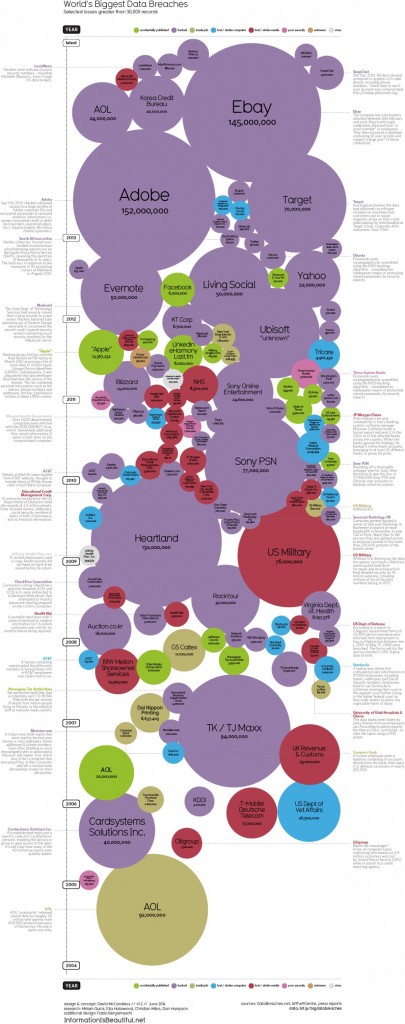
Click image above for larger image
Source: http://uk.businessinsider.com/data-breaches-infographic-2014-12
Many businesses aren’t taking data security seriously, especially within the SME group of businesses. People running websites based on popular content management systems often take the approach of ‘build it once and leave it’. This isn’t good enough. Instead you should be continually updating your website, updating plugins and patching security holes. All of which can reduce the possibility of your website being hacked.
Many times in the last year I have personally received an email from a senior person within a professional large business which has been sent after they have been hacked into, i.e. it wasn’t them who actually sent the email as it contained a virus. While this is never 100% inevitable, there are many things that you can do as a business to protect yourself online. Often with old email technologies, if someone hacked into your web server, they may also find it easier to access your email system.
The government recently announced the Cyber Essentials scheme to help businesses take data and security seriously within their business. Have a good read over what this means for you and your business. In addition to this, Google recently announced that they are considering marking all non-HTTPS websites as ‘non-secure’ which really highlights where websites are heading in the future. Security is key with your business, you digital assets including your website and your customers’ data. Keep things safe and secure by taking the steps needed.
A Bit Further Down the Line
Where would a 2015 blog post be without looking at some of the other items on the horizon but aren’t quite going to become mainstream in the next year. There is a lot of technology in the fringe that is growing in popularity which is really exciting for end users and certain businesses, although it is not quite at the stage for most businesses to take seriously. But let’s take a look at it anyway!
Wearable technologies have been talked about a lot recently and I recently had the opportunity to test out Google Glass and the Oculus Rift, both of which were rather cool I have to say. Recently Sony announced a similar technology designed to remove the ‘cringe factor’ of Google Glass.
Recently Nest announced that Google Now was now integrated into the device, bringing a HAL 9000 experience to the home. Such fun. This was an inevitable next step for Nest which is clearly one of the significant reasons why Google paid such a hefty sum for Nest in the first place. As Nest increases in popularity, Google is going to become further engrained in our daily lives without us having to visit a specific device to search, instead we can just say “Ok Google, what was the football score this afternoon”.
Uber, the taxi booking app, has taken the world by storm. Expect to see a lot more digital disruption in all industries in 2015 and beyond. For your business to stay ahead this year it is vital to innovate throughout every aspect of your business, products and services. Digital disruption is coming to every industry – be prepared.
Facebook search engine? Maybe. Well Facebook did recently announce that they are no longer going to be using Bing for their search provider. Does this mean that they are going to start competing with Google in the search space? Who knows? It will be interesting to see how this develops this year.
Internet of Things is a recent hot topic in digital which is still very much in its infancy. In the very near future, every electronic device will be connected to the internet, from sensors to devices and everything in between. When this happens, it is going to be a very exciting time as the online and offline worlds are connected more than ever. The data and insights that can be gained through such huge data could optimise the physical world we live in to make services and systems more efficient.

Image source: John Biehler
Bridging the gap between the online and offline worlds is going to become seamless for customers. Customers don’t particularly care whether they are dealing with your business online or offline, they simply want to deal with your business. Services such as our WiFi Marketing & Analytics system is ideal for leisure based venues to connect the online and offline dots together. Capturing customer data is the most valuable currency online in 2015.
Summary
Digital is going to be moving at a faster rate than ever in 2015. Your business needs to be prepared and take advantage of these changes or risk getting left behind. Only the strong will survive. Would you like to discuss how we can support your business goals throughout 2015? Then get in touch for an informal conversation about how we can help or take a look through the many services we can provide to increase revenue for your business.
by Michael Cropper | Dec 14, 2014 | SEO |
2014 has been an exciting year where everyone has taken to social media to share their experiences in life. Let’s take a look what the world has been doing this year, how many of these do you remember?
YouTube
Facebook
Top 10 topics discussed on Facebook in the UK in 2014;
- Scottish Referendum
- Ice Bucket Challenge
- World Cup
- Premier League title race
- Conflict in Gaza
- Robin Williams
- Louis van Gaal takes over at Manchester United
- Ebola virus outbreak
- Champions League Final
- First World War Centenary
Top 10 places discussed on Facebook in the UK in 2014;
- Warner Bros. Studio Tour London
- Madame Tussauds (London)
- Tower of London
- The London Eye
- Old Trafford – Manchester United stadium
- Chester Zoo
- ZSL London Zoo
- Alton Towers
- LEGOLAND Windsor
- Wembley Stadium
More exciting information: http://uk.yearinreview.fb.com/
Twitter
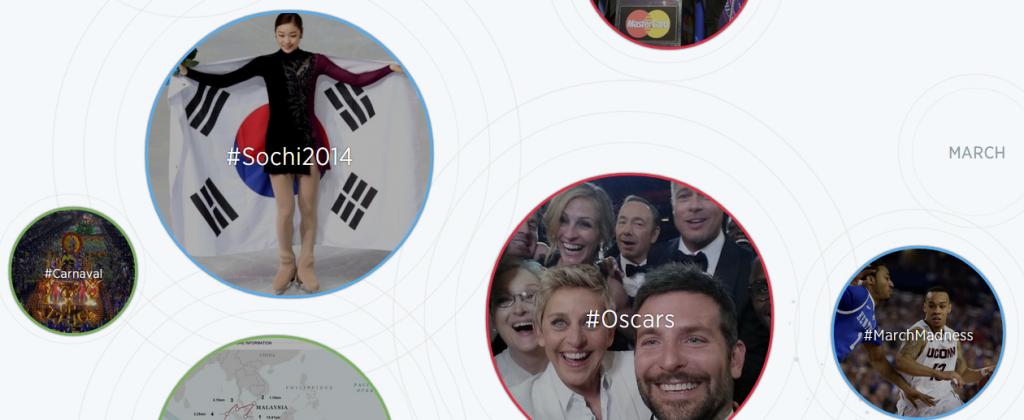
Explore the full website about everything that happened on Twitter this year: https://2014.twitter.com/moments
Google Search
Where would we be without Google? Here is how the world searched on Google in 2014
Read more about what the world searched for on Google in 2014 and explore the stories in more detail with Google Trends 2014.
Your 2014 Year in Review
What have you loved doing in 2014 that you have shared with the world on social media? Let us know in the comments below. Here is to an exciting 2015!
by Michael Cropper | Dec 14, 2014 | News, Social Media |
2014 has been an exciting year where everyone has taken to social media to share their experiences in life. Let’s take a look what the world has been doing this year, how many of these do you remember?
YouTube
Facebook
Top 10 topics discussed on Facebook in the UK in 2014;
- Scottish Referendum
- Ice Bucket Challenge
- World Cup
- Premier League title race
- Conflict in Gaza
- Robin Williams
- Louis van Gaal takes over at Manchester United
- Ebola virus outbreak
- Champions League Final
- First World War Centenary
Top 10 places discussed on Facebook in the UK in 2014;
- Warner Bros. Studio Tour London
- Madame Tussauds (London)
- Tower of London
- The London Eye
- Old Trafford – Manchester United stadium
- Chester Zoo
- ZSL London Zoo
- Alton Towers
- LEGOLAND Windsor
- Wembley Stadium
More exciting information: http://uk.yearinreview.fb.com/
Twitter
Explore the full website about everything that happened on Twitter this year: https://2014.twitter.com/moments
Google Search
Where would we be without Google? Here is how the world searched on Google in 2014
Read more about what the world searched for on Google in 2014 and explore the stories in more detail with Google Trends 2014.
Your 2014 Year in Review
What have you loved doing in 2014 that you have shared with the world on social media? Let us know in the comments below. Here is to an exciting 2015!
by Michael Cropper | Nov 23, 2014 | SEO |
As you know we recently renewed our Google AdWords qualifications for another 12 months after spending a couple of days over at Google’s Manchester office. Following on from this, we have a little over £5000 of Google AdWords vouchers to give away to businesses looking to increase traffic, sales and enquiries through their website! In addition to this, we are going to be hosting a full day event to help businesses get started with using Google AdWords and setting your account up in the best way possible.
Whether you are a complete beginner and know nothing about Google AdWords or if you are looking for some expert guidance, this training session is designed for you. We will talk you through the benefits of how Google AdWords can be used for your business and how it can be used to directly increase revenue for your business. Even better, all of this will be explained in a simple way that you can understand. If you don’t know your AdWords from your Analytics, then we will demystify this for you and get you set up on Google AdWords in no time.
Far too often businesses will jump in with both feet and set up a PPC campaign without fully understand the finer details about how Google AdWords actually works. What this inevitably leads to is a campaign that often doesn’t perform very well and businesses coming to the conclusion that Google AdWords doesn’t work for their business. This is such a shame to see as Google AdWords is an extremely powerful marketing channel that can grow your business. You just need to make sure that your campaigns are set up correctly to get the maximum return for your advertising spend.
The event will be a full say session with the main agenda outlined below.
When: Friday 5th December
Time: 9:30am – 4:30pm
Venue: Contrado Digital, The Innovation Centre, 1 Evolution Park, Haslingden Road, Blackburn, Lancashire, BB1 2FD
Morning Session
- Introduction to Google AdWords
- Account management
- Campaign and ad group management
- Keyword targeting
- Language & location targeting
- Ad formats
- Budgets and bidding
- Measurement and optimisation
- Performance, profitability and growth
- Managing multiple accounts
Lunch
Afternoon Session
Bring your laptops, it’s time to put everything you have learnt in the morning session into action and start your AdWords campaign running. Hands on second half to set up your campaign with qualified Google AdWords professionals on hand to help you along the way
As you can imagine, we are likely to get quite a large number of businesses looking to take advantage of this free training and Google AdWords voucher worth £150 per business, so get in touch now and fill out your details below;
[gravityform id=”1″ name=”Request Google AdWords Vouchers”]
Due to the popularity of the event, we cannot guarantee a place although we will do our very best to accommodate where possible. Get in touch now and you will be updated next week when places will be confirmed for qualifying businesses.
What’s the catch? There isn’t one. There will be a small charge between £15-£20 for the full day training event which is purely to cover the cost of lunch, drinks and room hire. What we would hope is that once you have your account set up correctly and it is working well for your business, that when the time comes that you decide to work with a company to manage your pay per click advertising campaigns, you would get back in touch to discuss things further. Managing pay per click advertising campaigns is something we understand in a lot of detail.
by Michael Cropper | Nov 23, 2014 | Events, PPC |
As you know we recently renewed our Google AdWords qualifications for another 12 months after spending a couple of days over at Google’s Manchester office. Following on from this, we have a little over £5000 of Google AdWords vouchers to give away to businesses looking to increase traffic, sales and enquiries through their website! In addition to this, we are going to be hosting a full day event to help businesses get started with using Google AdWords and setting your account up in the best way possible.
Whether you are a complete beginner and know nothing about Google AdWords or if you are looking for some expert guidance, this training session is designed for you. We will talk you through the benefits of how Google AdWords can be used for your business and how it can be used to directly increase revenue for your business. Even better, all of this will be explained in a simple way that you can understand. If you don’t know your AdWords from your Analytics, then we will demystify this for you and get you set up on Google AdWords in no time.
Far too often businesses will jump in with both feet and set up a PPC campaign without fully understand the finer details about how Google AdWords actually works. What this inevitably leads to is a campaign that often doesn’t perform very well and businesses coming to the conclusion that Google AdWords doesn’t work for their business. This is such a shame to see as Google AdWords is an extremely powerful marketing channel that can grow your business. You just need to make sure that your campaigns are set up correctly to get the maximum return for your advertising spend.
The event will be a full say session with the main agenda outlined below.
When: Friday 5th December
Time: 9:30am – 4:30pm
Venue: Contrado Digital, The Innovation Centre, 1 Evolution Park, Haslingden Road, Blackburn, Lancashire, BB1 2FD
Morning Session
- Introduction to Google AdWords
- Account management
- Campaign and ad group management
- Keyword targeting
- Language & location targeting
- Ad formats
- Budgets and bidding
- Measurement and optimisation
- Performance, profitability and growth
- Managing multiple accounts
Lunch
Afternoon Session
Bring your laptops, it’s time to put everything you have learnt in the morning session into action and start your AdWords campaign running. Hands on second half to set up your campaign with qualified Google AdWords professionals on hand to help you along the way
As you can imagine, we are likely to get quite a large number of businesses looking to take advantage of this free training and Google AdWords voucher worth £150 per business, so get in touch now and fill out your details below;
[gravityform id=”1″ name=”Request Google AdWords Vouchers”]
Due to the popularity of the event, we cannot guarantee a place although we will do our very best to accommodate where possible. Get in touch now and you will be updated next week when places will be confirmed for qualifying businesses.
What’s the catch? There isn’t one. There will be a small charge between £15-£20 for the full day training event which is purely to cover the cost of lunch, drinks and room hire. What we would hope is that once you have your account set up correctly and it is working well for your business, that when the time comes that you decide to work with a company to manage your pay per click advertising campaigns, you would get back in touch to discuss things further. Managing pay per click advertising campaigns is something we understand in a lot of detail.
by Michael Cropper | Nov 20, 2014 | SEO |
Recently we were invited over to Google’s Manchester offices to renew our Google AdWords qualification and I’m pleased to announce that we have successfully renewed the qualifications for the next 12 months!
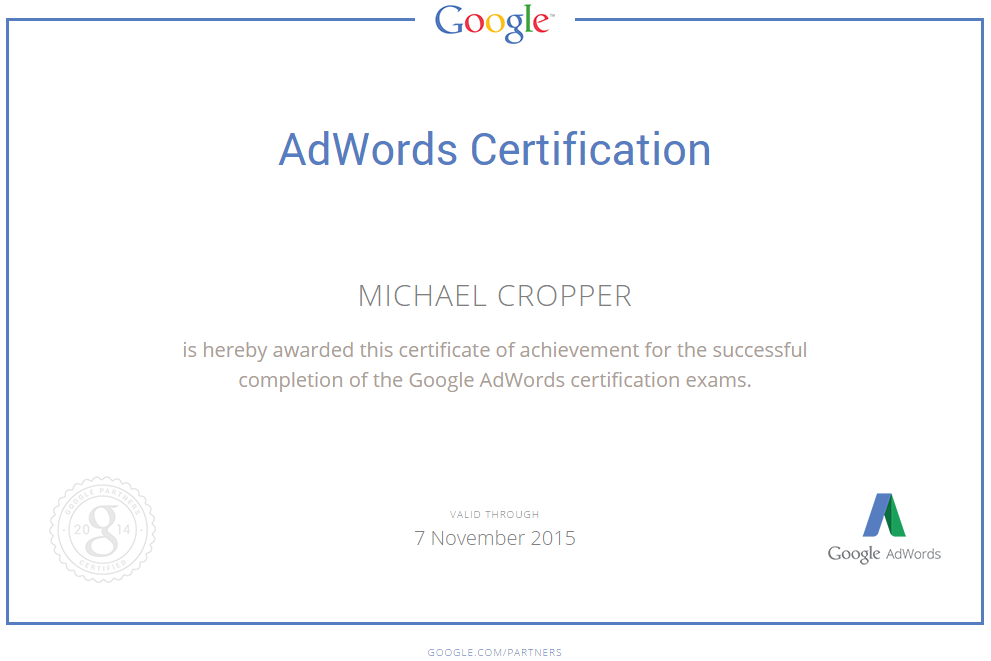
What this means is that we know a thing or two about how to manage a successful pay per click advertising campaign on Google AdWords. The ever increasing complexities involved with running a high performing PPC campaign means that you really need to be speaking with a professional if you are looking to seriously grow your business through Google AdWords.
There are an awful lot of changes within AdWords, on a regular basis, which is challenging for businesses to keep up with. At Contrado Digital it is our job to keep up to date with these changes and work with businesses like yours to improve the performance of AdWords campaigns.
Like with every celebration, it isn’t complete without a cake or two!
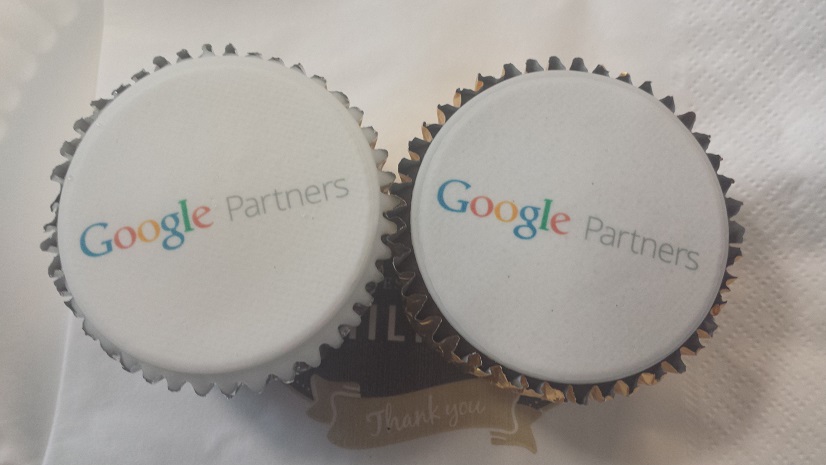
Contrado Digital Google AdWords Qualification Celebrations
While we were at the offices, we thought we’d share a bit more of the Google experience with you. Here are a few more photographs of the Google Manchester offices;
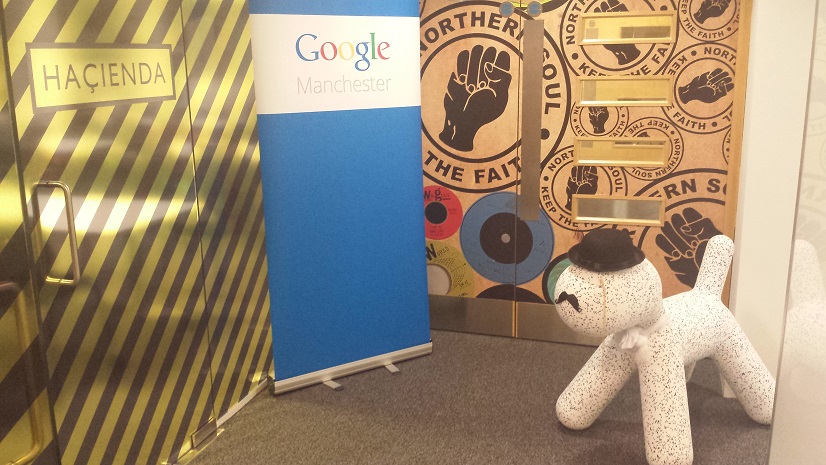
The Hacienda Lives at Google Manchester
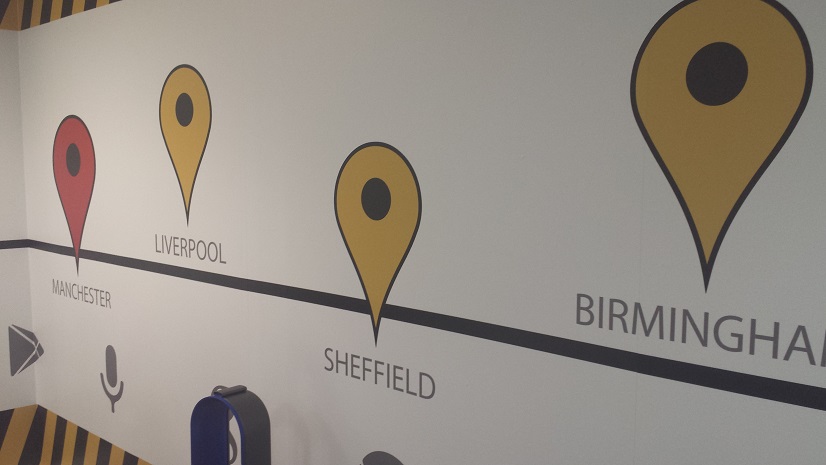
Google Manchester Office Wall Deco
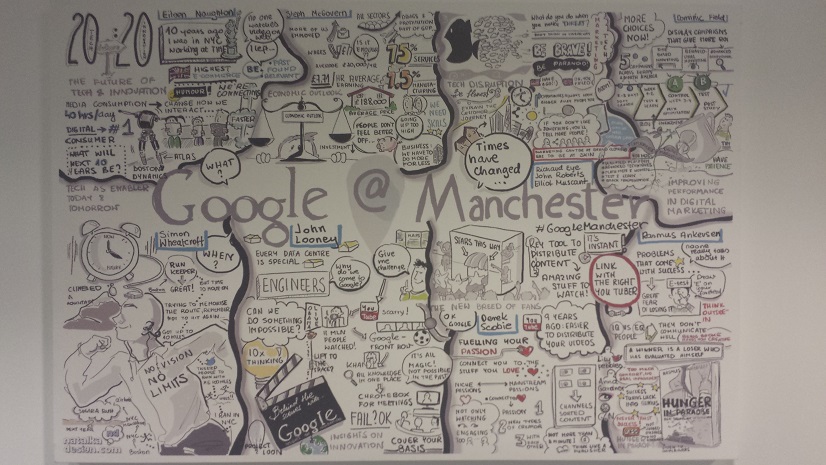
Google at Manchester Wall Art
Here is to more involvement between Google and Contrado Digital!
by Michael Cropper | Nov 20, 2014 | News |
Recently we were invited over to Google’s Manchester offices to renew our Google AdWords qualification and I’m pleased to announce that we have successfully renewed the qualifications for the next 12 months!
What this means is that we know a thing or two about how to manage a successful pay per click advertising campaign on Google AdWords. The ever increasing complexities involved with running a high performing PPC campaign means that you really need to be speaking with a professional if you are looking to seriously grow your business through Google AdWords.
There are an awful lot of changes within AdWords, on a regular basis, which is challenging for businesses to keep up with. At Contrado Digital it is our job to keep up to date with these changes and work with businesses like yours to improve the performance of AdWords campaigns.
Like with every celebration, it isn’t complete without a cake or two!
Contrado Digital Google AdWords Qualification Celebrations
While we were at the offices, we thought we’d share a bit more of the Google experience with you. Here are a few more photographs of the Google Manchester offices;
The Hacienda Lives at Google Manchester
Google Manchester Office Wall Deco
Google at Manchester Wall Art
Here is to more involvement between Google and Contrado Digital!
by Michael Cropper | Nov 20, 2014 | SEO |
Blogging is one of the best ways to increase traffic to your website from Google. It gives you the opportunity to increase your authority over time by sharing news, relevant information, key industry events and company information to your current customers and potential customers. That said, we often see times when people simply get the implementation of a blog completely wrong which means that their website is gaining very little or no SEO value from the content that is being created. With a few guidelines, you can make sure that your blog is benefiting your customers and search engines.

Platform and Location
A blog is simply a place where you can write blog posts (like this one you are reading now) which are displayed in reverse chronological order. This allows you keep your customers and potential customers up to date with what is going on in your business and industry.
You have quite a few options when running a blog, although for us there is really only one option that we would recommend, which is WordPress. We will cover the different options first and then explain why we would only recommend WordPress as a platform.
First you have several options where you can create a blog on one of the many free platforms such as Blogger which was previously called Blogspot and is still in use by some blogs today. To do this, you simply visit one of the websites, create an account and you are ready to start moving with your blog.
This can be a great option for running a personal blog as it doesn’t require any technical skills to set up. Simply sign up and start blogging within minutes. Using these platforms for a business blog probably isn’t the best option though. The main reason being branding. You are extremely limited by the branding options available to you on these platforms, so when a customer or potential customer visits your blog and it doesn’t look like the rest of the website, they are going to get a little confused. In addition, you generally have to stick with their domain. So for example, to access your blog, you would visit http://your-business-blog.blogger.com or http://your-business-blog.blogspot.com which again doesn’t present your business in the best way possible.
Aside from the branding aspect, this setup from an SEO angle is adding very little value to your website. The reason behind this comes down to how Google calculates authority and hence how visible you are on Google. Google calculates authority based on the domain name, i.e. your website address. In this case, to halves don’t make a whole. The image below shows an example of website authority when you separate out your blog and main website on two different domains;
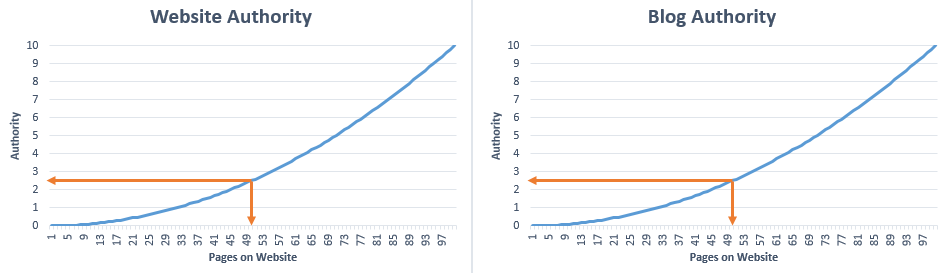
Google will see your main website at http://www.your-business.com and also your blog at http://your-business-blog.blogger.com and treat them as two separate entities, each with their own authority. While it often isn’t quite as straight forward as this, but if you think of authority being an exponential curve for the purposes of this example. What this means is that both your main website and your blog will be seen as mediocre instead of having one single website which also hosts your blog being seen as a highly authoritative source of information. In the examples above, imagine the higher the authority, the more visible your website is on Google. Here, we have 2.5 + 2.5 making 5. So for a total of 100 pages on a website, with an overall authority of 5. Now let’s compare this to how this would look when both the website and blog are on the same domain name;
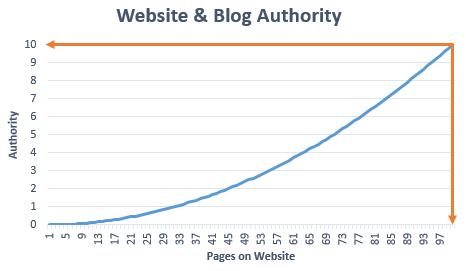
Here you can see that from the same quantity of pages, your overall domain authority is much higher. Double in fact. This is the reason why it is essential that your business blog sits on your main website rather than an external website.
This is why we would always recommend using WordPress as your blogging platform. To be clear, we are talking about the self-hosted version of WordPress opposed to simply creating an account at WordPress.com. The self-hosted version of WordPress allows you to have a blog at www.your-business.com/blog/ which may also be powering your whole webiste.
Going back to what we just spoke about, this means that from Google’s perspective, that all of the content on your website is on a single domain so your website will be seen as a more authoritative source of information. WordPress has been designed with blogging in mind and if you are in any doubt about how good it is, well we could give you a lot of features and functionalities lists, but instead we’ll just let you know that WordPress powers over 20% of websites on the whole internet and is by far the most popular content management system which has over a 50% market share. Still not convinced? Then get in touch and we will be more than happy to give you a demo of the platform to show you how powerful it actually is.
Depending on how your website is set up currently, there may be some technical challenges to implementing the above which require ad smarter work around. We will cover these a little later in the blog post.
Internal Linking
Ok, so you are writing content on your blog. Firstly, let’s just check that it has relevance for your website, products and services. It does, right? Ok, good, so you are writing relevant content on your blog. Now let’s look at how to get the most out of this content so Google will understand which pages on your website are Important.
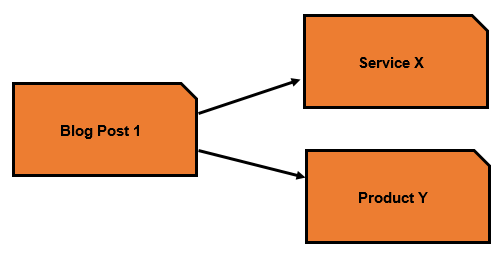
This may sound blindingly obvious, but you would be surprised at how many websites don’t do this correctly. Link to the pages you are talking about, you don’t have to do anything smarter than that. When you are talking about your products and services on your blog, make sure you link to the page that explains more about that product or service. For example, when we write content that is around the topic of digital marketing or website design, we will always link to those pages. This will tell Google that the page being linked to is an important one, so this can give you a nice little boost. This isn’t going to be a case of just doing it the once, but instead start to build this into the process of writing your content and over time this small benefit will be compounded. Likewise, if you talk about a previous blog post, then link to that too. And again, if you talk about an authoritative source of information or website, then don’t be afraid to link to those too, as long as they are good quality then you are on to a winner.
Technical Challenges
So we mentioned earlier that using WordPress may be a little challenging if your website isn’t built in WordPress already. Without wanting to go into all of the finer technical details, to put this into perspective for the non-technical people. It is like having a meal with both sweet food and savoury, it just doesn’t quite work. On the technical side, it actually means that you can’t run several server side languages from the same web server, you have to do a bit of jiggery pokery in the background along with having access to two web servers that are each capable of running the different platforms. Specifically for WordPress, your web server needs to be able to run PHP. So if your website is built in PHP already, then you are good to go. If on the other hand your website is running .Net or Java, then you are going to need another web server that is capable of running WordPress.

What all of this means is that if your website isn’t built in PHP already, then you need to have a discussion with your website developer. Speaking in geek, the blog on your website, I.e. www.website.com/blog/ needs to be set up to point to your web server that is hosting your WordPress blog, which will likely be through a proxy redirect. This will then mean that when Google looks at your blog, it appears to be on the same domain name as your main website, which can significantly help with your on-going SEO efforts. The quick and simple solution is to set up http://blog.website.com, but this often isn’t the best solution from an SEO point so bear this in mind. If your main website is running on an IIS server, then there are specific modules you need to add on, which gives you similar functionality to Apache’s .htaccess file.
Summary
To summarise how to get the most out of your blog for SEO, firstly make sure you are writing about relevant content for your audience. Secondly, make sure your blog sits on your main domain and not a sub domain or another website altogether. Thirdly, make sure you are linking your main products and services up within your blog posts where relevant.
by Michael Cropper | Nov 20, 2014 | SEO |
Blogging is one of the best ways to increase traffic to your website from Google. It gives you the opportunity to increase your authority over time by sharing news, relevant information, key industry events and company information to your current customers and potential customers. That said, we often see times when people simply get the implementation of a blog completely wrong which means that their website is gaining very little or no SEO value from the content that is being created. With a few guidelines, you can make sure that your blog is benefiting your customers and search engines.
Platform and Location
A blog is simply a place where you can write blog posts (like this one you are reading now) which are displayed in reverse chronological order. This allows you keep your customers and potential customers up to date with what is going on in your business and industry.
You have quite a few options when running a blog, although for us there is really only one option that we would recommend, which is WordPress. We will cover the different options first and then explain why we would only recommend WordPress as a platform.
First you have several options where you can create a blog on one of the many free platforms such as Blogger which was previously called Blogspot and is still in use by some blogs today. To do this, you simply visit one of the websites, create an account and you are ready to start moving with your blog.
This can be a great option for running a personal blog as it doesn’t require any technical skills to set up. Simply sign up and start blogging within minutes. Using these platforms for a business blog probably isn’t the best option though. The main reason being branding. You are extremely limited by the branding options available to you on these platforms, so when a customer or potential customer visits your blog and it doesn’t look like the rest of the website, they are going to get a little confused. In addition, you generally have to stick with their domain. So for example, to access your blog, you would visit http://your-business-blog.blogger.com or http://your-business-blog.blogspot.com which again doesn’t present your business in the best way possible.
Aside from the branding aspect, this setup from an SEO angle is adding very little value to your website. The reason behind this comes down to how Google calculates authority and hence how visible you are on Google. Google calculates authority based on the domain name, i.e. your website address. In this case, to halves don’t make a whole. The image below shows an example of website authority when you separate out your blog and main website on two different domains;
Google will see your main website at http://www.your-business.com and also your blog at http://your-business-blog.blogger.com and treat them as two separate entities, each with their own authority. While it often isn’t quite as straight forward as this, but if you think of authority being an exponential curve for the purposes of this example. What this means is that both your main website and your blog will be seen as mediocre instead of having one single website which also hosts your blog being seen as a highly authoritative source of information. In the examples above, imagine the higher the authority, the more visible your website is on Google. Here, we have 2.5 + 2.5 making 5. So for a total of 100 pages on a website, with an overall authority of 5. Now let’s compare this to how this would look when both the website and blog are on the same domain name;
Here you can see that from the same quantity of pages, your overall domain authority is much higher. Double in fact. This is the reason why it is essential that your business blog sits on your main website rather than an external website.
This is why we would always recommend using WordPress as your blogging platform. To be clear, we are talking about the self-hosted version of WordPress opposed to simply creating an account at WordPress.com. The self-hosted version of WordPress allows you to have a blog at www.your-business.com/blog/ which may also be powering your whole webiste.
Going back to what we just spoke about, this means that from Google’s perspective, that all of the content on your website is on a single domain so your website will be seen as a more authoritative source of information. WordPress has been designed with blogging in mind and if you are in any doubt about how good it is, well we could give you a lot of features and functionalities lists, but instead we’ll just let you know that WordPress powers over 20% of websites on the whole internet and is by far the most popular content management system which has over a 50% market share. Still not convinced? Then get in touch and we will be more than happy to give you a demo of the platform to show you how powerful it actually is.
Depending on how your website is set up currently, there may be some technical challenges to implementing the above which require ad smarter work around. We will cover these a little later in the blog post.
Internal Linking
Ok, so you are writing content on your blog. Firstly, let’s just check that it has relevance for your website, products and services. It does, right? Ok, good, so you are writing relevant content on your blog. Now let’s look at how to get the most out of this content so Google will understand which pages on your website are Important.
This may sound blindingly obvious, but you would be surprised at how many websites don’t do this correctly. Link to the pages you are talking about, you don’t have to do anything smarter than that. When you are talking about your products and services on your blog, make sure you link to the page that explains more about that product or service. For example, when we write content that is around the topic of digital marketing or website design, we will always link to those pages. This will tell Google that the page being linked to is an important one, so this can give you a nice little boost. This isn’t going to be a case of just doing it the once, but instead start to build this into the process of writing your content and over time this small benefit will be compounded. Likewise, if you talk about a previous blog post, then link to that too. And again, if you talk about an authoritative source of information or website, then don’t be afraid to link to those too, as long as they are good quality then you are on to a winner.
Technical Challenges
So we mentioned earlier that using WordPress may be a little challenging if your website isn’t built in WordPress already. Without wanting to go into all of the finer technical details, to put this into perspective for the non-technical people. It is like having a meal with both sweet food and savoury, it just doesn’t quite work. On the technical side, it actually means that you can’t run several server side languages from the same web server, you have to do a bit of jiggery pokery in the background along with having access to two web servers that are each capable of running the different platforms. Specifically for WordPress, your web server needs to be able to run PHP. So if your website is built in PHP already, then you are good to go. If on the other hand your website is running .Net or Java, then you are going to need another web server that is capable of running WordPress.
What all of this means is that if your website isn’t built in PHP already, then you need to have a discussion with your website developer. Speaking in geek, the blog on your website, I.e. www.website.com/blog/ needs to be set up to point to your web server that is hosting your WordPress blog, which will likely be through a proxy redirect. This will then mean that when Google looks at your blog, it appears to be on the same domain name as your main website, which can significantly help with your on-going SEO efforts. The quick and simple solution is to set up http://blog.website.com, but this often isn’t the best solution from an SEO point so bear this in mind. If your main website is running on an IIS server, then there are specific modules you need to add on, which gives you similar functionality to Apache’s .htaccess file.
Summary
To summarise how to get the most out of your blog for SEO, firstly make sure you are writing about relevant content for your audience. Secondly, make sure your blog sits on your main domain and not a sub domain or another website altogether. Thirdly, make sure you are linking your main products and services up within your blog posts where relevant.
by Michael Cropper | Aug 9, 2014 | Uncategorized @en-us |
On the 24th July, Google quietly released a new significant algorithm change which has since been unofficially titled the Google Pigeon Update. Within this blog post we are going to cover what this change is, how this impacts your business website and most importantly, what you need to do about it.

Image source: http://searchengineland.com/
What is the Google Pigeon Update
You may have heard about the Google Panda and Google Penguin algorithm changes on Google over the past few years. Well now we have Google Pigeon. Why such a strange name? Because someone at a popular search engine blog, www.searchengineland.com, decided it would be a good name.
So what exactly is the Google Pigeon update designed to do and who does it impact? In short, this algorithm change is only currently being used within the US for English language queries. So for UK based companies, then don’t panic, but do be prepared.
Algorithm changes always start off in the US for English language queries, which is shortly followed by all English language queries around the world and then finally followed by other languages as they are rolled out. What this means is that if your business is based in the UK and is only trading in the UK, then you have a bit of time to implement the changes and plan for this. Google hasn’t announced any specific dates when the algorithm change will be rolled out wider than the US so it is best to be prepared for this as it is rare that significant changes aren’t rolled out globally.
The Google Pigeon update is designed to tie the local search algorithm deeper into the main web search algorithm which uses hundreds of ranking signals. This includes search capabilities such as spelling corrections, synonyms and the Knowledge Graph. The change means that the new algorithm improves a few other factors for local search including the distance and location ranking factors for local businesses. The whole aim of the new algorithm is to provide a better experience for people searching for local results.
How Google Pigeon impacts your business website
What all of this means in simple terms is that your local business will show within the carousel area straight at the top of the search results on Google which can be seen here;
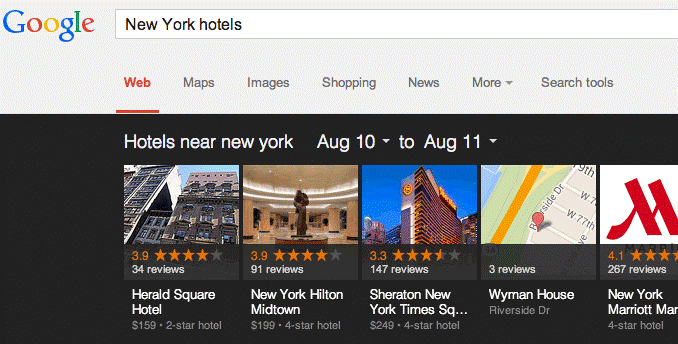
Image source: http://www.seroundtable.com/google-pigeon-update-18938.html
The algorithm is designed to give a boost to real world places, expanding beyond the initial places of interest that were originally being listed within the carousel. Search for “Things to do in Manchester” on Google to see how this looks at present in the UK;
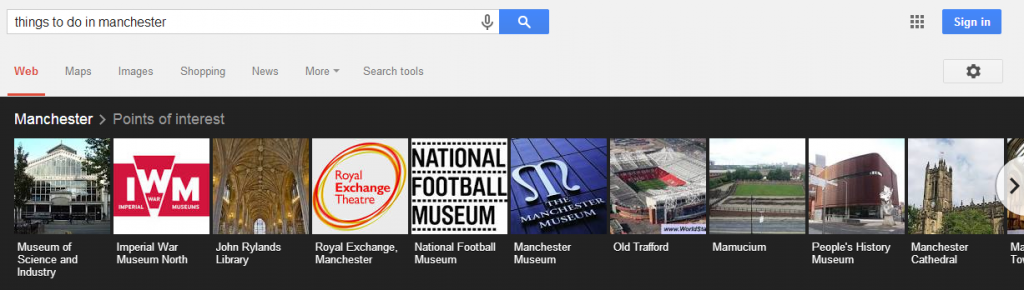
As this expands within the UK, we will start to see the carousel appearing more and more for searches such as;
- Builders Merchants in Manchester
- Timber Merchants in Manchester
- Plumbers in Manchester
- Builders in Manchester
- Restaurants in Manchester
…and many more similar types of phrases.
The carousel area is being used for local listings instead of what is currently being used which is known as the ‘7-Pack’ which is a group of local listings that are often given prominence when people are searching for phrases with a local intent. For example, here you can see the current ‘7-Pack’ listings when searching for “Restaurants in Manchester”;
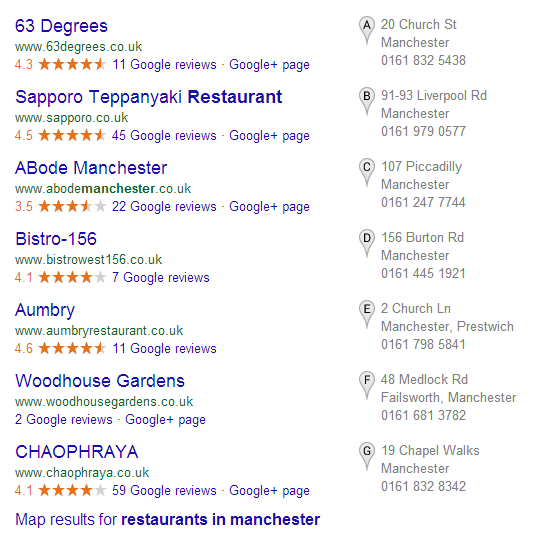
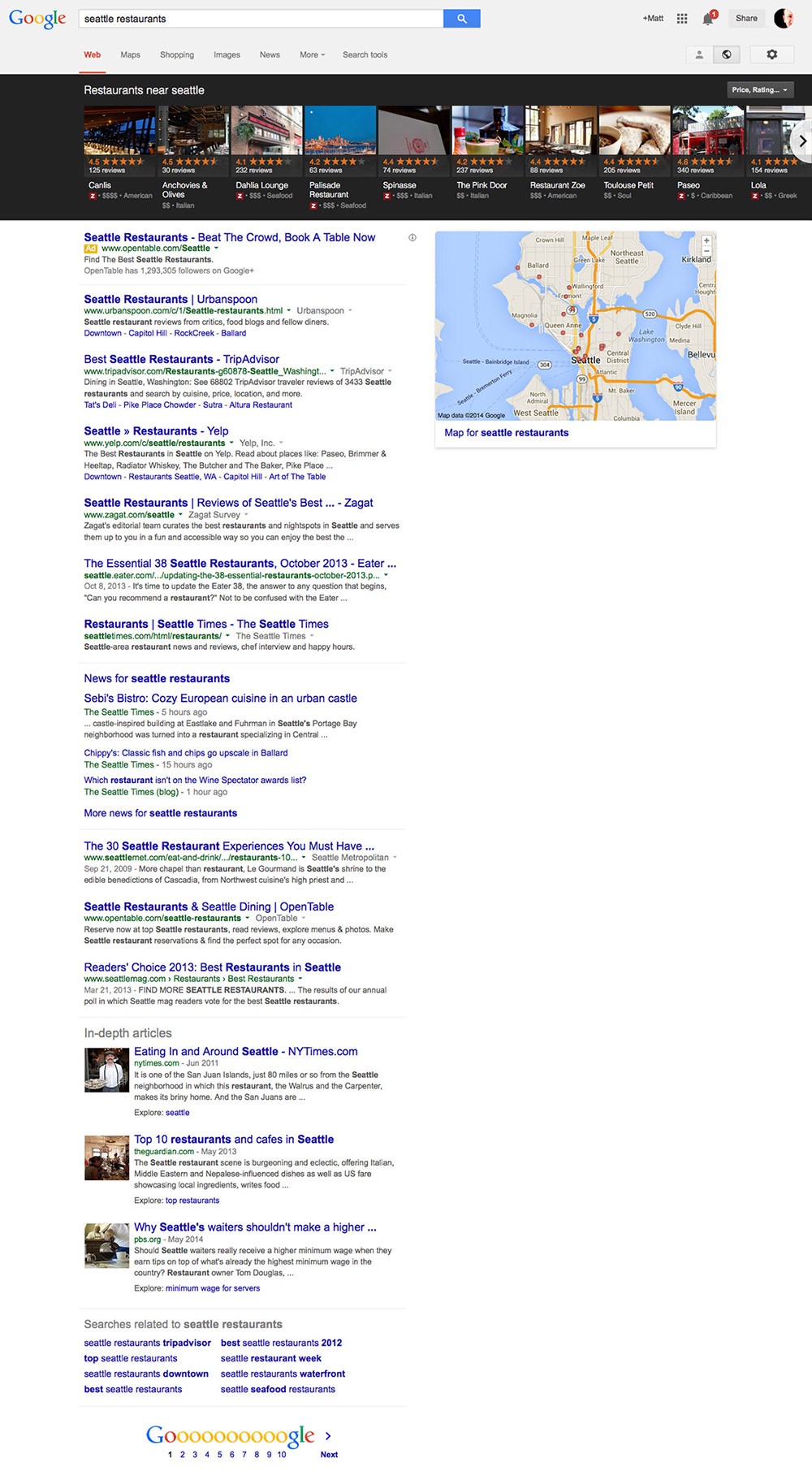
With the Google Pigeon algorithm update moving the local listings into the carousel, this also means that directory type websites are also getting a boost. With all of the local listings moving up into the carousel, this means that the other directory style websites are showing higher up the page. Higher visibility generally leads to higher traffic levels. Below shows a screenshot from the US whereby local businesses are listed within the top carousel and larger directory style websites are being listed within the main results (click for larger image);
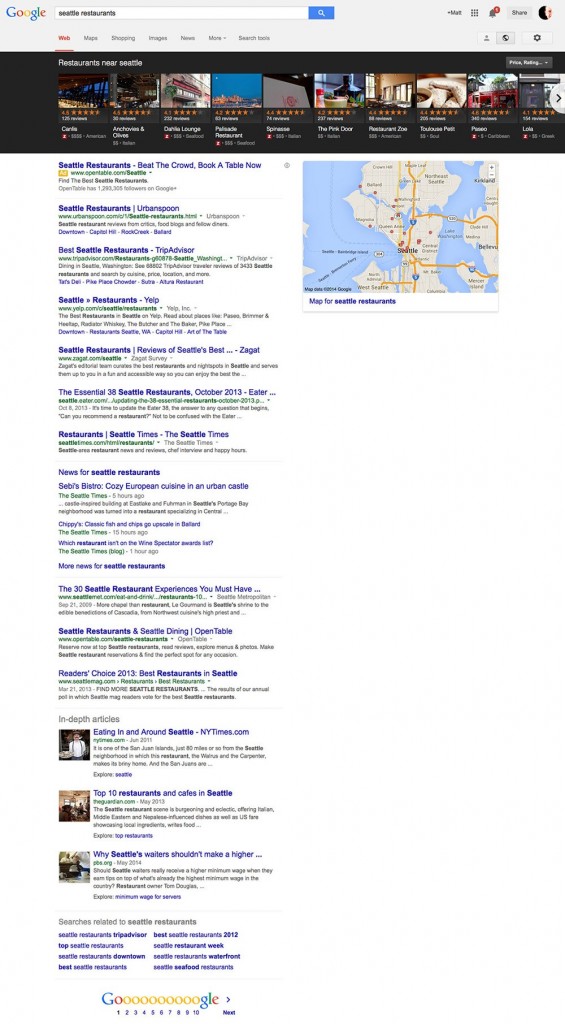
It is going to be interesting to see exactly how this plays out over time, but it seems that everyone is a winner here – as long as the correct measures are put in place. Some large directories are already seeing a 5-10% increase in organic traffic from this change.
Large branded web directories such as Yelp and Yell are likely to benefit hugely as they have extremely strong brands which helps greatly with the Search Engine Optimisation work. Which means that smaller businesses have to make sure they have the right pieces in place to be able to earn a listing within the carousel at the top to beat the large directories.
What you need to do next
Ok, so to put the Google Pigeon algorithm update into perspective and to lay out a clear plan of action there are several things that need to be done. While this update hasn’t been rolled out into England just yet, it is better to be ahead of the game as it is extremely likely that this will be rolled out within the next few months.
Complete your listing on branded business directories
It is important to stress here that this is for branded directories, not cheap, nasty, horrible traditional ‘SEO directories’. Stay away from those, stay well away. Here we are talking about well-known brands. Think Yelp, Yell, Urbanspoon, TripAdvisor, OpenTable and more.
While there are well known generic directories, there will also be some industry specific directories that will be worth getting listed in. So do your research, or get in touch and we can help you with the process to make sure your business is being listed in the places where it needs to be.
What this will mean is that if a person doesn’t click on your listing within the carousel, then you will have a greater chance that your business will be seen in one of the top business directories. By covering off both angles, this will increase the chances of a potential customer finding your business online.
Make sure Google knows about your business through Google My Business
Make sure your business is listed on Google My Business. Whether you have a single shop / store / outlet / office, or hundreds throughout the UK. Make sure you are listing all of your physical locations on Google My Business. You may have heard about Google My Business recently but if not, Google My Business has replaced the old Google Local and Google Places tools to list your business on Google.
If you aren’t listed on Google My Business and need some support with this then get in touch and we can work closely with you to get your business listed in preparation for when the change is rolled out within the UK and further afield.