by Michael Cropper | Jan 22, 2015 | SEO, Technical |
You may have heard about how Google has been dishing out unnatural link warnings over the past couple of years as they released their algorithm update, Google Penguin. We recently had the pleasure of resolving a resolving one of these warnings for a client who came to us with this problem – which had been generated as a result of previous shoddy work from an old supplier. Here is what we have learnt from this process and how these warnings often aren’t actually as bad to resolve as one may initially think, if you understand how Google is thinking. Firstly though, let’s take a look at what Google Penguin is and where these unnatural link warnings come about.
Google Penguin
So Google Penguin is an algorithm update that Google announced a couple of yea
rs ago. The algorithm was brought about to penalise websites who were building links from low quality websites to their own website with the aim of increasing their visibility within the search engines. Basically to manipulate their SEO efforts.
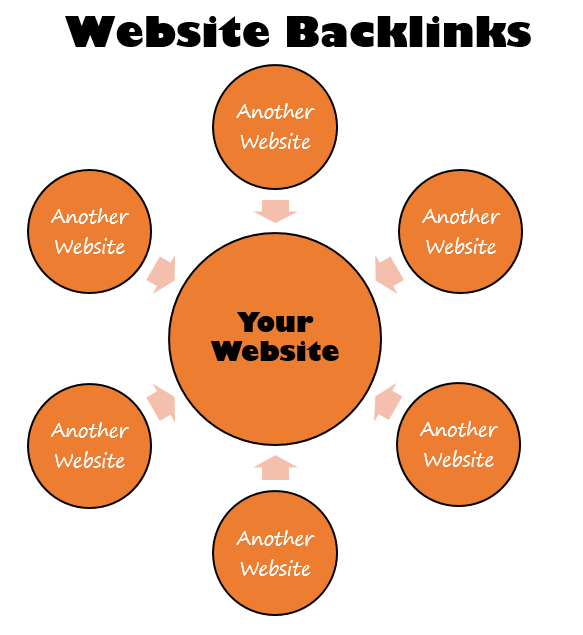
Google is determined to stop people and businesses gaming their algorithm and instead looks to reward websites who generate high quality and natural links from relevant websites. There is a clear reason why businesses have attempted this previously and that is because more visibility in the search engines ultimately leads to more traffic and sales.
After Google launched their Penguin algorithm, they started to send webmasters notifications and warnings via Google Webmaster Tools informing them that they needed to clear up their act. In a lot of cases, this was accompanied by a penalty in the search results leading to less visibility, less traffic and ultimately less sales. Yes, in the online world it seems that Google is indeed the judge, jury and executioner.
Unnatural Link Warnings
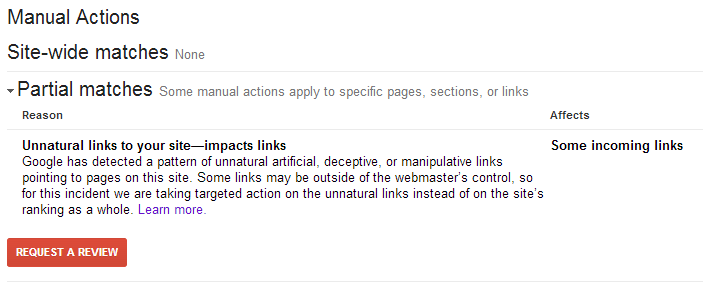
Well at least Google was kind enough to let people know which links pointing to their website were deemed to be low quality and causing the penalty and link warning, right? Well, no. That would be too easy! Google was a pain and gave virtually zero guidance as to what was causing the problem. So we had to investigate and start digging deep. We were looking for links that would be deemed to be seen as low quality by Google. Digging deep through thousands of backlinks across a large number of domains was the time consuming solution in this case. Below is the type of message you will see within Google Webmaster Tools if this problem is happening on your website;
Google officially recommends that you manually email each of the website owners where the low quality links are present and ask nicely if they could remove the link from their website. This is great in theory, but in practice this is absolute nonsense. Website owners of low quality websites are simply not interested in doing anything of the sort and any attempt at doing so is a waste of time. But let’s stick with this train of thought for now though, as this is what Google wants people to do.
Unnatural Link Warning Investigations
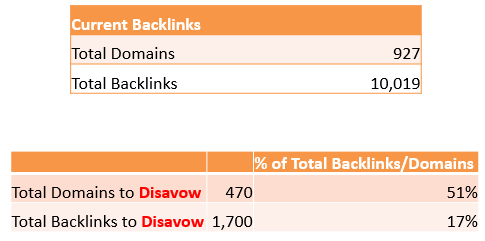
For the website in question, we identified all of the websites on the internet that were linking to the site and all of the pages. In total, this was almost 1000 domains and over 10,000 pages. Quite a few websites to crawl through to identify if the website would be deemed as ‘low quality’ by Google.
Google kindly put together a Disavow tool which is designed to inform Google which of the websites that are linking to you should be ignored during their ranking algorithm. For example, there is absolutely nothing stopping any single website owner on the planet linking to your website without your sign off. This is how the internet works, always has and always will. So the fact that Google introduced a penalty designed to penalise websites based on other peoples’ actions is a little odd to say the least and quite frankly is nothing more than Google admitting that their ‘all-knowing-algorithm’ isn’t actually as good at determining quality as they like to think, which is why they needed to enlist the help of thousands of website owners around the world. That said, it was introduced to target specific websites that were actively either selling links to websites, target low quality directory websites which offer no value to anyone along with other pointless websites on the internet that have no value to anyone.
Back to the investigation though. What we found for the client we were investigating this for was that over 51% of the websites (domains) that were linking to their website would be deemed as low quality by Google, which in total accounted for 17% of their total backlinks. This is quite a significant percentage of their backlinks that was causing the penalty. On further investigations we did find that these had clearly been built by a previous person who was aiming to game Google’s algorithm into making the client websites more visible on Google. Hence why you should never look to game Google and also why we don’t go out and build links for clients, it simply isn’t the right approach and hasn’t been for a good number of years now.
Ok, so remember that Google’s official guidelines are that you should go out and contact everyone who is linking to you and ask for that link to be removed, before submitting a Disavow file and a reconsideration request. Well, you don’t really need to do that. Just tell Google you did.
As a quick overview of the types of links we found that we needed to tell Google that they are low quality, via the Disavow file and reconsideration request. This included paid links (a big no-no), directory websites, thin affiliate websites, unrelated guest blog posts on other websites, low quality articles and even a few hacked websites. There are many other types of low quality websites that you really don’t want to be having links from, but this gives you an idea.
So once you have identified all of the websites that are linking to you that are deemed to be low quality, then Google recommends that you identify the specific pages of that website and add them into the Disavow file. Again, the reality of this is that this is a waste of time. If you have the time, energy and inclination to crawl through 10x the number of links then feel free, and while you are at it feel free to visit and make me a brew with all of the free time you have. Personally though, I like to take a more streamlined approach to achieve results. So here, we just Disavowed the whole domain.
Disavow Files and Reconsideration Requests
Knowing many other businesses who have gone through this same process, it was clear that Google very rarely used the information you gave them first time round and were generally quite unhelpful during the process. So we went through their recommendations and followed their guidelines anyway with this in mind.
Attempt 1
We created a Disavow file, submitted it to Google Webmaster Tools then wrote a lovely reconsideration request with all of the details about the history of the work and how this would never happen again to this client as they are working with a great company now (aka. us). Sob-story and all. We also told them that we had painstakingly taken weeks to contact each any every website owner to remove the links and they simply hadn’t got back to us (we hadn’t actually done this, they just needed to hear this).
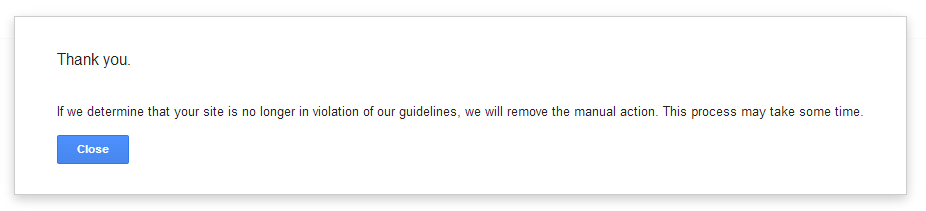
Result? No surprise, they gave the helpful information that “there are still some low quality backlinks that you need to remove”. We were expecting this. Thanks Google, very helpful.
Attempt 2
So we added a few more domains (around 20) into the Disavow file, followed the same process as before.
Result? Same again. Nothing.
Attempt 3
So we added a few more (around 5) into the Disavow file for a third time, repeated the process including the ‘begging letter’ aka the Reconsideration Request. This time talking about how we had spent an awful lot of time to do this costing a considerable amount of resources to go and how they weren’t being that useful.
One thing to note is that we did leave a week or two in between each time so that it would at least appear to Google that we had been working very hard between submitting the reconsideration requests.
Result? Yes! We had this lovely message from Google;
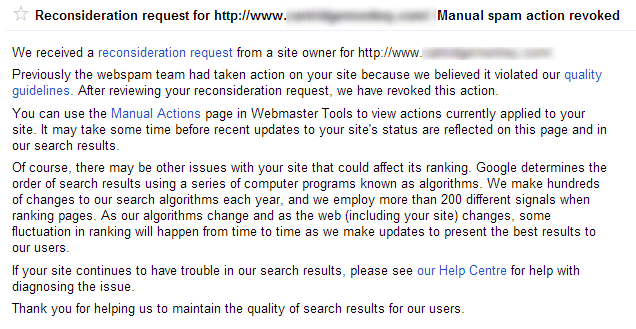
So what did we learn?
Be patient. Tell Google what they want to hear. Don’t waste your time on contacting website owners. Disavow the whole domain if it looks suspicious, life is too short to worry about individual pages.
Not sure if your current SEO activities are working? Then get in touch and speak with one of our professionals who will be able to help support the growth of your business online for the long term. Working with the Disavow file and reconsideration requests within Google Webmaster Tools can be a risky business if you don’t know what you are doing. You could end up telling Google to ignore some very powerful links to your website which would do even more harm, lower your visibility on Google and decrease your sales. Don’t play around with this unless you are confident about what you are doing. Better yet, leave it to the experts, get in touch to find out more.
by Michael Cropper | Jan 15, 2015 | Data and Analytics, Digital Marketing, Events, PPC, SEO, Social Media, Technical, Tracking |
Just before Xmas I was invited to speak at the Creative Entrepreneur event at Media City in Manchester to share insights into how online retail is changing. In-between speaking, it was great to listen to other online retail experts to hear their thoughts about where things are heading. So we can take a look through some of the discussions points in this blog post.

ASDA
First up we heard from Dom Burch, the serial speaker and senior director or marketing innovation and new revenue at Walmart UK (Asda). He shared his insights into how some of ASDA’s recent campaigns have been hugely successful in many aspects online and offline.
Dom’s first tip was around innovation and the importance of innovating throughout your entire business, regardless of how big or small you are. Innovation is key to long term and sustained growth. Simply dipping a toe in the water isn’t going to cut it here, Dom advised that you need to be giving projects at least 6 months to succeed (or fail!) so that you can be confident that you have exhausted all possibilities for the idea and had the time to gather data and assess the results accurately.
With all innovative ideas, you are starting with a goal of some kind for the business. Starting with ambitions to “become a big business” is equivalent to starting with the idea of “making a video go viral”. It’s simply the wrong approach to take and will inevitably lead to disappointment as goals are not hit. Instead, start with goals that are relevant for your business, goals that are in-line with your customer demands and goals that you can actually influence.
In between these ideas, Dom shared a few interesting statistics about ASDA;
- ASDA FM listeners have more people listening that Radio 1 and Radio 2 combined
- There are over 18 million customers who visit ASDA stores weekly
- ASDA’s website has over 300 million impressions every month
These are quite similar figures to what was announced last year at a digital marketing conference in Manchester.
With ASDA spending over £100 million per annum on broadcasting adverts, Dom’s approach was to get the PR team using Twitter, which was quite a challenge. Spending as little as 2 hours per week on Twitter, the newbie-to-Twitter PR team were already having a conversation with the editor of Vogue within 2 weeks. Where else could you get this kind of conversation going in 2 weeks? It simply wouldn’t be possible.
Another tip came in the form of doing something yourself first so that you know how to do it. This is something that I firmly believe in personally and in business. If you don’t at least understand what is happening, how can you ever hope to really manage this process? This is not to say you need to be an expert in every aspect as this would be impossible. Instead, it is hugely important to get a good grasp on every aspect within business and digital so that you can fully understand why things are being implemented and the reach they will ultimately have.
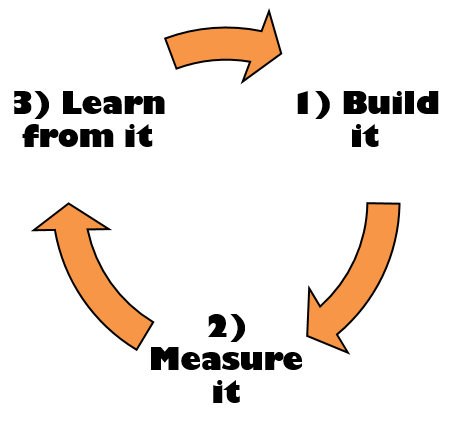
The simple process above will help you to build fast, fail quickly and innovate throughout your business at speeds you have never done before. Ideas are worthless, implementation is key and the only way to see what does and doesn’t work is to loop through the process as fast as possible, while giving every idea the time and energy to succeed.
Have a think for a moment, what are the 10 ideas that you have been talking about in your business last year? I can guarantee that there will certainly have been more than 10 ideas, but what were the 10 most important ideas? How many of these have you actually implemented, 5, 3, 1, none? Start the year off as you mean to go on. Run through these 10 ideas and measure everything to see how they impact your business. Capture the data and make informed decisions about the success of each campaign or idea.
For established businesses like ASDA, they aim to spend between 1-5% of their marketing budget on what Dom called “Trial and Error” campaigns which may or may not work. For businesses within the SME market, I would suggest this should be much higher as you are often still in the stages of experimenting with campaigns to see what works for your business. We naturally review and manage a lot of campaigns in the day to day work we do, although even we cannot tell you with 100% accuracy what will or won’t work for your individual business. We can certainly take into account the years of expertise and make a highly educated decision, although every business and every customer is different.
ASDA know that 74% of their customers are on Facebook, 20% are on Twitter and 15% of their customers watch YouTube daily. This information allows ASDA to invest their digital marketing spend in the right areas and not simply spend money on ‘more followers’ with no engagements. Their YouTube strategy focuses on how-to style videos and researching products which are broken down into 3 main groups;
- Hygiene content: Something that is core to what you do and for your core target market
- Hub content: Regularly created content designed to push this in front of your audience
- Hero content: Large scale campaigns to raise brand awareness, think about the epic Volvo Trucks campaign
The next of ASDA’s campaigns that was shared was with the involvement of Tanya Burr. Who you ask? Ask your teenage daughter if you have one. If you don’t, like me, then I also had to Google her to find out a bit more about her! She is described as a “Beauty, Fashion, Baking, Lifestyle Blogger & YouTuber” in a nutshell. And more than that, she has 1.2 million followers on Twitter. This is the reason ASDA worked with her, to reach this huge audience. The reach that ASDA’s products gained on social media was astronomical, just take a look through the number of views for each video that they produced together and you will start to understand how collaborations like this can pay off. Where else could you gain that kind of reach? To put things into context, Game of Thrones receives around 1.3 million views every week, which is less than what ASDA managed to reach with this collaboration. Likewise, Tanya Burr has more followers on Twitter than Sheryl Cole, Madonna and BBC Radio 1. Just because you have likely never heard of people like Tanya, doesn’t mean that they aren’t hugely successful.
When looking at YouTube videos specifically, always keep an eye out on the engagement levels and not simply the number of views of a video. Any brands that have a lot of views yet very few likes/dislikes means that they have likely paid a lot of money to drive traffic to the YouTube video and no-one liked it so they just bounced straight back out again. High engagement levels allow you to listen directly to your customers in ways like never before. ASDA’s videos with Tanya weren’t simply ‘buy this product’ videos, that’s boring and a fast way to drive customers away. Instead, they focused on food, health and wellness, beauty and style.
ASDA took this whole campaign one step further by creating the Mums Eye View YouTube channel which linked together their partnerships with Tanya Burr, Zoella and the Lean Machines. Google them all to grasp the scale of what is being achieved with strategic partnerships. This is a very young audience that ASDA was targeting here and one that has clearly paid off. With reports of as little as 2p per view of a YouTube video, 70% retention rate, 4 minutes minimum viewing time with an average of 7 minutes in length per video. You could only achieve these results with effective digital marketing that focuses directly on your customers. Not once did ASDA think “let’s make this video go viral”. What this also shows is that people like long form content on the web. No more do videos have to be 2 minutes in length, don’t be afraid of pushing the boundaries to meet customer demands.
This brings us nicely onto newspapers and traditional newspaper advertising. Quite frankly, no-one reads newspapers anymore, and I don’t say that lightly. Ask yourself, when was the last time you bought a newspaper? Personally, I can’t remember the last time I bought one, other than on the occasional times when I’m featured in one to keep as a little memento. Keep everything into context, could you seriously generate a response of someone looking at your advert for 4 minutes in a newspaper? I don’t need to answer that for you, it is clear. For ASDA, they know that 4/5 people don’t shop in ASDA and that is OK. So why spend £150,000 on a single press release in a national newspaper when 4/5 people of the people still reading newspapers aren’t ever going to be interested in ASDA anyway?
The summary of Dom’s keynote speech was that brands and businesses need to take a step back and see what is happening in the world. It’s time to start creating more content that relates to your audience.
Cyber Security
The next session was all about cyber security and the steps you can take to protect yourself. You need to look no further than the recent headlines about how many companies have been hacked into last year with millions of customer details stolen; eBay, Sony, Moonpig and endless more including 273 million customer details stolen from Yahoo and 250,000 customer details stolen from Twitter.
Some interesting statistics announced around cybercrime included that it costs the UK economy over £6.8 billion per year and the global economy £238 billion annually. With 81% of large businesses having experienced security breaches in 2014. The cost of a typical breach is now at £1.15 million, up from £600,000 in the previous year.
Some of the most common attacks are due to very basic hacking just after Update Tuesday. Windows PCs are updated every Tuesday with security patches that have been identified to keep your system and data safe and secure, yet so many people either ignore the messages on their computers or simply turn off the automatic updates. This is mad! As part of the weekly update from Microsoft, the hackers use this information as a shopping list of exploits on computers around the world they can attempt to get access to. If your system isn’t up to date, then you could be at risk.
Moving onto more sophisticated attacks such as DDoS attacks, which stands for Distributed Denial of Service attacks, these can bring down websites with ease. To the point at which you can actually purchase an attack on the black market to target a specific website for a specific amount of time. Unlawful and illegal hacking is turning into an underground commercial business. DDoS attacks are actually quite simple;

This method for DDoS are often using thousands, hundreds of thousands if not millions of computers from around the globe. For example, here you can see a short visualisation of a DDoS attack happening in real time on my personal blog a couple of years ago;
Have a read more about the full details if you are interested. The exact same thing happened to Mastercard, Visa and PayPal when they decided to stop sending funds through to the hacker group Anonymous. Whether you agree or disagree with this is another discussion all together and one that doesn’t have a simple answer. The important point here is that DDoS attacks are a real and present threat for businesses. While it is unlikely that you will encounter the wrath of some of the more prolific public hacking groups, the reality is that a lot of business websites for SMEs are hosted on cheap and nasty web servers that are poorly configured and have very little security built into them. Make sure your web server has the right protection in place to at least minimise the chances of DDoS attacks affecting you. The unfortunate reality is that if someone is determined enough to bring your website down, they will do. You can make it harder for this to happen though by having the right infrastructure in place for your website. Aren’t sure if your website and web server is protected? Then get in touch and we can review to check for vulnerabilities.
Moving away from hacking and looking at other types of data breaches now. Some of the most common data breaches often come in much simpler formats and often due to human error, aka. lack of awareness about threats. Threats including basic passwords on mobile and tablet devices to avoid automatic access to cloud based file storage systems for your company if a device is lot of stolen, to a deeper understanding of programming languages to avoid rookie mistakes.
Website vulnerabilities in particular happen for a number of reasons including unpatched software/content management systems/plugins, poor coding practices, poor server configuration, unencrypted data and more. Getting all of the above right is the absolute minimum businesses should be doing. Simply having a website built and not thinking about on-going updates is madness with how easy it is to exploit unloved websites. Every website should have regular and on-going maintenance to keep the website, content and data secure.
As of this year, there will be new EU Data Protection legislation that will be coming into force that businesses must adhere to. All of which is designed to move the current legislation into the digital age where customer data is collected at an alarming rate, often with very little visibility about what is being collected. This is likely to include full disclosure when data breaches happen so that customers are aware of what has happened. Far too often, businesses try and sweep large data breaches under the rug and hope that no-one will notice.
During the session, a live demonstration was given showing how easy it is for someone to steal your details – Even with my background, I was surprised at the level of things that can be done to steal personal details without you ever knowing what has happened. For example, simple things like clicking a link in an email can allow hackers to steal all of your saved login information in your browser. It really is that simple. Likewise, downloading a seemingly normal looking file from an untrusted source can result in a Key Logger being installed on your computer which will then be able to ‘read’ every single key you press, including your online bank account details and email passwords.
You may have heard about the infamous Stuxnet virus that swept the world almost by stealth last year. If you haven’t, you really need to read a few articles about this serious security threat; Wired, Business Insider, Wikipedia and what is even more worrying is that the source code for the virus is now publicly available on certain websites. As a quick overview if you haven’t come across Stuxnet before, the virus was designed specifically to find a physical controller located in power plants that controlled the heating/cooling of the nuclear material. As you can imagine, hacking into this and reporting an incorrect figure would lead to catastrophic results. This shows how sophisticated hacking has become. Some sources say that the virus was created by the US to target Iran’s nuclear facilities – how true this is, I don’t know. Other notable viruses including Duqu and Flame again highlight the level of sophistication that is happening right now.
Other common hacking attacks include the likes of SQL Injection attacks and Cross Site Scripting (XSS) attacks. Have a read up on these, again hugely important issues to be aware of and protect yourself against. Inexperienced and junior people working in digital are often oblivious to all of this type of information and most importantly how to protect against it. Always work with a company and people who are professional and have a very deep understanding of the industry they are working on. Remember the quote “If you think it’s expensive to hire a professional to do the job, wait until you hire an amateur”.
Now can you see why it is important to keep your systems, website and servers secure? Good, I’m glad the message has been received. If you don’t know what to do next, then get in touch and let’s have a chat.
Online Retail Panel
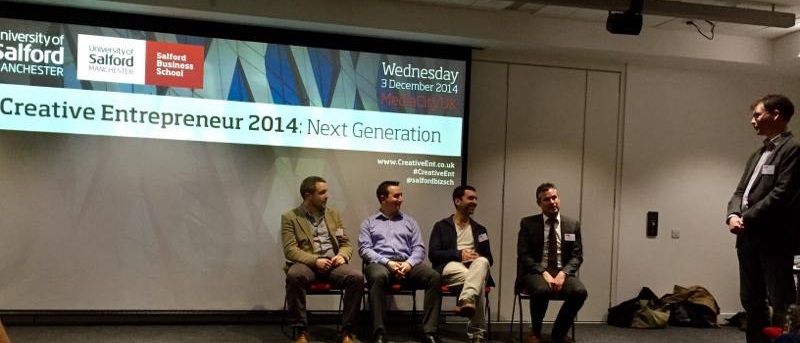
Next up was the panel that I was part of alongside three other digital agency owners in Manchester and London along with the Head of Online Retail for Iceland Foods, Andy Thompson. The session took a rather interesting turn to talk around a lot of digital topics about business growth through online retail, internal communication challenges and solutions along with some blindingly obvious opportunities for large brands to improve their sales online. The talks should be going online once they have been edited which you can look forward to watching, so for the meantime, here is a quick summary of the whole event and more information can also be found on the website;
Digital Marketing, SEO and the Internet of Things
The last few sessions of the day are combined within this section. We heard from many different speakers and panellists in the final sessions with lots of great tips for businesses. One key message that is extremely relevant for the SME market is that you simply can’t have social media accounts without creative content. You need to be creating your own content and sharing this socially along with utilising other great content around the web to fuel your social media channels.
The Tales of Things by Oxfam
Oxfam was involved in a very interesting project with the University of Salford titled The Tales of Things. Oxfam have invested £1.4 million over the past 3 years with the aim of revolutionising business systems and processes through the use of digital technologies. The Tales of Things project was a very interesting one and one which I believe we will start to see more of over the next few years.
The idea was around selling donated products that also have a QR code attached to them. Customers looking at the item would then scan the QR code to listen to a short story from the person who donated the item. Oxfam found that this actually increased sales by 57% in the Manchester shop. They then extended this into Selfridges in London where celebrities donated items with the same concept behind. Within 14 weeks, they had this technology applied in 10 Manchester shops. This is ultimately a historical archive for objects that are traded, thus turning an object into something more than an object as it has a story behind it.
Personally I hate QR codes with a passion due to the way that they are misused in 99% of circumstances by businesses. Although in this instance with Oxfam, this is a really great way to bring things to live and genuinely adds value to the product being purchased and the customer experience.
This project has been on-going for a few years now so have a good read about the finer details over at the BBC, Oxfam and Tales of Things.
Cool Tech
Where would we be without a blog post talking about some cool technology that is on the horizon? Here is a really cool digital air hockey game that Tom Cheesewright and I played (which I think I won, Tom may disagree, not that I’m competitive in any way! );

Image courtesy of Aleksej Heinze
And this was even more amazing, a 3D holographic projection (apologies for the poor quality, it was taken on my smartphone);
Summary of Event
Overall, the event was excellent with lots of great tips and advice to take away and implement. I’m sure there are a lot of questions about what you need to be focusing on in your business after the security discussions and digital marketing opportunities discussed above. Get in touch and we can talk things through with you to see how we can support the growth of your business.
Keep an eye out for next year’s event
by Michael Cropper | Jan 15, 2015 | Uncategorized @en-us |
Just before Xmas I was invited to speak at the Creative Entrepreneur event at Media City in Manchester to share insights into how online retail is changing. In-between speaking, it was great to listen to other online retail experts to hear their thoughts about where things are heading. So we can take a look through some of the discussions points in this blog post.
ASDA
First up we heard from Dom Burch, the serial speaker and senior director or marketing innovation and new revenue at Walmart UK (Asda). He shared his insights into how some of ASDA’s recent campaigns have been hugely successful in many aspects online and offline.
Dom’s first tip was around innovation and the importance of innovating throughout your entire business, regardless of how big or small you are. Innovation is key to long term and sustained growth. Simply dipping a toe in the water isn’t going to cut it here, Dom advised that you need to be giving projects at least 6 months to succeed (or fail!) so that you can be confident that you have exhausted all possibilities for the idea and had the time to gather data and assess the results accurately.
With all innovative ideas, you are starting with a goal of some kind for the business. Starting with ambitions to “become a big business” is equivalent to starting with the idea of “making a video go viral”. It’s simply the wrong approach to take and will inevitably lead to disappointment as goals are not hit. Instead, start with goals that are relevant for your business, goals that are in-line with your customer demands and goals that you can actually influence.
In between these ideas, Dom shared a few interesting statistics about ASDA;
- ASDA FM listeners have more people listening that Radio 1 and Radio 2 combined
- There are over 18 million customers who visit ASDA stores weekly
- ASDA’s website has over 300 million impressions every month
These are quite similar figures to what was announced last year at a digital marketing conference in Manchester.
With ASDA spending over £100 million per annum on broadcasting adverts, Dom’s approach was to get the PR team using Twitter, which was quite a challenge. Spending as little as 2 hours per week on Twitter, the newbie-to-Twitter PR team were already having a conversation with the editor of Vogue within 2 weeks. Where else could you get this kind of conversation going in 2 weeks? It simply wouldn’t be possible.
Another tip came in the form of doing something yourself first so that you know how to do it. This is something that I firmly believe in personally and in business. If you don’t at least understand what is happening, how can you ever hope to really manage this process? This is not to say you need to be an expert in every aspect as this would be impossible. Instead, it is hugely important to get a good grasp on every aspect within business and digital so that you can fully understand why things are being implemented and the reach they will ultimately have.
The simple process above will help you to build fast, fail quickly and innovate throughout your business at speeds you have never done before. Ideas are worthless, implementation is key and the only way to see what does and doesn’t work is to loop through the process as fast as possible, while giving every idea the time and energy to succeed.
Have a think for a moment, what are the 10 ideas that you have been talking about in your business last year? I can guarantee that there will certainly have been more than 10 ideas, but what were the 10 most important ideas? How many of these have you actually implemented, 5, 3, 1, none? Start the year off as you mean to go on. Run through these 10 ideas and measure everything to see how they impact your business. Capture the data and make informed decisions about the success of each campaign or idea.
For established businesses like ASDA, they aim to spend between 1-5% of their marketing budget on what Dom called “Trial and Error” campaigns which may or may not work. For businesses within the SME market, I would suggest this should be much higher as you are often still in the stages of experimenting with campaigns to see what works for your business. We naturally review and manage a lot of campaigns in the day to day work we do, although even we cannot tell you with 100% accuracy what will or won’t work for your individual business. We can certainly take into account the years of expertise and make a highly educated decision, although every business and every customer is different.
ASDA know that 74% of their customers are on Facebook, 20% are on Twitter and 15% of their customers watch YouTube daily. This information allows ASDA to invest their digital marketing spend in the right areas and not simply spend money on ‘more followers’ with no engagements. Their YouTube strategy focuses on how-to style videos and researching products which are broken down into 3 main groups;
- Hygiene content: Something that is core to what you do and for your core target market
- Hub content: Regularly created content designed to push this in front of your audience
- Hero content: Large scale campaigns to raise brand awareness, think about the epic Volvo Trucks campaign
The next of ASDA’s campaigns that was shared was with the involvement of Tanya Burr. Who you ask? Ask your teenage daughter if you have one. If you don’t, like me, then I also had to Google her to find out a bit more about her! She is described as a “Beauty, Fashion, Baking, Lifestyle Blogger & YouTuber” in a nutshell. And more than that, she has 1.2 million followers on Twitter. This is the reason ASDA worked with her, to reach this huge audience. The reach that ASDA’s products gained on social media was astronomical, just take a look through the number of views for each video that they produced together and you will start to understand how collaborations like this can pay off. Where else could you gain that kind of reach? To put things into context, Game of Thrones receives around 1.3 million views every week, which is less than what ASDA managed to reach with this collaboration. Likewise, Tanya Burr has more followers on Twitter than Sheryl Cole, Madonna and BBC Radio 1. Just because you have likely never heard of people like Tanya, doesn’t mean that they aren’t hugely successful.
When looking at YouTube videos specifically, always keep an eye out on the engagement levels and not simply the number of views of a video. Any brands that have a lot of views yet very few likes/dislikes means that they have likely paid a lot of money to drive traffic to the YouTube video and no-one liked it so they just bounced straight back out again. High engagement levels allow you to listen directly to your customers in ways like never before. ASDA’s videos with Tanya weren’t simply ‘buy this product’ videos, that’s boring and a fast way to drive customers away. Instead, they focused on food, health and wellness, beauty and style.
ASDA took this whole campaign one step further by creating the Mums Eye View YouTube channel which linked together their partnerships with Tanya Burr, Zoella and the Lean Machines. Google them all to grasp the scale of what is being achieved with strategic partnerships. This is a very young audience that ASDA was targeting here and one that has clearly paid off. With reports of as little as 2p per view of a YouTube video, 70% retention rate, 4 minutes minimum viewing time with an average of 7 minutes in length per video. You could only achieve these results with effective digital marketing that focuses directly on your customers. Not once did ASDA think “let’s make this video go viral”. What this also shows is that people like long form content on the web. No more do videos have to be 2 minutes in length, don’t be afraid of pushing the boundaries to meet customer demands.
This brings us nicely onto newspapers and traditional newspaper advertising. Quite frankly, no-one reads newspapers anymore, and I don’t say that lightly. Ask yourself, when was the last time you bought a newspaper? Personally, I can’t remember the last time I bought one, other than on the occasional times when I’m featured in one to keep as a little memento. Keep everything into context, could you seriously generate a response of someone looking at your advert for 4 minutes in a newspaper? I don’t need to answer that for you, it is clear. For ASDA, they know that 4/5 people don’t shop in ASDA and that is OK. So why spend £150,000 on a single press release in a national newspaper when 4/5 people of the people still reading newspapers aren’t ever going to be interested in ASDA anyway?
The summary of Dom’s keynote speech was that brands and businesses need to take a step back and see what is happening in the world. It’s time to start creating more content that relates to your audience.
Cyber Security
The next session was all about cyber security and the steps you can take to protect yourself. You need to look no further than the recent headlines about how many companies have been hacked into last year with millions of customer details stolen; eBay, Sony, Moonpig and endless more including 273 million customer details stolen from Yahoo and 250,000 customer details stolen from Twitter.
Some interesting statistics announced around cybercrime included that it costs the UK economy over £6.8 billion per year and the global economy £238 billion annually. With 81% of large businesses having experienced security breaches in 2014. The cost of a typical breach is now at £1.15 million, up from £600,000 in the previous year.
Some of the most common attacks are due to very basic hacking just after Update Tuesday. Windows PCs are updated every Tuesday with security patches that have been identified to keep your system and data safe and secure, yet so many people either ignore the messages on their computers or simply turn off the automatic updates. This is mad! As part of the weekly update from Microsoft, the hackers use this information as a shopping list of exploits on computers around the world they can attempt to get access to. If your system isn’t up to date, then you could be at risk.
Moving onto more sophisticated attacks such as DDoS attacks, which stands for Distributed Denial of Service attacks, these can bring down websites with ease. To the point at which you can actually purchase an attack on the black market to target a specific website for a specific amount of time. Unlawful and illegal hacking is turning into an underground commercial business. DDoS attacks are actually quite simple;
This method for DDoS are often using thousands, hundreds of thousands if not millions of computers from around the globe. For example, here you can see a short visualisation of a DDoS attack happening in real time on my personal blog a couple of years ago;
Have a read more about the full details if you are interested. The exact same thing happened to Mastercard, Visa and PayPal when they decided to stop sending funds through to the hacker group Anonymous. Whether you agree or disagree with this is another discussion all together and one that doesn’t have a simple answer. The important point here is that DDoS attacks are a real and present threat for businesses. While it is unlikely that you will encounter the wrath of some of the more prolific public hacking groups, the reality is that a lot of business websites for SMEs are hosted on cheap and nasty web servers that are poorly configured and have very little security built into them. Make sure your web server has the right protection in place to at least minimise the chances of DDoS attacks affecting you. The unfortunate reality is that if someone is determined enough to bring your website down, they will do. You can make it harder for this to happen though by having the right infrastructure in place for your website. Aren’t sure if your website and web server is protected? Then get in touch and we can review to check for vulnerabilities.
Moving away from hacking and looking at other types of data breaches now. Some of the most common data breaches often come in much simpler formats and often due to human error, aka. lack of awareness about threats. Threats including basic passwords on mobile and tablet devices to avoid automatic access to cloud based file storage systems for your company if a device is lot of stolen, to a deeper understanding of programming languages to avoid rookie mistakes.
Website vulnerabilities in particular happen for a number of reasons including unpatched software/content management systems/plugins, poor coding practices, poor server configuration, unencrypted data and more. Getting all of the above right is the absolute minimum businesses should be doing. Simply having a website built and not thinking about on-going updates is madness with how easy it is to exploit unloved websites. Every website should have regular and on-going maintenance to keep the website, content and data secure.
As of this year, there will be new EU Data Protection legislation that will be coming into force that businesses must adhere to. All of which is designed to move the current legislation into the digital age where customer data is collected at an alarming rate, often with very little visibility about what is being collected. This is likely to include full disclosure when data breaches happen so that customers are aware of what has happened. Far too often, businesses try and sweep large data breaches under the rug and hope that no-one will notice.
During the session, a live demonstration was given showing how easy it is for someone to steal your details – Even with my background, I was surprised at the level of things that can be done to steal personal details without you ever knowing what has happened. For example, simple things like clicking a link in an email can allow hackers to steal all of your saved login information in your browser. It really is that simple. Likewise, downloading a seemingly normal looking file from an untrusted source can result in a Key Logger being installed on your computer which will then be able to ‘read’ every single key you press, including your online bank account details and email passwords.
You may have heard about the infamous Stuxnet virus that swept the world almost by stealth last year. If you haven’t, you really need to read a few articles about this serious security threat; Wired, Business Insider, Wikipedia and what is even more worrying is that the source code for the virus is now publicly available on certain websites. As a quick overview if you haven’t come across Stuxnet before, the virus was designed specifically to find a physical controller located in power plants that controlled the heating/cooling of the nuclear material. As you can imagine, hacking into this and reporting an incorrect figure would lead to catastrophic results. This shows how sophisticated hacking has become. Some sources say that the virus was created by the US to target Iran’s nuclear facilities – how true this is, I don’t know. Other notable viruses including Duqu and Flame again highlight the level of sophistication that is happening right now.
Other common hacking attacks include the likes of SQL Injection attacks and Cross Site Scripting (XSS) attacks. Have a read up on these, again hugely important issues to be aware of and protect yourself against. Inexperienced and junior people working in digital are often oblivious to all of this type of information and most importantly how to protect against it. Always work with a company and people who are professional and have a very deep understanding of the industry they are working on. Remember the quote “If you think it’s expensive to hire a professional to do the job, wait until you hire an amateur”.
Now can you see why it is important to keep your systems, website and servers secure? Good, I’m glad the message has been received. If you don’t know what to do next, then get in touch and let’s have a chat.
Online Retail Panel
Next up was the panel that I was part of alongside three other digital agency owners in Manchester and London along with the Head of Online Retail for Iceland Foods, Andy Thompson. The session took a rather interesting turn to talk around a lot of digital topics about business growth through online retail, internal communication challenges and solutions along with some blindingly obvious opportunities for large brands to improve their sales online. The talks should be going online once they have been edited which you can look forward to watching, so for the meantime, here is a quick summary of the whole event and more information can also be found on the website;
Digital Marketing, SEO and the Internet of Things
The last few sessions of the day are combined within this section. We heard from many different speakers and panellists in the final sessions with lots of great tips for businesses. One key message that is extremely relevant for the SME market is that you simply can’t have social media accounts without creative content. You need to be creating your own content and sharing this socially along with utilising other great content around the web to fuel your social media channels.
The Tales of Things by Oxfam
Oxfam was involved in a very interesting project with the University of Salford titled The Tales of Things. Oxfam have invested £1.4 million over the past 3 years with the aim of revolutionising business systems and processes through the use of digital technologies. The Tales of Things project was a very interesting one and one which I believe we will start to see more of over the next few years.
The idea was around selling donated products that also have a QR code attached to them. Customers looking at the item would then scan the QR code to listen to a short story from the person who donated the item. Oxfam found that this actually increased sales by 57% in the Manchester shop. They then extended this into Selfridges in London where celebrities donated items with the same concept behind. Within 14 weeks, they had this technology applied in 10 Manchester shops. This is ultimately a historical archive for objects that are traded, thus turning an object into something more than an object as it has a story behind it.
Personally I hate QR codes with a passion due to the way that they are misused in 99% of circumstances by businesses. Although in this instance with Oxfam, this is a really great way to bring things to live and genuinely adds value to the product being purchased and the customer experience.
This project has been on-going for a few years now so have a good read about the finer details over at the BBC, Oxfam and Tales of Things.
Cool Tech
Where would we be without a blog post talking about some cool technology that is on the horizon? Here is a really cool digital air hockey game that Tom Cheesewright and I played (which I think I won, Tom may disagree, not that I’m competitive in any way! );
Image courtesy of Aleksej Heinze
And this was even more amazing, a 3D holographic projection (apologies for the poor quality, it was taken on my smartphone);
Summary of Event
Overall, the event was excellent with lots of great tips and advice to take away and implement. I’m sure there are a lot of questions about what you need to be focusing on in your business after the security discussions and digital marketing opportunities discussed above. Get in touch and we can talk things through with you to see how we can support the growth of your business.
Keep an eye out for next year’s event
by Michael Cropper | Jan 14, 2015 | SEO |
Digital is changing faster than ever, yet so many businesses fail to keep ahead of the essential changes required to meet customer demands. 2015 is the year where businesses who take digital seriously are going to thrive and leave their competitors well behind. It’s time to embrace digital and integrate digital technologies throughout your entire business, process and people. Here we are going to look at the priorities for your businesses to utilise digital to grow throughout 2015.
Platform
One of the common challenges for businesses is selecting the right platform for their website. A platform that allows members of the team to easily create, edit and delete pages, images and content throughout the website. A platform that puts you, your staff and your business in control of the direction of your own website. A platform that is capable of scaling as your business grows.

Image source: https://www.flickr.com/photos/ajpscs/
To keep things simple, you really need to be working towards one of the two leading platforms either WordPress or Magento. For most businesses within the SME bracket, one of these two platforms is really the only thing you need to scale your business. There are an awful lot of website platforms available to develop your website on, many of which have a lot of problems with them and are simply not good enough.
This is quite a big topic and is a little outside of the scope of this blog post, so we will cover this a little later down the line in a future blog post. For now, if you have any questions regarding the suitability of the platform you are using, then get in touch and we will be happy to give an honest opinion of the technology you are using and it’s suitability to cope with the growth plans for your business.
The important point around the platform and technology in use on your website is that it needs to be suitable for your business and puts the power in your hands with a Content Management System (CMS). Which brings us nicely onto the next point about ownership.
Ownership
As a business, you need to own your digital assets including your hosting solution and website. What this means is that you need to have access to your own assets and be able to change things as you require. Far too often businesses come to us and tell us the same story (we listen politely every time we hear the story! J), about how another website developer/company owns their website, their hosting and domain name, wants to charge a considerable amount of money for making basic changes on the website, which you should be able to do yourself, the relationship has broken down and they are refusing to release control of your own website to you.

Image source: Paul Townsend
Please, stop and think before purchasing a new website. You need to own everything that is going into it. A web development company exists to assist your business to grow, not to own a significant part of your digital assets and hold you to ransom for them.
Ownership comes in many forms from copyrighted images including stock photographs, your web hosting solution, your domain name, your emails, your website technology, your website content, your login details for all of the above along with external services that are being used on your website, social media channels and tracking solutions and many more. For everything that is implemented for your business digitally, you need to own everything to keep your business safe and secure.
Tracking
Would you like to give me £100,000? No? Why? How about if you gave me £100,000 and I gave you £120,000 back? How about now? Yes? What’s the difference? The difference is tracking. Tracking your digital investments and the return you are generating from your digital marketing channels. That’s the difference.

Image source: BK Koh
Most businesses simply aren’t tracking their digital marketing activities accurately which ultimately leads to bad investments and distrust in digital marketing activities. Businesses will quite happily spend hundreds of pounds on a printed advertisement in newspapers and magazines, thousands of pounds sponsoring a single event and even over £100,000 per year on radio advertising without any ability to accurately track direct results from those campaigns (yes, these are real figures and stories we have discussed with businesses!). Why? Because they are easy. It is easy to spend money on ‘Advertising’ without understanding what this is generating in return. What would happen if you didn’t do those things? What would happen if you reduced your spend in these areas by half? What would happen if you doubled your spend in these areas? Tracking is key to understanding profitability with marketing campaigns.
Traditional advertising, generally speaking, has an extremely low response rate and an even lower success rate. Compare this with digital advertising where you can track exactly what your results are;
Traditional Marketing
Investment –> Hard to track from here
Digital Marketing
Investment –> # of Website Visitors –> # of Conversions –> Revenue –> Profit –> ROI
Which brings us back to the question of how much money would you give me if you received more money back in return? It all comes down to tracking and data analysis. Being able to track results accurately from SEO, PPC and email marketing allows you to make smarter data driven business decisions. Invest in marketing activities wisely and most important track results accurately across all channels. Google Analytics is capable of tracking your every need.
Integrated Marketing
Have a think about the last time you purchased something in your own life, a car, a holiday, a TV, a laptop, a tablet, whatever. Did you ever just complete one single action during the purchasing journey you took? The answer is no. People are complex, people go through complex purchasing paths depending on their specific needs, level of trust, previous purchases and experiences. It is therefore no surprise that your customers also take a rather complex path when purchasing products and services from you. That’s why it is important to integrate your marketing channels to optimise every channel and touch point that your customers experience on their path to purchase.

Image source: Jon Tollefson
Think about your offline presence, digital presence including SEO, PPC, email, referral, direct, social and specific campaigns. When a customer experiences your brand on one of the marketing channels above, how do they feel? Are your marketing and communication messages the same across all channels? Are you even using all of the available marketing channels for your business? A positive or negative experience across a single touch point can result in a lost sale for your business.
The key message is to make sure you are active on all digital marketing channels available to you and ensure your customers have a positive experience. Join the dots across all digital marketing channels to enhance your customer’s lives through content, fun and interaction. This leads nicely onto the overall user experience of your brand online.
User Experience
When your customers interact with your brand online what is the experience they have on your website, from mobile devices, on social media, when they search for you on Google, when they see a PPC advert, when you send an email newsletter? Every experience is either a positive or negative one, there is no middle ground.
Taking your website first, how easy is your website to use in general and more specifically on mobile and tablet devices? Responsive design has been talked about for a couple of years now, yet still many websites simply aren’t user friendly and are difficult to use from a mobile. You need not look any further than the endless statistics that are being continually released about the proliferation of mobile devices throughout our everyday lives and interactions with brands online. If your website does not work effectively on a mobile device then you may as well deny people accessing your website from mobile devices as this sends the same message. Any new website that is developed in 2015 needs to be responsive as a minimum, just as it did in 2014. It needs work effectively on mobile devices and tablets.
What is the experience when people receive your weekly or monthly email marketing newsletters? Is this a typical sales focused shouting emails asking your customers to buy with yet another special offer, coupon code or last minute flash sale? Boring. Yes these type of emails clearly do work and should be part of an effective email marketing strategy, but they should not be the main focus. Aim to educate your customers, entertain them and show the personality of your brand. Look to engage with your customers and grow your email list.
What is the experience when people interact with your brand on social media? Are you busy talking about nonsense, retweeting everyone else’s tweets with no idea why and spending hours a day being busy without understanding what you are getting back? Stop, just stop. It’s time to start taking social media seriously, what are you looking to gain from social media? How is social media integrating with your overall digital marketing strategy? Who are you looking to engage on social media? Turn your social media activities into a positive experience for your customers online. Social PPC is essential to reach your customers on social media channels in 2015. Businesses have been testing this over the past couple of years to grow their audience and can be a very successful way to increase the reach of your messages.
Data Security
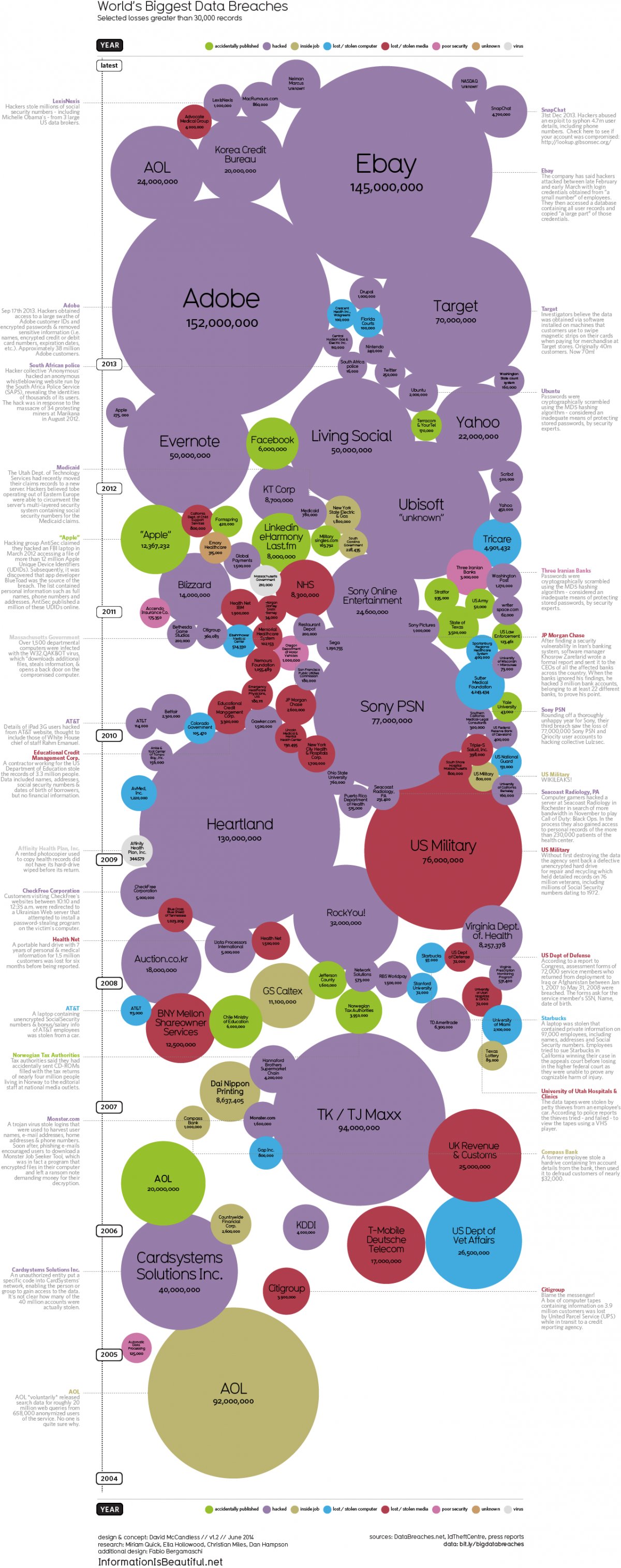
In 2014 more data security breaches were announced than ever before. The graphic below highlights how intense the large scale data security breaches have been in recent years;
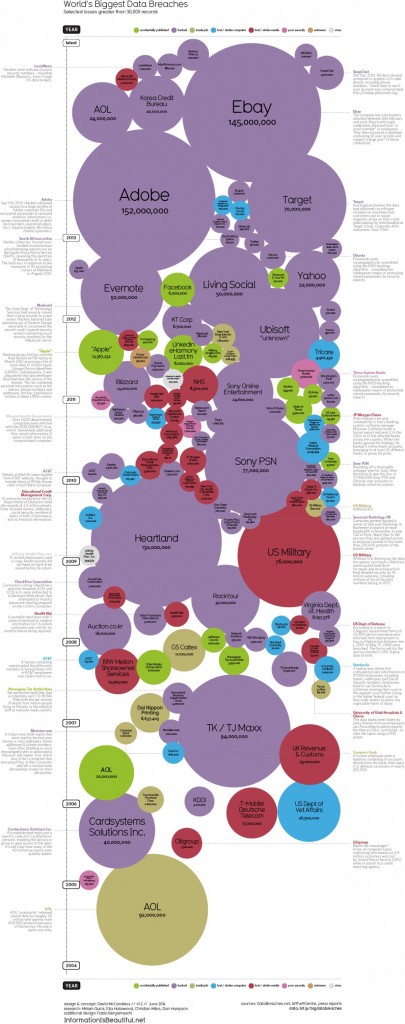
Click image above for larger image
Source: http://uk.businessinsider.com/data-breaches-infographic-2014-12
Many businesses aren’t taking data security seriously, especially within the SME group of businesses. People running websites based on popular content management systems often take the approach of ‘build it once and leave it’. This isn’t good enough. Instead you should be continually updating your website, updating plugins and patching security holes. All of which can reduce the possibility of your website being hacked.
Many times in the last year I have personally received an email from a senior person within a professional large business which has been sent after they have been hacked into, i.e. it wasn’t them who actually sent the email as it contained a virus. While this is never 100% inevitable, there are many things that you can do as a business to protect yourself online. Often with old email technologies, if someone hacked into your web server, they may also find it easier to access your email system.
The government recently announced the Cyber Essentials scheme to help businesses take data and security seriously within their business. Have a good read over what this means for you and your business. In addition to this, Google recently announced that they are considering marking all non-HTTPS websites as ‘non-secure’ which really highlights where websites are heading in the future. Security is key with your business, you digital assets including your website and your customers’ data. Keep things safe and secure by taking the steps needed.
A Bit Further Down the Line
Where would a 2015 blog post be without looking at some of the other items on the horizon but aren’t quite going to become mainstream in the next year. There is a lot of technology in the fringe that is growing in popularity which is really exciting for end users and certain businesses, although it is not quite at the stage for most businesses to take seriously. But let’s take a look at it anyway!
Wearable technologies have been talked about a lot recently and I recently had the opportunity to test out Google Glass and the Oculus Rift, both of which were rather cool I have to say. Recently Sony announced a similar technology designed to remove the ‘cringe factor’ of Google Glass.
Recently Nest announced that Google Now was now integrated into the device, bringing a HAL 9000 experience to the home. Such fun. This was an inevitable next step for Nest which is clearly one of the significant reasons why Google paid such a hefty sum for Nest in the first place. As Nest increases in popularity, Google is going to become further engrained in our daily lives without us having to visit a specific device to search, instead we can just say “Ok Google, what was the football score this afternoon”.
Uber, the taxi booking app, has taken the world by storm. Expect to see a lot more digital disruption in all industries in 2015 and beyond. For your business to stay ahead this year it is vital to innovate throughout every aspect of your business, products and services. Digital disruption is coming to every industry – be prepared.
Facebook search engine? Maybe. Well Facebook did recently announce that they are no longer going to be using Bing for their search provider. Does this mean that they are going to start competing with Google in the search space? Who knows? It will be interesting to see how this develops this year.
Internet of Things is a recent hot topic in digital which is still very much in its infancy. In the very near future, every electronic device will be connected to the internet, from sensors to devices and everything in between. When this happens, it is going to be a very exciting time as the online and offline worlds are connected more than ever. The data and insights that can be gained through such huge data could optimise the physical world we live in to make services and systems more efficient.

Image source: John Biehler
Bridging the gap between the online and offline worlds is going to become seamless for customers. Customers don’t particularly care whether they are dealing with your business online or offline, they simply want to deal with your business. Services such as our WiFi Marketing & Analytics system is ideal for leisure based venues to connect the online and offline dots together. Capturing customer data is the most valuable currency online in 2015.
Summary
Digital is going to be moving at a faster rate than ever in 2015. Your business needs to be prepared and take advantage of these changes or risk getting left behind. Only the strong will survive. Would you like to discuss how we can support your business goals throughout 2015? Then get in touch for an informal conversation about how we can help or take a look through the many services we can provide to increase revenue for your business.
by Michael Cropper | Jan 14, 2015 | Digital Marketing, Future |
Digital is changing faster than ever, yet so many businesses fail to keep ahead of the essential changes required to meet customer demands. 2015 is the year where businesses who take digital seriously are going to thrive and leave their competitors well behind. It’s time to embrace digital and integrate digital technologies throughout your entire business, process and people. Here we are going to look at the priorities for your businesses to utilise digital to grow throughout 2015.
Platform
One of the common challenges for businesses is selecting the right platform for their website. A platform that allows members of the team to easily create, edit and delete pages, images and content throughout the website. A platform that puts you, your staff and your business in control of the direction of your own website. A platform that is capable of scaling as your business grows.
Image source: https://www.flickr.com/photos/ajpscs/
To keep things simple, you really need to be working towards one of the two leading platforms either WordPress or Magento. For most businesses within the SME bracket, one of these two platforms is really the only thing you need to scale your business. There are an awful lot of website platforms available to develop your website on, many of which have a lot of problems with them and are simply not good enough.
This is quite a big topic and is a little outside of the scope of this blog post, so we will cover this a little later down the line in a future blog post. For now, if you have any questions regarding the suitability of the platform you are using, then get in touch and we will be happy to give an honest opinion of the technology you are using and it’s suitability to cope with the growth plans for your business.
The important point around the platform and technology in use on your website is that it needs to be suitable for your business and puts the power in your hands with a Content Management System (CMS). Which brings us nicely onto the next point about ownership.
Ownership
As a business, you need to own your digital assets including your hosting solution and website. What this means is that you need to have access to your own assets and be able to change things as you require. Far too often businesses come to us and tell us the same story (we listen politely every time we hear the story! J), about how another website developer/company owns their website, their hosting and domain name, wants to charge a considerable amount of money for making basic changes on the website, which you should be able to do yourself, the relationship has broken down and they are refusing to release control of your own website to you.
Image source: Paul Townsend
Please, stop and think before purchasing a new website. You need to own everything that is going into it. A web development company exists to assist your business to grow, not to own a significant part of your digital assets and hold you to ransom for them.
Ownership comes in many forms from copyrighted images including stock photographs, your web hosting solution, your domain name, your emails, your website technology, your website content, your login details for all of the above along with external services that are being used on your website, social media channels and tracking solutions and many more. For everything that is implemented for your business digitally, you need to own everything to keep your business safe and secure.
Tracking
Would you like to give me £100,000? No? Why? How about if you gave me £100,000 and I gave you £120,000 back? How about now? Yes? What’s the difference? The difference is tracking. Tracking your digital investments and the return you are generating from your digital marketing channels. That’s the difference.
Image source: BK Koh
Most businesses simply aren’t tracking their digital marketing activities accurately which ultimately leads to bad investments and distrust in digital marketing activities. Businesses will quite happily spend hundreds of pounds on a printed advertisement in newspapers and magazines, thousands of pounds sponsoring a single event and even over £100,000 per year on radio advertising without any ability to accurately track direct results from those campaigns (yes, these are real figures and stories we have discussed with businesses!). Why? Because they are easy. It is easy to spend money on ‘Advertising’ without understanding what this is generating in return. What would happen if you didn’t do those things? What would happen if you reduced your spend in these areas by half? What would happen if you doubled your spend in these areas? Tracking is key to understanding profitability with marketing campaigns.
Traditional advertising, generally speaking, has an extremely low response rate and an even lower success rate. Compare this with digital advertising where you can track exactly what your results are;
Traditional Marketing
Investment –> Hard to track from here
Digital Marketing
Investment –> # of Website Visitors –> # of Conversions –> Revenue –> Profit –> ROI
Which brings us back to the question of how much money would you give me if you received more money back in return? It all comes down to tracking and data analysis. Being able to track results accurately from SEO, PPC and email marketing allows you to make smarter data driven business decisions. Invest in marketing activities wisely and most important track results accurately across all channels. Google Analytics is capable of tracking your every need.
Integrated Marketing
Have a think about the last time you purchased something in your own life, a car, a holiday, a TV, a laptop, a tablet, whatever. Did you ever just complete one single action during the purchasing journey you took? The answer is no. People are complex, people go through complex purchasing paths depending on their specific needs, level of trust, previous purchases and experiences. It is therefore no surprise that your customers also take a rather complex path when purchasing products and services from you. That’s why it is important to integrate your marketing channels to optimise every channel and touch point that your customers experience on their path to purchase.
Image source: Jon Tollefson
Think about your offline presence, digital presence including SEO, PPC, email, referral, direct, social and specific campaigns. When a customer experiences your brand on one of the marketing channels above, how do they feel? Are your marketing and communication messages the same across all channels? Are you even using all of the available marketing channels for your business? A positive or negative experience across a single touch point can result in a lost sale for your business.
The key message is to make sure you are active on all digital marketing channels available to you and ensure your customers have a positive experience. Join the dots across all digital marketing channels to enhance your customer’s lives through content, fun and interaction. This leads nicely onto the overall user experience of your brand online.
User Experience
When your customers interact with your brand online what is the experience they have on your website, from mobile devices, on social media, when they search for you on Google, when they see a PPC advert, when you send an email newsletter? Every experience is either a positive or negative one, there is no middle ground.
Taking your website first, how easy is your website to use in general and more specifically on mobile and tablet devices? Responsive design has been talked about for a couple of years now, yet still many websites simply aren’t user friendly and are difficult to use from a mobile. You need not look any further than the endless statistics that are being continually released about the proliferation of mobile devices throughout our everyday lives and interactions with brands online. If your website does not work effectively on a mobile device then you may as well deny people accessing your website from mobile devices as this sends the same message. Any new website that is developed in 2015 needs to be responsive as a minimum, just as it did in 2014. It needs work effectively on mobile devices and tablets.
What is the experience when people receive your weekly or monthly email marketing newsletters? Is this a typical sales focused shouting emails asking your customers to buy with yet another special offer, coupon code or last minute flash sale? Boring. Yes these type of emails clearly do work and should be part of an effective email marketing strategy, but they should not be the main focus. Aim to educate your customers, entertain them and show the personality of your brand. Look to engage with your customers and grow your email list.
What is the experience when people interact with your brand on social media? Are you busy talking about nonsense, retweeting everyone else’s tweets with no idea why and spending hours a day being busy without understanding what you are getting back? Stop, just stop. It’s time to start taking social media seriously, what are you looking to gain from social media? How is social media integrating with your overall digital marketing strategy? Who are you looking to engage on social media? Turn your social media activities into a positive experience for your customers online. Social PPC is essential to reach your customers on social media channels in 2015. Businesses have been testing this over the past couple of years to grow their audience and can be a very successful way to increase the reach of your messages.
Data Security
In 2014 more data security breaches were announced than ever before. The graphic below highlights how intense the large scale data security breaches have been in recent years;
Click image above for larger image
Source: http://uk.businessinsider.com/data-breaches-infographic-2014-12
Many businesses aren’t taking data security seriously, especially within the SME group of businesses. People running websites based on popular content management systems often take the approach of ‘build it once and leave it’. This isn’t good enough. Instead you should be continually updating your website, updating plugins and patching security holes. All of which can reduce the possibility of your website being hacked.
Many times in the last year I have personally received an email from a senior person within a professional large business which has been sent after they have been hacked into, i.e. it wasn’t them who actually sent the email as it contained a virus. While this is never 100% inevitable, there are many things that you can do as a business to protect yourself online. Often with old email technologies, if someone hacked into your web server, they may also find it easier to access your email system.
The government recently announced the Cyber Essentials scheme to help businesses take data and security seriously within their business. Have a good read over what this means for you and your business. In addition to this, Google recently announced that they are considering marking all non-HTTPS websites as ‘non-secure’ which really highlights where websites are heading in the future. Security is key with your business, you digital assets including your website and your customers’ data. Keep things safe and secure by taking the steps needed.
A Bit Further Down the Line
Where would a 2015 blog post be without looking at some of the other items on the horizon but aren’t quite going to become mainstream in the next year. There is a lot of technology in the fringe that is growing in popularity which is really exciting for end users and certain businesses, although it is not quite at the stage for most businesses to take seriously. But let’s take a look at it anyway!
Wearable technologies have been talked about a lot recently and I recently had the opportunity to test out Google Glass and the Oculus Rift, both of which were rather cool I have to say. Recently Sony announced a similar technology designed to remove the ‘cringe factor’ of Google Glass.
Recently Nest announced that Google Now was now integrated into the device, bringing a HAL 9000 experience to the home. Such fun. This was an inevitable next step for Nest which is clearly one of the significant reasons why Google paid such a hefty sum for Nest in the first place. As Nest increases in popularity, Google is going to become further engrained in our daily lives without us having to visit a specific device to search, instead we can just say “Ok Google, what was the football score this afternoon”.
Uber, the taxi booking app, has taken the world by storm. Expect to see a lot more digital disruption in all industries in 2015 and beyond. For your business to stay ahead this year it is vital to innovate throughout every aspect of your business, products and services. Digital disruption is coming to every industry – be prepared.
Facebook search engine? Maybe. Well Facebook did recently announce that they are no longer going to be using Bing for their search provider. Does this mean that they are going to start competing with Google in the search space? Who knows? It will be interesting to see how this develops this year.
Internet of Things is a recent hot topic in digital which is still very much in its infancy. In the very near future, every electronic device will be connected to the internet, from sensors to devices and everything in between. When this happens, it is going to be a very exciting time as the online and offline worlds are connected more than ever. The data and insights that can be gained through such huge data could optimise the physical world we live in to make services and systems more efficient.
Image source: John Biehler
Bridging the gap between the online and offline worlds is going to become seamless for customers. Customers don’t particularly care whether they are dealing with your business online or offline, they simply want to deal with your business. Services such as our WiFi Marketing & Analytics system is ideal for leisure based venues to connect the online and offline dots together. Capturing customer data is the most valuable currency online in 2015.
Summary
Digital is going to be moving at a faster rate than ever in 2015. Your business needs to be prepared and take advantage of these changes or risk getting left behind. Only the strong will survive. Would you like to discuss how we can support your business goals throughout 2015? Then get in touch for an informal conversation about how we can help or take a look through the many services we can provide to increase revenue for your business.