by Michael Cropper | May 13, 2015 | SEO |
Seriously, have we reached full capacity? I’m speaking specifically about traditional broadband connections, not fibre broadband. The ‘old’ broadband running on the copper lines from the exchange. It seems that this technology is well and truly full, at least based on personal experience and that of anecdotal evidence from speaking with other people in a similar situation.
To put this into context, previously the internet connection at home has been more than adequate for a good number of years based on the type of activities within the household. More recently, since our old provider was bought out by a larger provider and my personal working habits have changed slightly, I am starting to question if the current broadband infrastructure has reached full capacity and I’m putting the question out there, have you noticed any difference recently in your home non-superfast internet speeds?
Superfast Internet
The rollout of superfast broadband throughout the UK is absolutely needed, but have we gone far enough with the rollout? The current superfast broadband rollout is what is technically known as Fibre to the Cabinet, FTTC for short. In lay-person speak, this means that there is now a fibre connection from your local telephone exchange to the little green box at the end of your street.
Traditionally, this part of the journey was powered using copper wire. This is a problem due to the laws of physics. Transferring data (i.e. your internet connection) is significantly faster through a fibre optic cable than through the old copper wires. Hence why the rollout of fibre broadband was essential as data usage has significantly increased over recent years with the growth of services such as Netflix, YouTube, Amazon Prime, Tesco Blink, Xbox Live, Online Gaming and more.
But I question whether we have gone far enough with the upgrades and whether we actually have a long term solution in place for the growing data requirements for home and business users. The current superfast broadband rollout is a significant improvement which has implemented the improvements to part of the line as can be seen below;
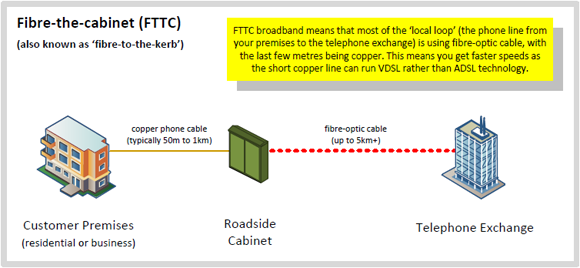
Source: http://www.thinkbroadband.com/guide/fibre-broadband.html
What you will notice is that this isn’t the whole picture. There is part of the connection which is still using the older technology, which is the part of the connection between your green box and your home. For office use, this generally is not a problem as there is either a leased line to the premises or similar technology making the internet connection truly superfast. For some users, and most importantly, the growing remote and flexible workers as part of your workforce, this is actually a large problem. Personally, there is rarely a working day that is the same, with work being completed in various locations depending on the plan for the week. Which means that for myself personally, I could be experiencing internet connections with down streams nearing 100 mb/s or as poor as 2mb/s with continuous dropouts depending on the time of the day. While this doesn’t interrupt any activities, it does require a little more planning, a backup plan in place at all times in the form of mobile data, oh, and the forced upgrade to a fibre connection – more on that later though.
Speaking based only on anecdotal evidence, on a traditional broadband connection at home, the evidence is clear, broadband connectivity issues starting around 3:30pm, peaking around 5pm, starting to tailor off around 7pm. What I’m talking about here is when the internet connectivity gets so bad that it is not possible to load a website or connect to the internet. After a lot of thought on the topic, the only conclusion that I can make based on this is that children are arriving home from school at around 3:30pm, accessing all of the on-demand services, clogging up the internet then going to bed around 7pm. Thinking through many options that could be causing this, along with endless discussions with home broadband technical departments working to ‘resolve the issue’ (and failing miserably), it is clear that the old provider was not able to fix the issue which I believe to be related to the capacity crunch that we are all experiencing invisibly at the minute.
The Capacity Crunch
The next step of my personal story is that we are moving to superfast fibre broadband at home, not out of a want for faster speeds as for home use, traditional broadband used to be absolutely fine for our needs as a home user. No, we are moving to a superfast fibre connection out of necessity. As part of the process, one comment from the new supplier struck a cord and made me think about what has actually happened with the recent broadband rollout project within the UK. The comment was that the new provider is going to have to send out an engineer to the green box and flick us on to fibre.
So in summary, unless you are paying directly for a fibre connection, you simply aren’t benefiting from this new technology. Call me a cynic, but this does seem a little strange why home users aren’t automatically switched over to this upgrade when they already often paying reasonably hefty prices for basic usage, on the whole – and that the project was part funded (50/50) by the European Union through the European Regional Development Fund and local authorities throughout the UK.
The question I came to ask myself was whether we, as home consumers, were being forced down a paid upgrade route when the reality is that the current service being provided simply isn’t up to scratch and is not fit for purpose. The copper pipe is already full which is causing service issues for those people using traditional broadband technology.
Another topic in this area, which we will cover in more depth in another blog post is the difference between broadcast technology (i.e. your live TV) VS streaming technology (i.e. anything over the internet). We’ll look at the technical details a little more another time, for now, the key point is that broadband technology is a first-come-first-serve basis, meaning that if there is a certain amount of capacity on the old copper lines, then whoever uses the capacity first wins and those who aren’t quick enough lose out. All of this is clearly a little more complex than this in the background and simply put, those closer to the exchange have priority over the bandwidth. Meaning that the further away from your local exchange you are, the further down the pecking order you are when it comes to getting your fair share of bandwidth and often those further out are left with the crumbs at the end.
It may be no surprise to you based on the tone of this blog post that we aren’t quite sat next to the local exchange at home. Never the less, we also aren’t tens of miles away either. Traditional broadband has been (up until recently) and should be absolutely fine for our needs, yet it isn’t. Instead, a forced ‘upgrade’ to a fibre service is required to maintain basic connectivity to the home, not to get 200x the speed we currently get.
The Cloud
Putting this into context from a business perspective as a whole, more and more staff are requesting home and flexible working options for various reasons. The image I came across on LinkedIn recently resonated with a lot of people and really does go to show where business and the idea of ‘work’ is heading;
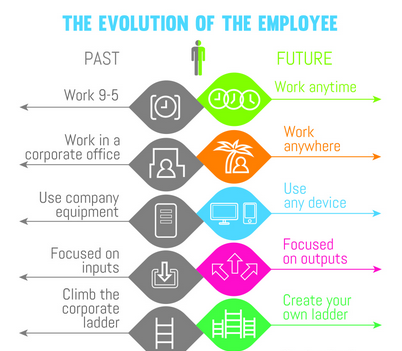
Attribution required: If this is your image, get in touch and we’ll credit you accordingly J
The concept of a modern day working environment requires an unbelievable robust internet connection throughout the UK that can be enjoyed by all. One that I do not believe we have. The recent upgrades are a step in the right direction but we need more.
As more businesses migrate their entire business to the cloud for all of the benefits this brings, the key to all of this working seamlessly is a robust internet network. With accounting software, project management software, research tools, file storage systems, customer relationship management systems and more all being contained within the cloud. This all only works with a fantastic internet connection throughout all parts of the data journey.
The Reality for Many
While this blog post may seem like a little rant against poor performing internet speeds at home, it isn’t. I’ve had that spat directly with the current provider on Twitter J No, this blog post is to highlight the issue that many people are currently experiencing yet there seems to be no real long term solution to this growing problem. Sure, we have had a significant improvement in the form of fibre broadband throughout the UK, but this is not going to last and quite frankly this rollout is not the inclusive Britain that we all aim to strive for. The ever increasing costs related to basic services, and I do include internet in this category, needs addressing and a real solution needs to be identified.
Browse through the swarms of people on Twitter complaining every day about broadband connection speed problems from all suppliers à https://twitter.com/search?f=realtime&q=slow%20broadband&src=typd. Backing up personal anecdotal evidence. This isn’t just the reality for a small number of people, this is a problem impacting an awful lot more people than those just voicing their opinions on Twitter.
Again, putting this into perspective, when comparing home broadband speeds directly with data speeds when connecting to the internet via a mobile phone provider, it is clear there is an issue with the technology;
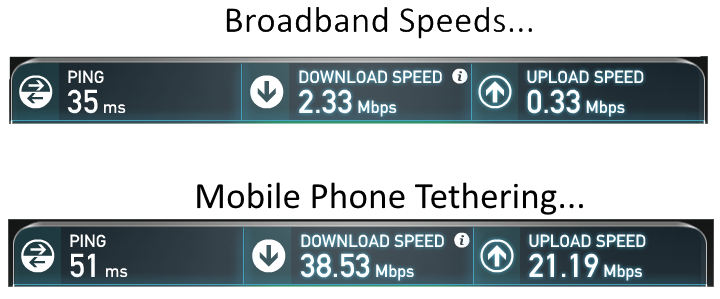
The mobile data tariffs are just way too expensive currently to warrant permanent connectivity through mobile phone networks. Although maybe this is a longer term solution and the reason why BT is looking to buy EE for £12.5 billion, the largest and fastest mobile network throughout the UK.
The Future
So where do we go from here? Clearly this is a problem where the solution is a little more involved than my thoughts in a blog post. With some interesting blog posts coming from BT on the matter recently, the issue is clearly already under discussion;
“BT’s head of optical access, Professor Andrew Lord, who will take part in the conference said: “It’s the first time we have had to worry about optical fibres actually filling up. We could expand the network by laying more cables but the economics of that do not work and it would increase power consumption. Prof Lord added that a possible solution to the problem would be to ration internet access, where household consumers and businesses would be charged for the amount of data they use.” – Source (5th May 2015)
“The internet will not need to be rationed in the future because of a “data capacity crunch”, according to a leading scientist from telecoms giant BT.” – Source (11th May 2015)
Whatever the solution, it is clear that more needs to be done by all the key players in this market to address these issues, and fast. Many web services are seeing exponential growth in data usage as consumer behaviour shifts from broadcast to on-demand services which is only going to grow further. Couple this with the future horizon in an internet connected world with the Internet of Things, we have a serious crunch approaching in my opinion.
This is purely my personal opinion on where we are at currently and where we are heading. It would be great to hear your thoughts on the topic and share your experience in the comments. Do you think the internet has reached full capacity? Do you think we are heading for a capacity crunch? Or are you simply loving your new fibre broadband speeds streaming series after series of the latest dramas on Netflix?
by Michael Cropper | May 13, 2015 | Thoughts |
Seriously, have we reached full capacity? I’m speaking specifically about traditional broadband connections, not fibre broadband. The ‘old’ broadband running on the copper lines from the exchange. It seems that this technology is well and truly full, at least based on personal experience and that of anecdotal evidence from speaking with other people in a similar situation.
To put this into context, previously the internet connection at home has been more than adequate for a good number of years based on the type of activities within the household. More recently, since our old provider was bought out by a larger provider and my personal working habits have changed slightly, I am starting to question if the current broadband infrastructure has reached full capacity and I’m putting the question out there, have you noticed any difference recently in your home non-superfast internet speeds?
Superfast Internet
The rollout of superfast broadband throughout the UK is absolutely needed, but have we gone far enough with the rollout? The current superfast broadband rollout is what is technically known as Fibre to the Cabinet, FTTC for short. In lay-person speak, this means that there is now a fibre connection from your local telephone exchange to the little green box at the end of your street.
Traditionally, this part of the journey was powered using copper wire. This is a problem due to the laws of physics. Transferring data (i.e. your internet connection) is significantly faster through a fibre optic cable than through the old copper wires. Hence why the rollout of fibre broadband was essential as data usage has significantly increased over recent years with the growth of services such as Netflix, YouTube, Amazon Prime, Tesco Blink, Xbox Live, Online Gaming and more.
But I question whether we have gone far enough with the upgrades and whether we actually have a long term solution in place for the growing data requirements for home and business users. The current superfast broadband rollout is a significant improvement which has implemented the improvements to part of the line as can be seen below;
Source: http://www.thinkbroadband.com/guide/fibre-broadband.html
What you will notice is that this isn’t the whole picture. There is part of the connection which is still using the older technology, which is the part of the connection between your green box and your home. For office use, this generally is not a problem as there is either a leased line to the premises or similar technology making the internet connection truly superfast. For some users, and most importantly, the growing remote and flexible workers as part of your workforce, this is actually a large problem. Personally, there is rarely a working day that is the same, with work being completed in various locations depending on the plan for the week. Which means that for myself personally, I could be experiencing internet connections with down streams nearing 100 mb/s or as poor as 2mb/s with continuous dropouts depending on the time of the day. While this doesn’t interrupt any activities, it does require a little more planning, a backup plan in place at all times in the form of mobile data, oh, and the forced upgrade to a fibre connection – more on that later though.
Speaking based only on anecdotal evidence, on a traditional broadband connection at home, the evidence is clear, broadband connectivity issues starting around 3:30pm, peaking around 5pm, starting to tailor off around 7pm. What I’m talking about here is when the internet connectivity gets so bad that it is not possible to load a website or connect to the internet. After a lot of thought on the topic, the only conclusion that I can make based on this is that children are arriving home from school at around 3:30pm, accessing all of the on-demand services, clogging up the internet then going to bed around 7pm. Thinking through many options that could be causing this, along with endless discussions with home broadband technical departments working to ‘resolve the issue’ (and failing miserably), it is clear that the old provider was not able to fix the issue which I believe to be related to the capacity crunch that we are all experiencing invisibly at the minute.
The Capacity Crunch
The next step of my personal story is that we are moving to superfast fibre broadband at home, not out of a want for faster speeds as for home use, traditional broadband used to be absolutely fine for our needs as a home user. No, we are moving to a superfast fibre connection out of necessity. As part of the process, one comment from the new supplier struck a cord and made me think about what has actually happened with the recent broadband rollout project within the UK. The comment was that the new provider is going to have to send out an engineer to the green box and flick us on to fibre.
So in summary, unless you are paying directly for a fibre connection, you simply aren’t benefiting from this new technology. Call me a cynic, but this does seem a little strange why home users aren’t automatically switched over to this upgrade when they already often paying reasonably hefty prices for basic usage, on the whole – and that the project was part funded (50/50) by the European Union through the European Regional Development Fund and local authorities throughout the UK.
The question I came to ask myself was whether we, as home consumers, were being forced down a paid upgrade route when the reality is that the current service being provided simply isn’t up to scratch and is not fit for purpose. The copper pipe is already full which is causing service issues for those people using traditional broadband technology.
Another topic in this area, which we will cover in more depth in another blog post is the difference between broadcast technology (i.e. your live TV) VS streaming technology (i.e. anything over the internet). We’ll look at the technical details a little more another time, for now, the key point is that broadband technology is a first-come-first-serve basis, meaning that if there is a certain amount of capacity on the old copper lines, then whoever uses the capacity first wins and those who aren’t quick enough lose out. All of this is clearly a little more complex than this in the background and simply put, those closer to the exchange have priority over the bandwidth. Meaning that the further away from your local exchange you are, the further down the pecking order you are when it comes to getting your fair share of bandwidth and often those further out are left with the crumbs at the end.
It may be no surprise to you based on the tone of this blog post that we aren’t quite sat next to the local exchange at home. Never the less, we also aren’t tens of miles away either. Traditional broadband has been (up until recently) and should be absolutely fine for our needs, yet it isn’t. Instead, a forced ‘upgrade’ to a fibre service is required to maintain basic connectivity to the home, not to get 200x the speed we currently get.
The Cloud
Putting this into context from a business perspective as a whole, more and more staff are requesting home and flexible working options for various reasons. The image I came across on LinkedIn recently resonated with a lot of people and really does go to show where business and the idea of ‘work’ is heading;
Attribution required: If this is your image, get in touch and we’ll credit you accordingly J
The concept of a modern day working environment requires an unbelievable robust internet connection throughout the UK that can be enjoyed by all. One that I do not believe we have. The recent upgrades are a step in the right direction but we need more.
As more businesses migrate their entire business to the cloud for all of the benefits this brings, the key to all of this working seamlessly is a robust internet network. With accounting software, project management software, research tools, file storage systems, customer relationship management systems and more all being contained within the cloud. This all only works with a fantastic internet connection throughout all parts of the data journey.
The Reality for Many
While this blog post may seem like a little rant against poor performing internet speeds at home, it isn’t. I’ve had that spat directly with the current provider on Twitter J No, this blog post is to highlight the issue that many people are currently experiencing yet there seems to be no real long term solution to this growing problem. Sure, we have had a significant improvement in the form of fibre broadband throughout the UK, but this is not going to last and quite frankly this rollout is not the inclusive Britain that we all aim to strive for. The ever increasing costs related to basic services, and I do include internet in this category, needs addressing and a real solution needs to be identified.
Browse through the swarms of people on Twitter complaining every day about broadband connection speed problems from all suppliers à https://twitter.com/search?f=realtime&q=slow%20broadband&src=typd. Backing up personal anecdotal evidence. This isn’t just the reality for a small number of people, this is a problem impacting an awful lot more people than those just voicing their opinions on Twitter.
Again, putting this into perspective, when comparing home broadband speeds directly with data speeds when connecting to the internet via a mobile phone provider, it is clear there is an issue with the technology;
The mobile data tariffs are just way too expensive currently to warrant permanent connectivity through mobile phone networks. Although maybe this is a longer term solution and the reason why BT is looking to buy EE for £12.5 billion, the largest and fastest mobile network throughout the UK.
The Future
So where do we go from here? Clearly this is a problem where the solution is a little more involved than my thoughts in a blog post. With some interesting blog posts coming from BT on the matter recently, the issue is clearly already under discussion;
“BT’s head of optical access, Professor Andrew Lord, who will take part in the conference said: “It’s the first time we have had to worry about optical fibres actually filling up. We could expand the network by laying more cables but the economics of that do not work and it would increase power consumption. Prof Lord added that a possible solution to the problem would be to ration internet access, where household consumers and businesses would be charged for the amount of data they use.” – Source (5th May 2015)
“The internet will not need to be rationed in the future because of a “data capacity crunch”, according to a leading scientist from telecoms giant BT.” – Source (11th May 2015)
Whatever the solution, it is clear that more needs to be done by all the key players in this market to address these issues, and fast. Many web services are seeing exponential growth in data usage as consumer behaviour shifts from broadcast to on-demand services which is only going to grow further. Couple this with the future horizon in an internet connected world with the Internet of Things, we have a serious crunch approaching in my opinion.
This is purely my personal opinion on where we are at currently and where we are heading. It would be great to hear your thoughts on the topic and share your experience in the comments. Do you think the internet has reached full capacity? Do you think we are heading for a capacity crunch? Or are you simply loving your new fibre broadband speeds streaming series after series of the latest dramas on Netflix?
by Michael Cropper | Apr 27, 2015 | SEO |

Last week we were invited to a party Google was throwing for those involved in the recent Grow Local campaign which was designed to help businesses get on board with Google AdWords. Held at Europe’s largest multi-arts and conference venue, the Barbican in London. We had a great evening full of goodies, entertainment and a bit of technology, naturally.
-

-
Google Squishy Toy
-

-
Grow Local Activities
-

-
Grow Local….get it…
-

-
Google Goodies!
-

-
Grow Local Activities
-

-
Fish
-

-
Thirsty fish
-

-
Garden Party at the Barbican
-

-
Create your own garden from food
-

-
Google Boxes
-

-
Google Grub
-

-
Make a wish…
-

-
Some wishes never come true…
-

-
General ambiance
-

-
General ambiance
-

-
General ambiance
-

-
Allotments
-

-
Google Grow Local Party
-

-
The Barbican
Google Cardboard
We got our hands on our own Google Cardboard Virtual Reality system. And yes, it is just a piece of cardboard, but it is a cool piece of cardboard. The pack comes in flat-pack mode and allows you to place your smartphone into the device and be truly immersed in a virtual world. Hold the device and look in any direction and control your movements inside the virtual world. Ride on virtual rollercoasters, view museum exhibits, walk around stately homes, fly over Chicago or get immersed in a Paul McCartney concert (if that’s your thing…). Our custom paint job on the Google Cardboard leaves a little to be desired…
-

-
Google Cardboard
-

-
Google Cardboard
-

-
Google Cardboard
-

-
Google Cardboard
-

-
Google Cardboard
-

-
Google Cardboard
-

-
Google Cardboard
-

-
Google Cardboard
-

-
Google Cardboard
-

-
Google Cardboard
by Michael Cropper | Apr 27, 2015 | Events, PPC |
Last week we were invited to a party Google was throwing for those involved in the recent Grow Local campaign which was designed to help businesses get on board with Google AdWords. Held at Europe’s largest multi-arts and conference venue, the Barbican in London. We had a great evening full of goodies, entertainment and a bit of technology, naturally.
-
-
Google Squishy Toy
-
-
Grow Local Activities
-
-
Grow Local….get it…
-
-
Google Goodies!
-
-
Grow Local Activities
-
-
Fish
-
-
Thirsty fish
-
-
Garden Party at the Barbican
-
-
Create your own garden from food
-
-
Google Boxes
-
-
Google Grub
-
-
Make a wish…
-
-
Some wishes never come true…
-
-
General ambiance
-
-
General ambiance
-
-
General ambiance
-
-
Allotments
-
-
Google Grow Local Party
-
-
The Barbican
Google Cardboard
We got our hands on our own Google Cardboard Virtual Reality system. And yes, it is just a piece of cardboard, but it is a cool piece of cardboard. The pack comes in flat-pack mode and allows you to place your smartphone into the device and be truly immersed in a virtual world. Hold the device and look in any direction and control your movements inside the virtual world. Ride on virtual rollercoasters, view museum exhibits, walk around stately homes, fly over Chicago or get immersed in a Paul McCartney concert (if that’s your thing…). Our custom paint job on the Google Cardboard leaves a little to be desired…
-
-
Google Cardboard
-
-
Google Cardboard
-
-
Google Cardboard
-
-
Google Cardboard
-
-
Google Cardboard
-
-
Google Cardboard
-
-
Google Cardboard
-
-
Google Cardboard
-
-
Google Cardboard
-
-
Google Cardboard
by Michael Cropper | Apr 22, 2015 | SEO |
We recently attended the Cyber Security Conference which was looking at the enormous problem that is cyber security, or should I say cyber crime. Cyber security is a bigger issue than most businesses realise, with central government classifying cyber security as a Tier 1 threat, the same level as terrorism. Yet we will see many businesses not taking adequate steps to secure their businesses. At Contrado Digital, our focus is on digital marketing, websites and other online topics. These naturally are open to many of the issues related to cyber security which often aren’t in the realms of the traditional IT Support type companies who manage the physical security related to network routing and more. There is naturally a cross over between the two areas, which is why we have started to cover this area a little more recently as it is an area that is not understood that well by most businesses, particularly those within the SME bracket.

Security Investment
One phrase that you should really think about is this; Good security will cost you, bad security will cost you more. This is one that resonated with me at the conference as I can relate to this on many occasions when businesses have come to us with problems related to security. On many occasions we hear businesses say things along the lines of “We don’t have access to our own website, webserver or social media accounts and the web developer has gone AWOL, what can we do?” This is security and is a big risk for your business.
Coming back to the phrase, good security will cost you, bad security will cost you more, what can you realistically do in this situation? Well, you have to start again in many instances which is a much more costly approach than simply getting the right processes and training in place within your business from the start. This specific example is the reason why we have put together a free resource for keeping tracking of your digital assets with our Digital Assets Tracker document.
Going beyond the basics, it is hugely important to look at the training requirements within your organisation and invest in a creating a security culture. To the point whereby local IT support company Holker IT have recently launched a campaign to educate businesses with their Think Before You Click campaign. So many issues related to security are human error due to lack of knowledge, so make sure your staff have been trained up and are aware of the latest security threats that could cause a serious problem for your business.
Planning for Problems
No system is infallible, this is an unfortunate fact of life when dealing with computer systems, programs, hardware and processes reliant on human input. So what are your plans for when something does happen? What, you don’t have any? Far too many businesses don’t have any serious plans in place for when cyber security issues arise and simply have the opinion that it will never happen to them. I’m sure the people involved with the recent celebrity scandal thought the same…
The reality is that something will happen and you need to plan for when this does and put in procedures that can mitigate against issues. This broadly falls into three categories;
- How will you deter it?
- How will you detect it?
- How will you respond to it?
Thinking through the potential problems that could occur and planning for this will mean you have a much more secure business, lower your chances of financial and reputational damage along with allowing you to focus on what is important, growing your business.
Let’s look at a few examples to put things into perspective.
Distributed Denial of Service (DDoS) Attack
A cyber criminal has decided to attack your website with a Distributed Denial of Service attack (DDoS) and your website is no longer accessible. Read up about an example a while ago that we had to deal with. This was only a small scale attack in the grand scheme of things, what if it had been bigger?
How will you deter it? – While you cannot control if someone has decided they are going to attack your website, you can put in place measures to pro-actively block attacks. For example, with WordPress, there are plugins such as Limit Login Attempts and Akismet that will help to deter DDoS attacks which should be installed along with other professional security plugins which we also use.
How will you detect it? – What systems have you got in place to detect when this is happening? Or do you simply find out when you happen to check your website and realise that it is not working? How many enquiries or lost ecommerce sales have you had during this time? Any reputable web hosting company will have pro-active monitoring in place to alert you to when your server falls over due to hugely increased loads, allowing you to respond in a timely manner and deal with the issue promptly.
How will you respond to it? – What are you actually going to do to stop the attack? Simply sit it out and watch it unfold until it hopefully stops? If your web server has already fallen over, then there is little you can do until you can gain access again. Depending on the technical configurations you have in place along with the nature of the attack, it may be possible to divert traffic to another server, allowing you to get access to your main server and implement security changes such as blocking all traffic from a certain IP address or a group of IP addresses. Then once the change has been made, you can redirect all traffic back to your main server which should reduce the load and allow your websites to function normally again. Again, certain hosting companies pro-actively monitor for DDoS attacks and intervene by automatically blocking suspicious traffic on the network level before they even get to your web server which is great.
WordPress Brute Force Password Hacking
A cyber criminal has decided to hack into your website by guessing your administrator password. They have wrote a basic computer programme which loops through common passwords before running through a password generator script in a logical order to find your password.
How will you deter it? – There are plugins available for WordPress which will automatically block anyone who attempts to login to your website using the ‘Admin’ username which is the WordPress default. You should always be using a unique Administrator username which isn’t ‘Admin’ or ‘Administrator’. Pick something unique for you which is hard to guess. This means that any hacker has to guess both the username and password which is exponentially more difficult. In addition, certain plugins will automatically block IP addresses from accessing your website if they guess any password incorrectly a set number of times.
How will you detect it? – There are plugins available for WordPress that will automatically send you an email when an IP address has been blocked from logging in to your website due to too many failed login attempts. This can alert you to a problem and can help to highlight the start/stop of any attack that is happening.
How will you respond to it? – Responding to a hacking attempt which is aiming to guess your password is about being pro-active. If you have a password which is ‘password123’ then this isn’t the most secure password in the world and could be cracked by a computer programme within minutes. Always make sure you are using strong usernames and passwords for your WordPress websites to avoid vulnerabilities.
WordPress Plugin Vulnerability Exploits
A cyber criminal has noticed that you are running your website from the world’s most popular content management system WordPress and has decided that you are a good target. They know that many WordPress website owners don’t update their plugins and patch security holes regularly so have decided that you would be a good target for hacking into. After all, they already have a list of what has been patched by comparing the older versions of plugins to the latest versions of plugins so they have an easy shopping list of exploits to try and hack into your website with.
How will you deter it? – What activities are you doing to avoid leaving your WordPress website open to vulnerability exploits? You are keeping all of your plugins, themes and WordPress core up to date, right? This is the absolute minimum that you should be doing to avoid cyber criminals taking over your website. You really need to be thinking about subscribing to a service that will detect threats in real time which will keep you much safer.
How will you detect it? – How will you detect if your website has been exploited? Often many website owners and businesses have no idea that their website has been infected by some malicious code that has been placed there which could be hiding in the background working away. When a cyber criminal exploits a vulnerability in your website, this usually isn’t about changing the visual appearance of your website, this is usually about hiding code away so that you think everything is fine. Again, there are many services available that will scan your core WordPress files for vulnerability exploits and raise a flag if a piece of unexpected code is found which is likely to be an exploit.
How will you respond to it? – Now you have managed to detect the problem, getting rid of the problem can be a whole other challenge. Depending on the complexity of the hijacked code will determine how easy or difficult this is to get rid of. Prevention is always better than dealing with these types of problems when they occur since many sophisticated pieces of code will hide their self from your view and only show to search engines and only under certain circumstances.
Summary Planning
The three examples above are just the basics when it comes to protecting your website from attacks. The real focus should be about planning for problems so your website doesn’t become one of the statistics around hacked websites.
Do not think that this will never happen to you, it will. Cyber criminals often don’t care about you or your website specifically, they simply create computer programmes which crawl the internet (in the same way Google does) to find all target websites (i.e. WordPress and others). Once they have found their targets, they simply automatically test each website for known vulnerabilities. At this level, which isn’t hard to achieve, hacking is basically a spectator sport. Press ‘go’ on your script and you just sit back and wait for a report to be generated for every websites in your target list (bearing in mind that WordPress powers over 23% of websites on the entire internet….that’s a lot of targets…) with a list of which vulnerabilities they are open to.
You cannot rely on any kind of enforcement here to get you out of a sticky situation. The unfortunate reality is that you are on your own (or getting help from us…). There are so many potential problems beyond the three examples above that people need to protect their website from this is an area that needs serious attention. With many hacking attempts coming from over-seas, there is very little jurisdiction that can help dealing with problems after they have occurred.
Thankfully we offer WordPress Security services which are designed to keep your website safe and secure so that you are prepared and don’t fall victim. Always think about any potential problem in relation to your own website and business; How will you deter it? How will you detect it? How will you respond to it? Reactive approaches are too late. Proactivity is key.
Scale of the Problem
A recent report from Trustwaves in the form of their Global Security Report found some interesting statistics including;
- 45% of data thefts are for non-payment card data
- Ecommerce made up 54% of assets targeted
- Point of sale (POS) breaches accounted for 33% of investigations they did
- Retail was the top compromised industry- likely due to the nature of data they keep about customers in databases
- 85% of the exploits detected were from 3rd party plugins
- Weak passwords contributed to 31% of breaches
- 96% of investigated applications had one or more serious security vulnerabilities
- Ecommerce and website breaches rose by 5% since 2012 – I believe this figure is hugely understated
- The average number of vulnerabilities identified per application was 14
- 100% of mobile applications tested contained at least one vulnerability
- 71% of victims did not detect the breach their self
- The average number of days from initial intrusion to detection was a whopping 87 days
When terms such as application, website, ecommerce etc. are used. This is often the same underlying programming languages and exploits that are being used in different ways. Do not think that these problems are isolated to a specific area.
Going beyond simply looking at the enormous numbers behind these problems. There are services available online including Shodan which has a fantastic blog covering lots of ‘interesting’ topics. The service classifies itself as ‘The search engine for internet-connected devices’. I.e. Internet of Things, Webcams, Buildings, Websites, Refrigerators, Power Plants and more. I’m not going to talk about the technologies behind how all of this works here as this gets a little geeky. What is important is that for only $9 / month, you can literally search the world of internet connected devices for vulnerabilities.
So again, are you confident that you are protected and have the right procedures in place?
Physical Hardware
There was a lot of talk at the conference along the lines of physical hardware security and network security. A little beyond our area of expertise, but a couple of interesting points around this which may resonate;
- You need solutions at the network security level, not just software solutions. For example if you have a multi-site office, it was recommended that you look at using MPLS to protect your data in transit.
- Your home broadband provider can see what devices you have connected to your router. If you regularly work from home or you have a home based business, you may prefer to keep your business hardware private from prying eyes. It was recommended to always have an additional router between the router provided by your ISP and your devices so that wandering eyes cannot see what is connected to your network from further afield. For example, imagine a call centre employee noticing that your house appears to have 15 iPads, 3 iMacs, 12 iPhones and 4 smart TVs all connected to the router you were provided (yes, you have a big house…). This would certainly be more of a target for thieves. Whereas if they only saw that 1 additional router was connected to the network then they would simply look elsewhere.
Information Governance Programme
While this may sound like the setup for much larger multi-national organisations, it is important to recognise the importance for all businesses large and small. Larger organisations often rely on smaller organisations as part of their supply chain in one way, shape or form which are often a target for attackers due to the often more relaxed approach to information security.
Recently central government made the new Cyber Essentials certification a mandatory requirement for anyone bidding for central government contracts which highlights the importance. From many speakers at the event from mammoth organisations and senior positions in government were reiterating the importance of security throughout the entire supply chain. To the point whereby many large organisations are putting together training programmes for their supply chain to educate them about the standards that they expect.
Information governance is not just data, it is a lot more than that. It includes areas such as;
- Information risk management
- Information management
- Intellectual property
- Knowledge management
- ICT
All of which touch on some of the terms that you may be more familiar with; SaaS (Software as a Service), BYOD (Bring Your Own Devices), cloud, virtualisation, employees, customers, contractors, outsourced people/companies. Looking at this in more technical terms to see what areas are often attacked when you look at data assets;
- Data at rest – For example data in the many databases you use within your business across multiple systems
- Data in use – For example data that is stored in caches, security certificates, data in RAM
- Data in motion – For example networked systems
A professor from Lancaster University talked through a range of the options hackers have to access systems ranging from the obvious technical areas such as HTTP, downloads/uploads, SQL injection to the ones people often don’t think about as much such as FTP clients, emails/webmail, instant messaging, peer-2-peer, file sharing, HTTPS, STFP, SSH, VPN, protocol tunnelling including DNS, HTTP, ICMP, Box, Dropbox, image steganography, VOIP, routing control packets and more. Some of these you will likely never have heard of if you aren’t that technical, but I guarantee that you will be using them in some way without even realising.
The graphic below from Lancaster University highlights some of the common methods used;
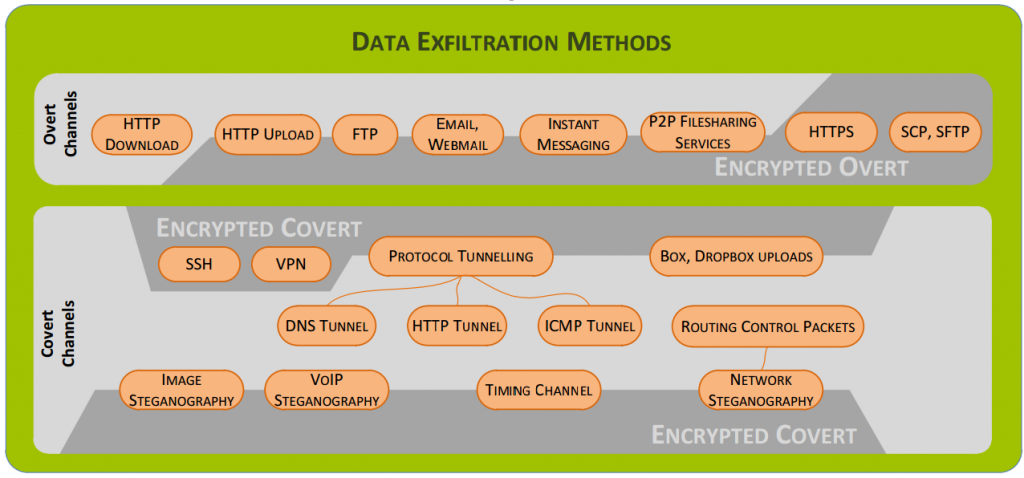
Again, all of these acronyms above are used by the many of the technologies that you use on a daily basis without even realising.
Summary
Cyber security is a serious problem. These are just some of the highlights from the excellent conference. Many other topics were discussed, although I feel that the people speaking about the more exciting topics would prefer if some of this information wasn’t boasted about so this has been left out for obvious reasons.
By far, the largest problem around cyber security at the moment which was reiterated by all at the event was around lack of education of the real problem that is out there. Many businesses simply have the opinion that it will never happen to them, or they are too small for people to care. This is simply not the case and I hope this blog post covering a small selection of the many exciting topics discussed will help to highlight some of the issues and what businesses can do to protect their-self online.
If you would like to discuss any website security related issues then get in touch or see how our website security audit could help. There are many aspects related to cyber security and we are by no means an expert on every aspect. With dealing predominantly with websites and online ‘things’ this is where our focus lies including details around specific technologies and systems. If you ask us about something that is a little outside of the scope of our expertise, then we can certainly put you in touch with one of our many contacts that are more suitable to support your business.
Resources, Sources and Further Reading
UK National Security Strategy: https://www.gov.uk/government/uploads/system/uploads/attachment_data/file/61936/national-security-strategy.pdf
UK Cyber Security Strategy: https://www.gov.uk/government/uploads/system/uploads/attachment_data/file/60961/uk-cyber-security-strategy-final.pdf
HMG Security Policy Framework: https://www.gov.uk/government/uploads/system/uploads/attachment_data/file/316182/Security_Policy_Framework_-_web_-_April_2014.pdf
Introduction to Cyber Security course from the Open University: http://www.open.edu/openlearn/futurelearn/cyber-security
Cyber Streetwise: https://www.cyberstreetwise.com/
10 Steps to Cyber Security: http://www.gchq.gov.uk/press_and_media/news_and_features/Pages/Relaunch-10-Steps-to-Cyber-Security.aspx
Competitive analysis of the UK cyber security sector: https://www.gov.uk/government/uploads/system/uploads/attachment_data/file/259500/bis-13-1231-competitive-analysis-of-the-uk-cyber-security-sector.pdf
Information Security Breaches Survey 2014: http://www.pwc.co.uk/assets/pdf/cyber-security-2014-technical-report.pdf