by Michael Cropper | Sep 19, 2016 | Client Friendly, News |
We speak with many businesses who simply do not have the budgets to pay for quality websites which is a shame as this ultimately ends up with their websites being built extremely badly, costing a lot of money in the long run and the businesses suffer as a result. Generally speaking, businesses come to us after they have gone through this pain and need the right solutions putting in place, when they have a realistic budget to work with. Digital doesn’t come cheap, until now.
Introducing CreoPressto, the only website builder that gives you full control of your website without you ever needing to get into the technical aspects at all. Whether you are looking for a basic brochure website or a fully-fledged ecommerce website, CreoPressto is capable of growing with you. It’s so easy to use, literally anyone in the office could build a website with CreoPressto.
We challenge you to take a look at how CreoPressto can revolutionise the way you work with your website by empowering your organisation and taking control of your own destiny. The self-build technology allows you to make your website look and feel however you want with no restrictions or limitations in place. If you can imagine it, the CreoPressto platform can work for you.
Never have to worry about the technical aspects in the background, we’ve brought together various industry leading website technologies to create an awesome platform that is capable of powering your entire website with ease and growing with you over time so you don’t need to keep buying a brand new website every few years.
With hundreds of features and functionality to keep you busy, the pain free quick and easy drag and drop visual website builder allows anyone to build a website with ease, with no prior knowledge required. If you can use Microsoft Word, you can build a website with CreoPressto that is safe, secure, flexible and capable of growing with you as an organisation. Here’s just a small handful of the features available with CreoPressto.
Bar Counter Modules

Blurb Modules

Countdown Timer Modules

Google Maps Modules

Social Media Modules

User Account Management Modules
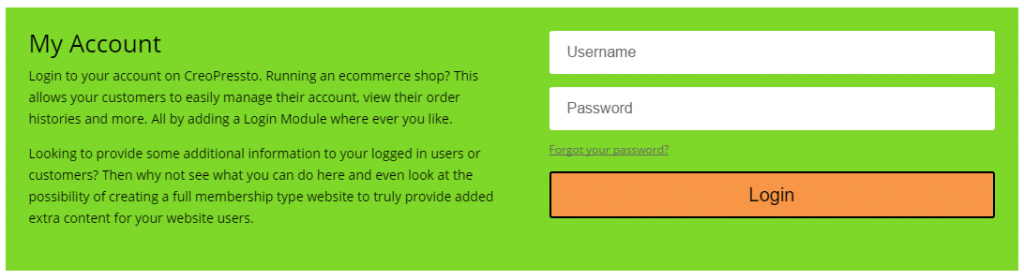
And many many many more options to choose from!
Pricing
CreoPressto is entirely self-service, allowing you to create whatever you can imagine. Due to this, pricing starts as little as £49.99 + VAT / month which gives you enterprise level functionality on your website without the traditional costs associated with this. Pretty awesome, right? To give you an idea of what is included with this;
- Web Hosting
- SSL Certificate
- WordPress Installation
- Website Blog
- Awesome Page Builder
- Ecommerce
- Over 30,000 Free Plugins
- Forum Support
- Google Analytics
- Search Engine Optimisation
- Automatic Security Updates
- Automatic Backups
- Automatic Server Updates
- cPanel Server Access
- FTP Access
- 10 GB Storage
- 5 GB Monthly Bandwidth
- Forum Support
With packages designed to grow with you over time as your needs expand. The beauty of CreoPressto is that if you need additional support with building your website, this is on hand from the team at Contrado Digital or anyone else you wish to work with.

by Michael Cropper | Sep 19, 2016 | Client Friendly, News |
Such a common rhetoric from virtually every business who is looking to recruit digital talent within their organisation, “We can’t find people with the right skills”. Firstly, to those organisation, make sure your jobs are posted on Tendo Jobs, it’s free to do so and we have lots of active job hunters regularly searching for skills in every sector ranging from retail to highly technical digital roles to C-level roles. Secondly, instead of complaining about not being able to find the right staff, let’s look at the practical steps to growing your own talent.
Quite frankly, the lack of skills talk hasn’t changed in the digital world over the last several years and it’s getting a bit boring to keep listening to if I’m honest. So we thought we could do something about that. Introducing Contrado Academy, the practical hands on courses designed to allow your staff to learn how to ‘do digital’ the right way. With a variety of courses running in locations throughout the UK, we’re able to deliver high quality training courses that teach the practical skills and real-world experience that your employees need to know. Whether you are looking to know the basics or progress through the variety of courses and become a fully-fledged digital expert, we have courses available from beginners to advanced in a variety of areas.
Contrado Academy is not a traditional academic setup, the courses have been created by professionals working in digital day-in-day-out which covers the practical skills and information that is in demand from employers. Traditional education establishments are great, seriously, go to Colleges and Universities when you are looking for the long term investment. The unfortunately reality for people working in digital though is that employers need skills now, they cannot afford to wait for 1-3 years for a new course to be signed off by the various committees involved then a further 3-4 years for students to graduate. The world has moved on by then. Digital apprenticeships are certainly doing something to address these issues, yet not everyone wants to do an apprenticeship, they just want to complete a short course that gives them the skills and information required to do they job they are doing, do it better or develop their skills for the future.
Take a look at the variety of courses on offer and stay tuned for dates when courses are announced very shortly.
https://academy.contradodigital.com/courses/
Current courses available include;
- Web Development for Beginners
- WordPress for Beginners
- Intermediate WordPress
- Advanced WordPress
- HTML for Beginners
- CSS for Beginners
- JavaScript for Beginners
- Linux Web Server Management for Beginners
- PHP for Beginners
- Java for Beginners
- Java Web Applications for Beginners
- Social Media for Beginners
- Introduction to Digital Marketing
- Google Analytics for Beginners
- Google AdWords for Beginners
- Email Marketing for Beginners
- Ecommerce for Beginners
- Apple iOS Development for Beginners
- Android Development for Beginners
- Search Engine Optimisation SEO for Beginners
- Cyber Security for Beginners
Whether you are looking to train your current staff in the vast array of digital technologies or you are reading this as someone who is looking to enter the world of digital, there are a variety of courses available to suit your needs.
by Michael Cropper | Sep 14, 2016 | Client Friendly, Security |
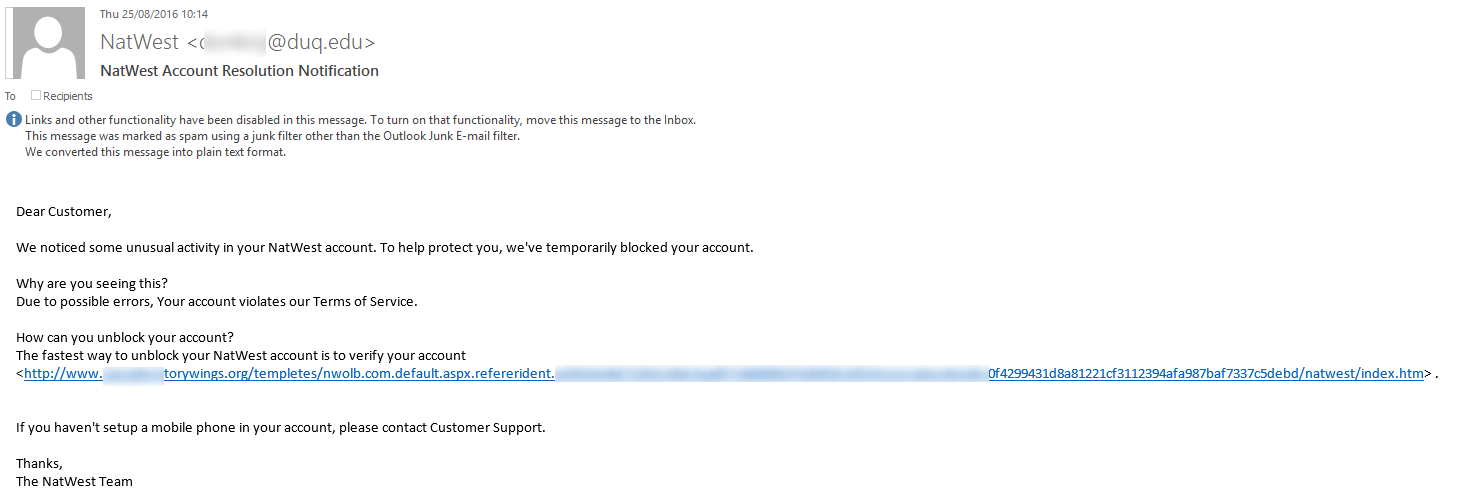
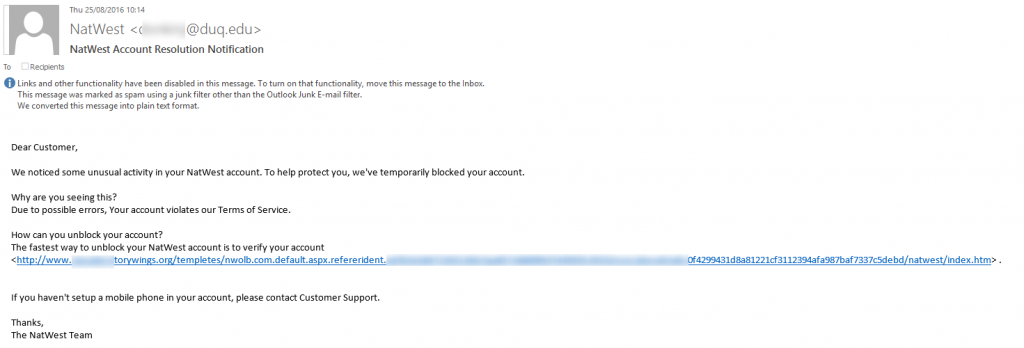
Probably one of the worst examples we’ve seen for a phishing email recently. Be aware though that these things do still catch people out. When you receive emails like this, always check the email address is from the correct website. Clearly in this case it isn’t. While this information cannot be trusted as this can be easily spoofed, many phishing emails like this one appearing to be from NatWest haven’t even bothered to add in the correct from email address.
Likewise, you will notice that the link they are asking you to click doesn’t go through to a NatWest website. Again, this information can be easily masked so you are best never to click on links in emails which appear to be suspicious. Always make sure that you open your web browser, go to the website directly without clicking on any links in emails to view notifications on your account. If the email was genuine, you will also have a notification within your account with the relevant information on.
Be safe.

by Michael Cropper | Sep 4, 2016 | Thoughts |
This blog post is a personal bugbear of mine when it comes to people working in the digital industry and with technology. The scenario generally plays out as follows;
Client: “We’ve seen this really amazing flashy whoosh thing on {insert big brand website here} and we want you to do this on our website“
Or
Client: “I’ve had this amazing idea, hear me out, {insert the craziest wackiest idea you can imagine that is trying to do something non-website related on a website}
Digital Person / Agency: “Sure, we can look to do that. What a great idea.”…. They then scramble off to talk about how they go about doing this. Internal discussions, questions on Stack Overflow or Facebook WordPress groups or other digital groups before rushing into implementing this idea as quickly as possible to please the client.
This is such a destructive attitude to take and one which not only shows your lack of understanding about the digital world but also the lack of confidence the client has in you to recommend the right solutions. In my experience, whenever a client asks us these similar questions on a regular basis we put a halt to their thought process straight away and get to the bottom of what they are actually trying to achieve.
What do they actually want? When a client comes to you with a solution to their idea, they often haven’t shared with you their initial idea in the first place. It is your job as a digital expert to get to the bottom of what they actually want before blindly jumping into delivering a preconceived solution. I can guarantee that if you just blindly implement what the client wants, you will end up in a very sticky situation further down the line which will result in the client blaming you for implementing their ideas which were ultimately flawed. It is your responsibility as a digital expert to help the client turn their ideas into realities by using the best possible solution for their needs.
To name just a few real world situations recently to highlight this point and why you should not just blindly implement what the client wants. Below are several examples when digital people have been asking us advice on how to implement various requirements from their clients and haven’t had the guts to tell the client no;
- Requirement: Client wants to use WordPress as an intranet (which is certainly possible), and they want to have a directory structure like they see on their computer so it’s easy to find files to use.
- Why this is a bad idea: WordPress doesn’t work like this. Dropbox and other cloud based document sharing facilities do. Don’t go re-inventing the wheel. Tell the client why their solution isn’t the best setup for their requirements and keep telling them until they understand and agree. Blindly trying to implement this kind of file directory style setup in WordPress is just going to cause problems in the long run.
- Requirement: Client wants to use this fancy font from Photoshop on their website. So we implemented this as an image for all headers. Now they’ve said they want to translate their website. How do we go about this?
- Why this is a bad idea: Sorry, things now have to be rebuilt correctly. Images should have never been used for headings as they don’t work very well on mobile devices, aren’t SEO friendly and don’t work from a translations point of view. Not to mention the inherent challenges around which browsers support which fonts on different devices etc. Keep things simple.
- Requirement: Client wants to use their AOL account to send emails from their WordPress website but the emails keep going into people’s spam folders.
- Why this is a bad idea: Emails aren’t meant to be used like this, particularly AOL accounts. Seriously, who still has an AOL account? As a business owner you need to be using suitable email technologies and when sending emails from web applications, there are specific technical aspects that need configuring to get this working correctly.
You get the drift. Blindly implementing requests from clients is a fool’s game. If you are working in the digital industry, please, stop doing this. Instead, take a step back whenever a request comes through and start to think strategically about what they are ultimately trying to achieve and what the best solutions truly are.
Every single website is restrained in some way based on the web hosting setup, the technologies in use, the frameworks that are used and lots of other moving parts. You cannot simply implement something that you’ve seen on one website into another website without fully understanding the technical implications of what this means. Don’t go re-inventing the wheel and quite frankly if the idea the client has come up with is hair brained, tell them, it will save you endless problems in the future. Start to recommend the best solutions based on their requirements instead of simply blindly implementing everything they want.
Remember, the client often has no idea about the finer details of the technical and digital world. All they often see is the visual side of things and don’t understand what goes into creating functional, scalable and reliable systems that are capable of growing with them. We get a lot of work coming through to us when people have gone down this route in the past, with clients working with digital people and agencies who have blindly implemented what they wanted, only to then by told by us that everything needs rebuilding. Hey, I can’t complain, this generates a lot of work for us, but let’s be honest, from a client’s perspective they are paying, two, three or four times for things when digital people keep implementing everything they want blindly and wondering why things aren’t working for them.
Managing client projects is actually relatively simple. Assume they know nothing and question everything that they say. Start to really get to the bottom of what they are looking for, then use this information with your knowledge and expertise to recommend suitable solutions. Please, stop blindly implementing what clients want. In the meantime, we’ll happily keep picking up failed projects and getting thing working correctly. It’s what we’re best at.