by Michael Cropper | Aug 29, 2015 | Digital Strategy |
You may think this is a strange title for a blog post, particularly when we are always talking about integrated online marketing and how it’s essential to join the dots within your organisation. Well this is true and we aren’t having a disagreement with ourselves here. What we’re talking about when it comes to decoupling your digital services is specifically technology related and how it is important to keep control of your systems and decrease dependencies.

Having a technical background myself, I naturally like to see technical aspects and website development design patters in real life. I’m a geek, get over it 🙂 But seriously, applying the same methodologies to your business can have significant benefits just as it can within the digital world of programming and website development.
In the Programming World
I’m not going to bore you with the finer details about the technical requirements behind website design and development, I’ll leave that for another blog post. Instead, and to keep things simple, let’s look at two options. Repeating yourself or referring to what you said.
Repeating yourself
Whatever you do in business you often end up repeating yourself quite a lot. Whether this is related to staff training, staff development, internal communications, describing processes, as part of the sales process and more. This is certainly one way to do things. But what if you didn’t have to keep repeating yourself. Let’s ignore the real world for a minute and how people like people and all that. Let’s just look at the task of saying the same thing over and over again. There must be a more efficient way of working.
Referring to what you said
So as an alternative. Imagine that every time someone asked you a question, you could simply point them in the direction of the answer. Saving you valuable time and money within your business. You would naturally get asked the same questions again and again over a period of time which can soon add up into significant time savings for your personal time and throughout your business as a whole. This is where systems, design patters and processes come into play.
Object Orientated Programming
The above example about referring to what you said is called Object Orientated Programming in the website development world. It basically means that you don’t have to keep repeating yourself when writing code. Instead you can simply refer to the piece of code you need and pull in this information as and when needed.
This is extremely important as this decouples your functionality within the code and makes it significantly easier to develop and maintain over time. And this is the lesson about how you can use the same design patterns within your business by decoupling your digital services.
Decoupling your Digital Services
Following on with this same example, imagine if your entire business was run from a single computer. This computer was used to handle customer enquiries, send invoices, do accounts, manage your website, handle your customer relationship management system and more. It would be quite a challenge for many people to use the same computer doing different tasks at the same time.
Now bringing this towards key digital services that you have, let’s look at a common setup for businesses within the SME bracket, they generally have;
- A domain name
- A web server
- Email technologies
- Website technologies
- Email marketing technologies
- Social media management tools
- Integrated systems
- Stock control systems
- Accountancy systems
- Project management systems
- And many more items
Looking at a few of these, picture this scenario (which we’ve seen happen on numerous occasions). All of the following services are purchased from a single provider which is either a software company, a digital agency or some specialist system;
- Your domain name
- Your web server
- Your email technologies live on the web server
- Your website is a custom built content management system
- Your email marketing campaigns are managed through your website
- Your social media updates are automatically posted based on the content of your website
- Your project management system lives on your web server
Now, what happens when your web server dies? An unbelievable amount of businesses do not have an automated backup solution in place for their web server which is shocking and highly risky. Taking this one step further, which again is based on what we’ve seen on numerous occasions, what if your web server was managed completely by a 3rd party such as your web designer. What then happens when they go AWOL? Quite simply, you’re screwed. And this is the importance of decoupling your digital services to protect your business and make your life much simpler.
How to decouple your digital services
Think strategically and plan for the worst case scenario. Firstly, it is absolutely essential that you own all of your digital assets. Once you’ve read over that, let’s look at how you actually go about decoupling your digital services. Before we do though, it’s important to say here that there are always trade-offs based on the skill set within your business and the skills you require from 3rd parties like ourselves. At Contrado Digital, we always work in a structured way to ensure the businesses we work with have complete ownership over their digital assets. We work in a way whereby we simply manage businesses digital assets on their behalf. It’s no good us owning your website, what good is this to us, really?
Starting from the top;
- A domain name: Make sure this is registered with an actual registrar. We could sell you a domain name if we wanted, but we choose not to. Just go direct to a registrar such as 123-Reg.co.uk or GoDaddy. Keeping this under your full control will make your life so much easier if you decide to switch providers for your website. Believe it or not, some companies will actually hold you to ransom by keeping your domain name if you decide to stop using their services. Reputable providers such as 123-Reg.co.uk and GoDaddy clearly don’t do this.
- A web server: Again, make sure this is suitable for your needs and is decoupled from your registrar. Many businesses when they first start buy a domain name they then buy the addon web hosting package available too. You really need to stop and think about this because if you are purchasing a web hosting package that is unsuitable (or doesn’t have automated backups in place) then you are going to run into problems sooner rather than later. Particularly when many web hosting packages will tie you in for a minimum of 12 months, this can be a costly decision to make.
- Email technologies: Many smaller businesses around the sub £500,000 turnover mark use email technologies that are sitting on their web server. Quite simply, stop doing this. Read over our Really Simple Guide to Business Email Addresses to understand why and just get Microsoft Exchange in place throughout your business. Again, decoupling your email technologies from your domain name and from your web server. It will save you a heap of time and effort in the long run.
- Website technologies: If you have purchased your domain name from one of the many website builder type companies around, you will likely have purchased a website builder package from them too. You don’t own this and this is an extremely risky strategy as you cannot simply take your website elsewhere, you are well and truly tied into their services for life unless you start everything from scratch and rebuild your website. Start thinking about decoupling your digital services at the start. And whenever you hear the words of a a company wanting to build you a bespoke website or bespoke content management system, run for the hills.
- Email marketing technologies: We’ve seen email marketing technologies run by many companies under a form of white label system, whereby it appears that the email marketing system is being provided by an individual company when in fact this is actually being run by a much larger company in the background. In our experience, many of the basic white label email marketing technologies aren’t that good, particularly when you compare them to the extremely affordable services from companies such as MailChimp. Not only do companies like MailChimp provide a better service based on their underlying technology, they are also another step to decouple your digital services from a single company.
- And many more items….you get the point
For any set of systems, if you are dependent on a single point of failure not failing then you increase the risk of running into problems at some point down the line. Start to decouple your digital services and think more strategically about what technologies you really need in place and how you can orchestrate your digital assets in a way that works for your business.
Integration
Before we finish the details about the importance of decoupling your digital services, we need to look seriously at integration. It is essential that systems integrate together. A decoupled system that stands in complete isolation is going to be even worse for you than a coupled system. Many older systems (as in +2 years old) don’t integrate that well on the whole. Technology moves on at such a pace that it is essential to keep up to date.
As a prime example, the accountancy system Xero which is taking the world by storm allows you to integrate your website ecommerce systems directly with your accountancy package to make your life easier managing your accounts. Whether this is you personally, an internal book keeper, an internal accounts team or an external accountancy practice. Integrating website technologies directly with your accountancy system will save your business a significant amount of time in the long run. Or, of course, you could carry on doing things the old way.
Systems that integrate well together are the systems that are going to be around for years to come. Systems that work in complete isolation are going to be replaced by better, smarter and faster systems that automate work, save your business money and allow you to focus on the things that matter.
Get in touch if you would like to discuss your digital systems, their suitability and how they are going to help or hinder your business growth.
by Michael Cropper | Aug 18, 2015 | A Short Story About |
Today I wanted to share a short story about the importance of keeping your technology up to date within your business and the consequences if you heed to take notice of this advice. Far too often within business, business owners and employees have an approach of “do it once and forget about it”, well with technology, this approach is doomed to failure and can cost your business a lot of money in the long run.
Computer Hardware
The first recent example relates to a business whose computer equipment wasn’t as up to date as it should have been. The hardware was around 3 years old, which on a laptop by this time the performance has already started to significantly degrade from when you first bought it, and the software simply hadn’t been managed well during this time either.

While this is a recent example, this same scenario we have seen multiple times before with businesses of varying sizes so this is certainly not uncommon which is why we want to stress the importance of keeping your technology up to date. Avoid going through the same frustrations others businesses go through by implementing a common sense approach to maintaining your technology on a regular basis.
Firstly, running your business on slow computer hardware can significantly impact the performance of you, your staff and your business as a whole. For example, I recently heard a story from a reputable source which went as follows; UPS would save $1,000,000 of costs for every 60 seconds per day of time saved for each of their delivery drivers globally. When you start to add this up over the year, this is an enormous amount. Knowing this, they spend a significant amount of time, money and resources in optimising delivery routes using technology which is ultimately designed to work towards reducing the time it takes drivers to deliver parcels. Based on this, they implemented several interesting technologies designed to reduce wasted time. They placed a Bluetooth fob on each driver and connected all devices to the cloud. What this meant is that when the delivery driver had stopped at the next delivery point, known based on the GPS location, and they turned the engine off, the rear hatch of the van would open automatically, saving precious seconds of wasted time. As the driver walked up the garden path to deliver the parcel, if the package had not been signed for on their handheld device, this was a signal that the back of the van needed to be opened again automatically as the driver returns to the vehicle so the package can be placed back into the van, again saving precious seconds. Then finally, as the driver returned to the front of the vehicle, the engine would automatically start to save a further few seconds. Based on all of these small time savings throughout the day, UPS found that they would save 17 seconds per driver per day by utilising technology to drive efficiencies within the business. Based on the savings they make per 60 seconds, it is clear to see how this significantly impacts the bottom line. Whether this story is 100% accurate or not isn’t the point, this is a believable story about a company of this size. Regardless of the accuracy of this particular story the point is still valid about companies utilising technology to improve the business as a whole which is true in endless organisations.
Now I’m not saying that your business is going to go to these lengths to optimise your business but when you look at the computer hardware running in your business and ask yourself, is it helping or hindering your business and employees? Remember, there is no middle ground. A slow running computer results in staff sat there waiting for technology to keep up with them which is extremely inefficient and can cost a significant amount of money over time;
- 60 seconds per hour wasted
- 8 minutes per day
- 40 minutes per week
- 2.6 hours per month
- 34.6 hours per year
- X the number of employees
What is a week of time worth to you, your employees and your business as a whole? I can bet that it is more than the cost of upgrading the underperforming technology within your business!
Now this isn’t just about cost savings, but imagine what you could achieve in a week. Having an additional 2% of time available per year per employee, I’m sure you could achieve some amazing things. New customers, new processes, technologies, investments within your business, additional revenue and more.
The same is true for website technology. There have been countless studies proving how website speed directly impacts the performance of your website, particularly ecommerce and can show significant improvements in conversion rates and revenue based on technology improvements.
Skimping on your hardware is only costing your business money, just in ways that aren’t as clear to see. You either choose to do something about this and get the right technology in place that you need, or you choose to “put up with it for another year” and cost your business money.
Computer Software
Along the same lines as computer hardware, it is imperative to keep your computer software up to date. This is the software that you are using on a day-in-day-out basis which is powering your business. We’ve seen organisations still using Windows XP which is no longer supported from a security point and businesses running 5 year old software because they haven’t made the small investments of generally less than £200 to upgrade their software.

To put this into perspective, the same situation occurred with two businesses recently who were running outdated software on the computer. When it came to upgrading a completely separate system, their business email addresses, then integrating this into their current desktop software of their choice, the result was nothing but problems with their computer software.
What should have been a 2 minute job to integrate the two together turned out to be hours worth of work from both parties testing various solutions to fix the desktop software to work as it should do. Again, hours of wasted time for all involved because the wrong technology was implemented from the start, configured by someone who had no idea what they were doing and working form software that is now almost 6 years out of date.
Within business the decisions are simple, you either do the right thing, or you choose not to do the right thing. We see time and time again the cost of bad decisions when it comes to technology which is why we try and educate businesses to working with the right technology from the start to save them money.
We aren’t an IT support company, there are plenty of great IT support companies around who do that far better than we ever could. That being said, as we are in the technology industry working with leading edge technologies, we come across a lot of antiquated systems before we get around to upgrading them which often requires us to cross that bridge into the IT support world to integrate systems together.
Website Technology
Again, along the same lines as the several examples already given but now looking at website technology. A story about a businesses who required serious security updates to their WordPress website. On first glance, this sounded like an hour or two’s worth of work which was explained with the caveat that we would need to take a look at the underlying technology in a little more detail before we could provide an accurate estimate of the work involved.

Lo and behold, the same bad decisions in a different area we see time and time again. This time, the decision around 3 years ago was to purchase a cheap WordPress Theme from one of the many Theme Directories / Marketplaces on the web. This was likely an innocent decision to purchase a $49 theme “because it looked nice”. The realities of this meant that it was not possible to upgrade their system in the expected hour or two’s worth of work. Instead, this was looking like 4-5 day’s worth of time to implement the right solution and patch the security holes.
I won’t bore you with the finer technical details of this, so suffice to say that the problem lied with purchasing a poorly built WordPress Theme 3 years ago. Due to this, certain key ecommerce technologies and core WordPress files once upgraded would actively break the website, essentially closing the digital doors of your business and turning off your revenue stream. So it was either leave the website open to hackers by not patching known and commonly exploited security holes, or, making the essential upgrade to the right solution.
All of this can be avoided when you are working with the right digital agency and you select the suppliers who are adding value to your business. I’d urge you to consider the longer term impacts of the technology decisions you are making today. Time and time again we see bad decisions made with businesses having to spend a lot of money fixing problems instead of implementing real solutions to grow their business. For us, this is part and part of what we do, what we enjoy and ultimately what we get paid for. We would much rather be focusing work towards implementing technologies within your business that are going to take your business to the next level rather than fixing problems caused by poor decisions years ago. We do both thankfully and I can honestly say that the clients who see the greatest returns from their investment in digital and technology are the clients who make the right technology decisions time and time again. I’ll never forget a phrase an old colleague once said to me and it couldn’t be truer in this scenario, “Quick wins lead to long losses”. Think about that.
Solution
Ok, so we’ve talked about the problems that poor technology causes and given a few prime examples related to this. So what next? How do you keep your technology up to date without spending an arm and a leg every month? Well, it’s actually relatively straight forward and only requires a strict procedure within your business or from your suppliers who actively maintain the core aspects of your business;
- Hardware Technology: Keep it up to date! Slow hardware costs money in terms of staff time, unproductive time, missed opportunities and more. Invest in the right equipment to do the job. You could eat soup with a fork, but it’s probably best you use a spoon…
- Software Technology: Keep it up to date! Patch software and update as soon as possible after the improvement has been announced. Don’t delay and don’t wait years before upgrading. Out of date software causes a lot of problems and makes any integrations harder to work with. There is only so much you can do with the digital equivalent of Gaffer tape…
- Website Technology: Keep it up to date! Particularly when using popular open source software and 3rd party plugins, it is imperative to keep your website up to date purely from a security point of view to update core files, plugins and themes. Beyond this, regular website maintenance packages and continual improvements allows your website to be ever evolving and working for your business. So rather than seeing your website as a cost look at this as a digital asset worthy of investing in.
You may be noticing a trend here….keep your technology up to date or it will cost your business money further down the line. If you would like an informal conversation about how we can work together to keep your technology up to date then get in touch. Our focus is on digital marketing, online technologies and software integrations so if you need any IT support then if you don’t know of anyone who does this just drop us an email and we’ll be sure to point you in the right direction of a few great companies. If you’re looking for a sounding board for your technology decisions within your business we are more than happy to talk and have starter packages designed to give your business the expertise it needs to grow through our Digital Lifeline packages.
by Michael Cropper | Aug 18, 2015 | SEO |
Today I wanted to share a short story about the importance of keeping your technology up to date within your business and the consequences if you heed to take notice of this advice. Far too often within business, business owners and employees have an approach of “do it once and forget about it”, well with technology, this approach is doomed to failure and can cost your business a lot of money in the long run.
Computer Hardware
The first recent example relates to a business whose computer equipment wasn’t as up to date as it should have been. The hardware was around 3 years old, which on a laptop by this time the performance has already started to significantly degrade from when you first bought it, and the software simply hadn’t been managed well during this time either.
While this is a recent example, this same scenario we have seen multiple times before with businesses of varying sizes so this is certainly not uncommon which is why we want to stress the importance of keeping your technology up to date. Avoid going through the same frustrations others businesses go through by implementing a common sense approach to maintaining your technology on a regular basis.
Firstly, running your business on slow computer hardware can significantly impact the performance of you, your staff and your business as a whole. For example, I recently heard a story from a reputable source which went as follows; UPS would save $1,000,000 of costs for every 60 seconds per day of time saved for each of their delivery drivers globally. When you start to add this up over the year, this is an enormous amount. Knowing this, they spend a significant amount of time, money and resources in optimising delivery routes using technology which is ultimately designed to work towards reducing the time it takes drivers to deliver parcels. Based on this, they implemented several interesting technologies designed to reduce wasted time. They placed a Bluetooth fob on each driver and connected all devices to the cloud. What this meant is that when the delivery driver had stopped at the next delivery point, known based on the GPS location, and they turned the engine off, the rear hatch of the van would open automatically, saving precious seconds of wasted time. As the driver walked up the garden path to deliver the parcel, if the package had not been signed for on their handheld device, this was a signal that the back of the van needed to be opened again automatically as the driver returns to the vehicle so the package can be placed back into the van, again saving precious seconds. Then finally, as the driver returned to the front of the vehicle, the engine would automatically start to save a further few seconds. Based on all of these small time savings throughout the day, UPS found that they would save 17 seconds per driver per day by utilising technology to drive efficiencies within the business. Based on the savings they make per 60 seconds, it is clear to see how this significantly impacts the bottom line. Whether this story is 100% accurate or not isn’t the point, this is a believable story about a company of this size. Regardless of the accuracy of this particular story the point is still valid about companies utilising technology to improve the business as a whole which is true in endless organisations.
Now I’m not saying that your business is going to go to these lengths to optimise your business but when you look at the computer hardware running in your business and ask yourself, is it helping or hindering your business and employees? Remember, there is no middle ground. A slow running computer results in staff sat there waiting for technology to keep up with them which is extremely inefficient and can cost a significant amount of money over time;
- 60 seconds per hour wasted
- 8 minutes per day
- 40 minutes per week
- 2.6 hours per month
- 34.6 hours per year
- X the number of employees
What is a week of time worth to you, your employees and your business as a whole? I can bet that it is more than the cost of upgrading the underperforming technology within your business!
Now this isn’t just about cost savings, but imagine what you could achieve in a week. Having an additional 2% of time available per year per employee, I’m sure you could achieve some amazing things. New customers, new processes, technologies, investments within your business, additional revenue and more.
The same is true for website technology. There have been countless studies proving how website speed directly impacts the performance of your website, particularly ecommerce and can show significant improvements in conversion rates and revenue based on technology improvements.
Skimping on your hardware is only costing your business money, just in ways that aren’t as clear to see. You either choose to do something about this and get the right technology in place that you need, or you choose to “put up with it for another year” and cost your business money.
Computer Software
Along the same lines as computer hardware, it is imperative to keep your computer software up to date. This is the software that you are using on a day-in-day-out basis which is powering your business. We’ve seen organisations still using Windows XP which is no longer supported from a security point and businesses running 5 year old software because they haven’t made the small investments of generally less than £200 to upgrade their software.
To put this into perspective, the same situation occurred with two businesses recently who were running outdated software on the computer. When it came to upgrading a completely separate system, their business email addresses, then integrating this into their current desktop software of their choice, the result was nothing but problems with their computer software.
What should have been a 2 minute job to integrate the two together turned out to be hours worth of work from both parties testing various solutions to fix the desktop software to work as it should do. Again, hours of wasted time for all involved because the wrong technology was implemented from the start, configured by someone who had no idea what they were doing and working form software that is now almost 6 years out of date.
Within business the decisions are simple, you either do the right thing, or you choose not to do the right thing. We see time and time again the cost of bad decisions when it comes to technology which is why we try and educate businesses to working with the right technology from the start to save them money.
We aren’t an IT support company, there are plenty of great IT support companies around who do that far better than we ever could. That being said, as we are in the technology industry working with leading edge technologies, we come across a lot of antiquated systems before we get around to upgrading them which often requires us to cross that bridge into the IT support world to integrate systems together.
Website Technology
Again, along the same lines as the several examples already given but now looking at website technology. A story about a businesses who required serious security updates to their WordPress website. On first glance, this sounded like an hour or two’s worth of work which was explained with the caveat that we would need to take a look at the underlying technology in a little more detail before we could provide an accurate estimate of the work involved.
Lo and behold, the same bad decisions in a different area we see time and time again. This time, the decision around 3 years ago was to purchase a cheap WordPress Theme from one of the many Theme Directories / Marketplaces on the web. This was likely an innocent decision to purchase a $49 theme “because it looked nice”. The realities of this meant that it was not possible to upgrade their system in the expected hour or two’s worth of work. Instead, this was looking like 4-5 day’s worth of time to implement the right solution and patch the security holes.
I won’t bore you with the finer technical details of this, so suffice to say that the problem lied with purchasing a poorly built WordPress Theme 3 years ago. Due to this, certain key ecommerce technologies and core WordPress files once upgraded would actively break the website, essentially closing the digital doors of your business and turning off your revenue stream. So it was either leave the website open to hackers by not patching known and commonly exploited security holes, or, making the essential upgrade to the right solution.
All of this can be avoided when you are working with the right digital agency and you select the suppliers who are adding value to your business. I’d urge you to consider the longer term impacts of the technology decisions you are making today. Time and time again we see bad decisions made with businesses having to spend a lot of money fixing problems instead of implementing real solutions to grow their business. For us, this is part and part of what we do, what we enjoy and ultimately what we get paid for. We would much rather be focusing work towards implementing technologies within your business that are going to take your business to the next level rather than fixing problems caused by poor decisions years ago. We do both thankfully and I can honestly say that the clients who see the greatest returns from their investment in digital and technology are the clients who make the right technology decisions time and time again. I’ll never forget a phrase an old colleague once said to me and it couldn’t be truer in this scenario, “Quick wins lead to long losses”. Think about that.
Solution
Ok, so we’ve talked about the problems that poor technology causes and given a few prime examples related to this. So what next? How do you keep your technology up to date without spending an arm and a leg every month? Well, it’s actually relatively straight forward and only requires a strict procedure within your business or from your suppliers who actively maintain the core aspects of your business;
- Hardware Technology: Keep it up to date! Slow hardware costs money in terms of staff time, unproductive time, missed opportunities and more. Invest in the right equipment to do the job. You could eat soup with a fork, but it’s probably best you use a spoon…
- Software Technology: Keep it up to date! Patch software and update as soon as possible after the improvement has been announced. Don’t delay and don’t wait years before upgrading. Out of date software causes a lot of problems and makes any integrations harder to work with. There is only so much you can do with the digital equivalent of Gaffer tape…
- Website Technology: Keep it up to date! Particularly when using popular open source software and 3rd party plugins, it is imperative to keep your website up to date purely from a security point of view to update core files, plugins and themes. Beyond this, regular website maintenance packages and continual improvements allows your website to be ever evolving and working for your business. So rather than seeing your website as a cost look at this as a digital asset worthy of investing in.
You may be noticing a trend here….keep your technology up to date or it will cost your business money further down the line. If you would like an informal conversation about how we can work together to keep your technology up to date then get in touch. Our focus is on digital marketing, online technologies and software integrations so if you need any IT support then if you don’t know of anyone who does this just drop us an email and we’ll be sure to point you in the right direction of a few great companies. If you’re looking for a sounding board for your technology decisions within your business we are more than happy to talk and have starter packages designed to give your business the expertise it needs to grow through our Digital Lifeline packages.
by Michael Cropper | Aug 14, 2015 | SEO |
Today I want you to have a think about your organisation and its suppliers in general, digital or otherwise. And ask yourself the question; are your suppliers costing you money or adding value to your business?
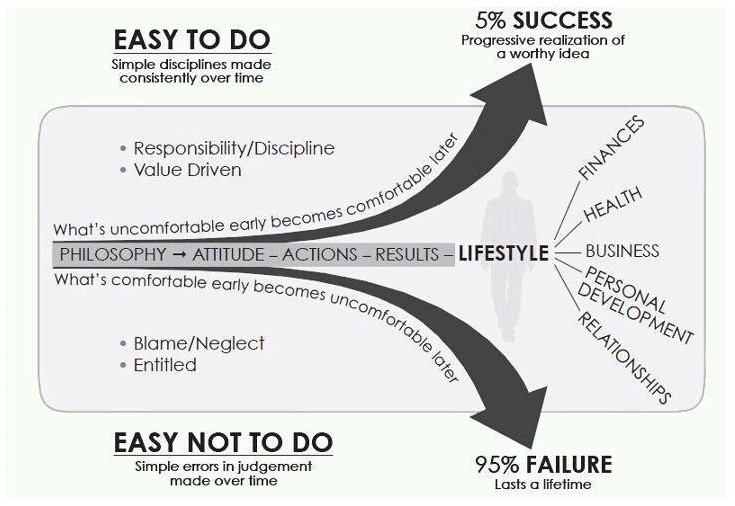
Naturally with speaking with a lot of businesses we hear a lot of information and comments about costs, investments, pricing information and a lot of other information that enables us to get a good feel for how a business perceives different items within their business and supply chain. There is an excellent book titled The Slight Edge by Jeff Olson, which if you haven’t read I’d urge you to go out and buy a copy now. The book can really be summarised by the image below;
Source: http://slightedgecommunity.com/blogs/12726/3614/beyond-the-12-steps-the-slight
And summarised further by a quote from Yoda in Star Wars;
“No. Try not. Do… or do not. There is no try.” – Yoda
The same is true in business. You either make the right decision, or the wrong decision, there is no middle ground. Many businesses often make the wrong decisions when it comes to their digital assets, but we’ve already talked about that quite a bit recently. Here I want you to take a bit of time and think about your business in a slightly different way than you do currently. Think critically about where you are now, where you want to get to and if the decisions that are being made are working towards these goals or away from them. As Yoda said, there is no try, you are either making strategic decisions daily which are working towards your goals or you are naturally moving away from your goals either by doing nothing or making the wrong decisions.
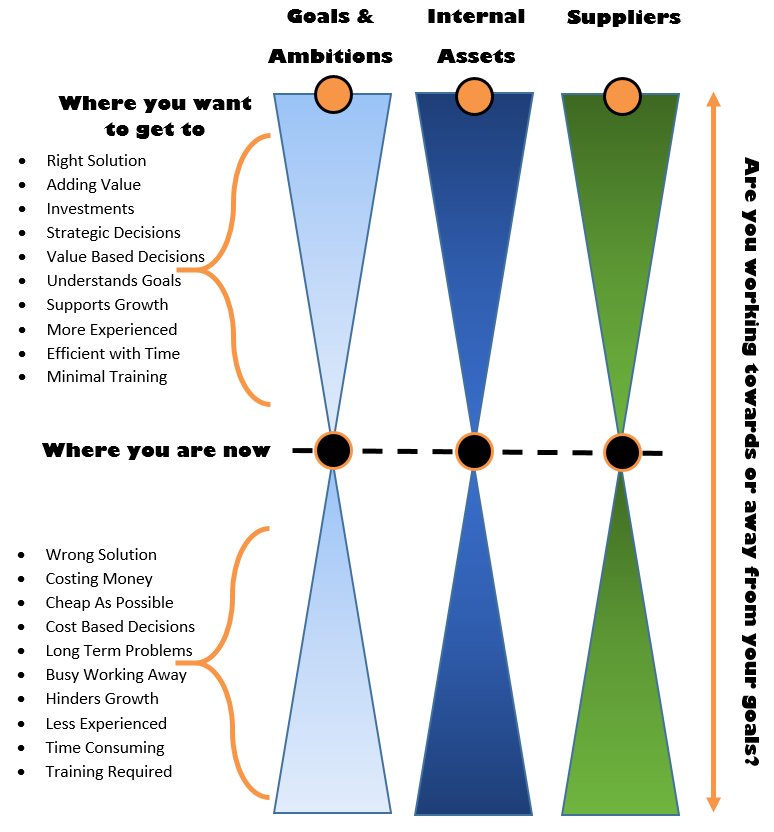
Markets are changing at a faster pace than ever before and as a business it is essential that you keep up to date with these changes to compete. There is an enormous cost of doing nothing within business as competitors are continually improving and markets are ever shifting. We’re not talking about significant innovation within your business, although this is absolutely essential and a topic for a future blog post, no, where talking about incremental improvements based on making strategic decisions that are going to move your business forward.
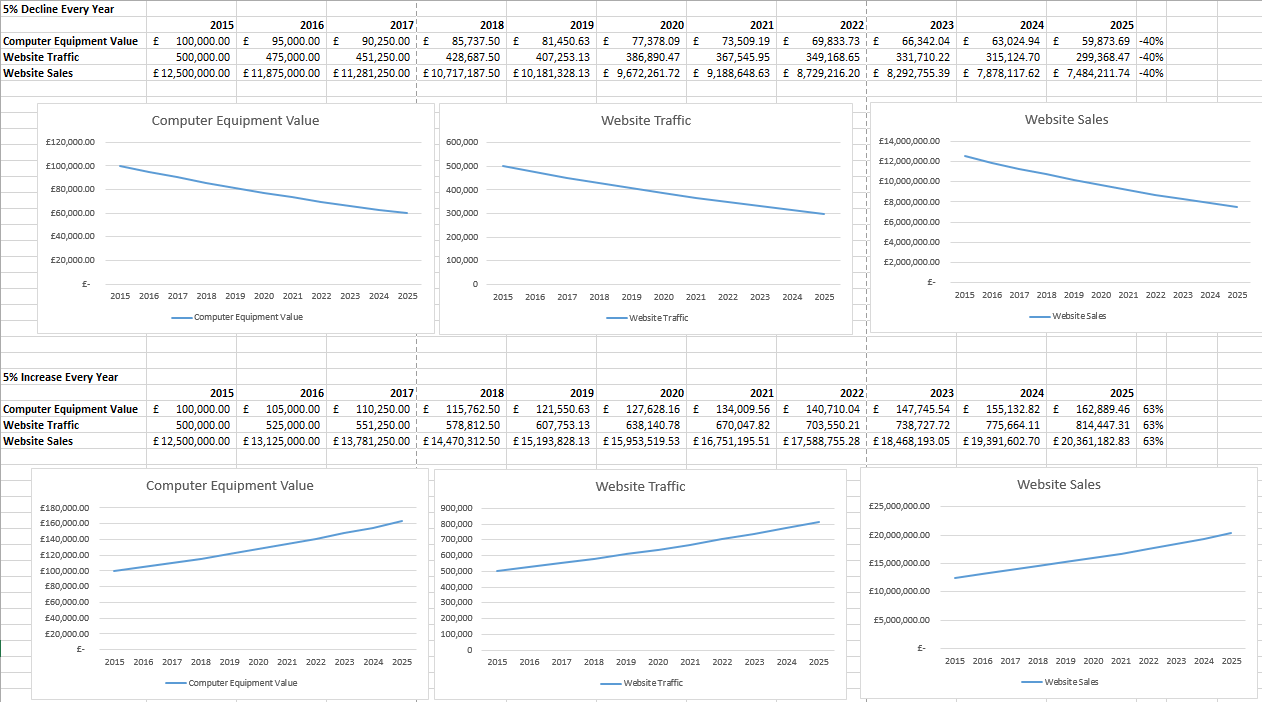
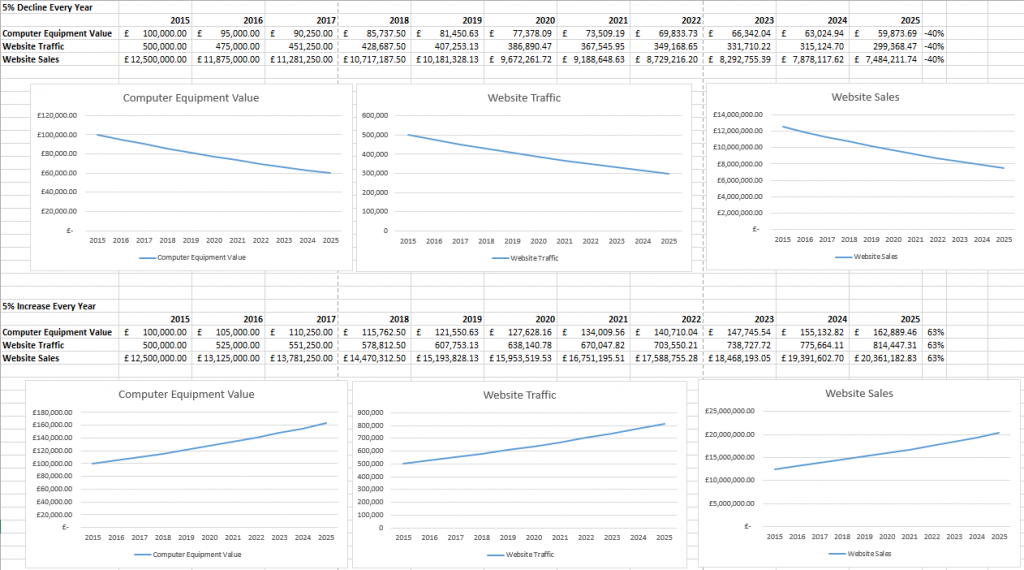
To put this into perspective, below are a few graphs showing the cost of doing nothing compared to the results of making the right decisions. The top graphs show a 5% decline year on year based on an ever more competitive market place, which you have failed to keep up with, and the bottom graph showing a 5% increase year on year based on making the right strategic decisions. The data is clear;
(click for larger graphs)
Remember, you are either actively improving your business in all aspects or you are falling behind. There is no middle ground of staying steady. Take some time and have a think about your business in a critical way for every aspect. And remember, we always have time for a coffee if you want to bounce a few ideas off us, we’re a friendly bunch and will always give you honest feedback and comments about your digital and technology choices whether this is what you want to hear or not. We like to work with businesses and help them along their journey to their goals and ambitions.
by Michael Cropper | Aug 14, 2015 | Thoughts |
Today I want you to have a think about your organisation and its suppliers in general, digital or otherwise. And ask yourself the question; are your suppliers costing you money or adding value to your business?
Naturally with speaking with a lot of businesses we hear a lot of information and comments about costs, investments, pricing information and a lot of other information that enables us to get a good feel for how a business perceives different items within their business and supply chain. There is an excellent book titled The Slight Edge by Jeff Olson, which if you haven’t read I’d urge you to go out and buy a copy now. The book can really be summarised by the image below;
Source: http://slightedgecommunity.com/blogs/12726/3614/beyond-the-12-steps-the-slight
And summarised further by a quote from Yoda in Star Wars;
“No. Try not. Do… or do not. There is no try.” – Yoda
The same is true in business. You either make the right decision, or the wrong decision, there is no middle ground. Many businesses often make the wrong decisions when it comes to their digital assets, but we’ve already talked about that quite a bit recently. Here I want you to take a bit of time and think about your business in a slightly different way than you do currently. Think critically about where you are now, where you want to get to and if the decisions that are being made are working towards these goals or away from them. As Yoda said, there is no try, you are either making strategic decisions daily which are working towards your goals or you are naturally moving away from your goals either by doing nothing or making the wrong decisions.
Markets are changing at a faster pace than ever before and as a business it is essential that you keep up to date with these changes to compete. There is an enormous cost of doing nothing within business as competitors are continually improving and markets are ever shifting. We’re not talking about significant innovation within your business, although this is absolutely essential and a topic for a future blog post, no, where talking about incremental improvements based on making strategic decisions that are going to move your business forward.
To put this into perspective, below are a few graphs showing the cost of doing nothing compared to the results of making the right decisions. The top graphs show a 5% decline year on year based on an ever more competitive market place, which you have failed to keep up with, and the bottom graph showing a 5% increase year on year based on making the right strategic decisions. The data is clear;
(click for larger graphs)
Remember, you are either actively improving your business in all aspects or you are falling behind. There is no middle ground of staying steady. Take some time and have a think about your business in a critical way for every aspect. And remember, we always have time for a coffee if you want to bounce a few ideas off us, we’re a friendly bunch and will always give you honest feedback and comments about your digital and technology choices whether this is what you want to hear or not. We like to work with businesses and help them along their journey to their goals and ambitions.