by Michael Cropper | May 2, 2014 | SEO |
Wow, wow and wow!! That’s right, we are in the finals for 4 separate categories for the Lancashire wide business awards, The Bibas 2014! This is such an amazing achievement within the short space of 9 months since officially launching.
The Be Inspired Business Awards is the largest business awards in Lancashire designed to showcase leading companies in Lancashire. This year there were over 1232 applications from 576 companies. Lancaster University Management School prepared the judges for the awards who undertook rigorous training. The research project from Lancaster University examined the world’s leading business awards to gain insight into how to judge the best companies. Based on this, they established a set of criteria to evaluate the large amount of applications to create a shortlist of excellent companies.
Dr Ellie Hamilton from Lancaster University Management School said;
“I promise you, if your business makes it to the interview stage, you have done very well indeed.”
The awards are being backed by leading companies including;
Here are the four award categories that we have been shortlisted for.
Creative Business of the Year
 Companies shortlisted for the finals of the Creative Business of the Year award category had to show how their creative expertise delivered innovative products and services to their clients. We showcased how we balance both creative and commercial development for projects with clients and the strategies we use to ensure both work in harmony.
We are a creative company and are always looking for new opportunities for our clients. Within the application for this category we had to explain how we nurture creativity within the business and how we achieve excellence as a company by providing solutions to our clients to suit their individual and unique needs. You may have seen earlier in the year, we became an official HootSuite Solutions Partner.
E-Business of the Year
We have been shortlisted in the finals for the E-Commerce Business of the Year. This category was open to businesses that have significantly grown their business or that of a client. This may be achieved through e-commerce, communications and mobile technologies.
As part of the application, we demonstrated how we have used the internet and technology in an innovative way to enhance commercial performance for our clients, and identified opportunities for growth.
Given the pace of change, it is a constant challenge to respond with meaningful actions and strategies for our clients. There have been several major changes within the digital industry that we have had to adapt to stay ahead since launching only 9 months ago.
We are always looking ahead at what the next big thing is going to be and we strongly believe that digital is on the verge of changing everyone’s lives in ways we can’t even imagine. With the rise of superfast broadband throughout the country along with physical computing and wearable devices gaining ground, this really is going to be an interesting time ahead.
New Business of the Year
Another award category we have been shortlisted for is the New Business of the Year award. This award was open to businesses that have been operating for less than 3 years.
We had to explain how we identified key opportunities within the digital and creative sector and innovations we have brought to the market. Since launching in 2013, we have grasped huge opportunities and continue to grow the business further.
Stay tuned for how this start-up company grows over the next few years!
Most Inspiring Business of the Year
Finally, we have also been nominated for the Most Inspiring Business of the Year award. This category wasn’t actually open for applications like the other awards.
Instead, the judges looked at the 1232 applications from all 576 companies and decided that we were a company worthy of the finals and one to watch for the future!
Wish us luck!!
by Michael Cropper | May 2, 2014 | News |
Wow, wow and wow!! That’s right, we are in the finals for 4 separate categories for the Lancashire wide business awards, The Bibas 2014! This is such an amazing achievement within the short space of 9 months since officially launching.
The Be Inspired Business Awards is the largest business awards in Lancashire designed to showcase leading companies in Lancashire. This year there were over 1232 applications from 576 companies. Lancaster University Management School prepared the judges for the awards who undertook rigorous training. The research project from Lancaster University examined the world’s leading business awards to gain insight into how to judge the best companies. Based on this, they established a set of criteria to evaluate the large amount of applications to create a shortlist of excellent companies.
Dr Ellie Hamilton from Lancaster University Management School said;
“I promise you, if your business makes it to the interview stage, you have done very well indeed.”
The awards are being backed by leading companies including;
Here are the four award categories that we have been shortlisted for.
Creative Business of the Year
Companies shortlisted for the finals of the Creative Business of the Year award category had to show how their creative expertise delivered innovative products and services to their clients. We showcased how we balance both creative and commercial development for projects with clients and the strategies we use to ensure both work in harmony.
We are a creative company and are always looking for new opportunities for our clients. Within the application for this category we had to explain how we nurture creativity within the business and how we achieve excellence as a company by providing solutions to our clients to suit their individual and unique needs. You may have seen earlier in the year, we became an official HootSuite Solutions Partner.
E-Business of the Year
We have been shortlisted in the finals for the E-Commerce Business of the Year. This category was open to businesses that have significantly grown their business or that of a client. This may be achieved through e-commerce, communications and mobile technologies.
As part of the application, we demonstrated how we have used the internet and technology in an innovative way to enhance commercial performance for our clients, and identified opportunities for growth.
Given the pace of change, it is a constant challenge to respond with meaningful actions and strategies for our clients. There have been several major changes within the digital industry that we have had to adapt to stay ahead since launching only 9 months ago.
We are always looking ahead at what the next big thing is going to be and we strongly believe that digital is on the verge of changing everyone’s lives in ways we can’t even imagine. With the rise of superfast broadband throughout the country along with physical computing and wearable devices gaining ground, this really is going to be an interesting time ahead.
New Business of the Year
Another award category we have been shortlisted for is the New Business of the Year award. This award was open to businesses that have been operating for less than 3 years.
We had to explain how we identified key opportunities within the digital and creative sector and innovations we have brought to the market. Since launching in 2013, we have grasped huge opportunities and continue to grow the business further.
Stay tuned for how this start-up company grows over the next few years!
Most Inspiring Business of the Year
Finally, we have also been nominated for the Most Inspiring Business of the Year award. This category wasn’t actually open for applications like the other awards.
Instead, the judges looked at the 1232 applications from all 576 companies and decided that we were a company worthy of the finals and one to watch for the future!
Wish us luck!!
by Michael Cropper | Mar 14, 2014 | News |
We are really pleased to announce that we have got through to the finals in the Prolific North Awards 2014 within the SEO & PPC Agency category. This has come from achieving outstanding results with our clients, driving huge increases in traffic and sales through their websites.
The Prolific North Awards celebrate excellence, recognise leading companies and reward outstanding campaigns and exceptional talent in the creative and media industries across the North of England. The Search Engine Optimisation & Pay per Click Agency category is for companies who demonstrate consistently high standards of work, have identified and exploited new markets, income streams and opportunities for clients along with demonstrating exceptional search results for Search Engine Optimisation campaigns.

SEO & PPC Agency category
Find out more about the awards and see who we are up against. We’re up against some much larger and well established companies with over 250 members of staff, which is a significant achievement and huge recognition for us within our first year of trading. We have also recently been shortlisted in the finals in the prestigious Lancashire Red Rose Awards.
The judging panel for the Prolific North Awards 2014 include Andy Barke the Industry Head at Google UK, Russ Brady the Group Head of Public Relations at The Co-operative, Leanne Buchan the Culture & Sport City Development Directorate at Leeds City Council, Mark Dickinson the Chairman at Prolific North, Dave Edmundson-Bird the Principle Lecturer for Digital Marketing & Enterprise at MMU Business School, Richard Frediani the Programme Editor at ITN, Jim Hancock a Journalist & Presenter, Dee Marshall the Director of Communications at Welcome to Yorkshire, Neil Roscoe the Communications Officer at Jaguar Land Rover, Sally Sykes the Executive Director for External Affairs & Strategy at the Parliamentary & Health Service Ombudsman plus many more.
by Michael Cropper | Mar 14, 2014 | SEO |
We are really pleased to announce that we have got through to the finals in the Prolific North Awards 2014 within the SEO & PPC Agency category. This has come from achieving outstanding results with our clients, driving huge increases in traffic and sales through their websites.
The Prolific North Awards celebrate excellence, recognise leading companies and reward outstanding campaigns and exceptional talent in the creative and media industries across the North of England. The Search Engine Optimisation & Pay per Click Agency category is for companies who demonstrate consistently high standards of work, have identified and exploited new markets, income streams and opportunities for clients along with demonstrating exceptional search results for Search Engine Optimisation campaigns.
SEO & PPC Agency category
Find out more about the awards and see who we are up against. We’re up against some much larger and well established companies with over 250 members of staff, which is a significant achievement and huge recognition for us within our first year of trading. We have also recently been shortlisted in the finals in the prestigious Lancashire Red Rose Awards.
The judging panel for the Prolific North Awards 2014 include Andy Barke the Industry Head at Google UK, Russ Brady the Group Head of Public Relations at The Co-operative, Leanne Buchan the Culture & Sport City Development Directorate at Leeds City Council, Mark Dickinson the Chairman at Prolific North, Dave Edmundson-Bird the Principle Lecturer for Digital Marketing & Enterprise at MMU Business School, Richard Frediani the Programme Editor at ITN, Jim Hancock a Journalist & Presenter, Dee Marshall the Director of Communications at Welcome to Yorkshire, Neil Roscoe the Communications Officer at Jaguar Land Rover, Sally Sykes the Executive Director for External Affairs & Strategy at the Parliamentary & Health Service Ombudsman plus many more.
by Michael Cropper | Feb 18, 2014 | SEO |
You may have heard recently that the internet is about to change, in a big way, with the launch of new top level domains. While I’m sure this is exciting news for people working in the digital industry, it may not mean much to people who are busy running their businesses. Once you have read over the blog post, you will understand what this change is all about and learn what this means for your business.
What are top level domains?
Firstly, let’s take a step back and ask what a top level domain is. The way the internet works is all powered by top level domains, we’ll leave all the really geeky bits for another post. The best way of understanding this is to look at a few different domains. Below highlights which part of the domain name is the top level bit;
- www.contradodigital.com
- www.google.co.uk
- www.number10.gov.uk
- www.facebook.com
- www.twitter.com
Hopefully it is clear to see above that the top level domain can be classified as ‘the last bit’ in layman terms. Following on from this, there are two basic categories of top level domains which are either Generic Top Level Domains (gTLDs for short) and Country Code Top Level Domains (ccTLDs for short).
A Generic Top Level Domain is one that doesn’t relate to a specific country, whereas a Country Code Top Level Domain is one that does relate to a specific country. If you want to see all of the different top level domains that are available, the best resource for this is to look through the official 362 top level domains within the Root Zone Database from IANA (the people who manage all this).
Ok, so what has all of this got to do with the new top level domains that are being launched? Well, in summary, everything. Currently the way domain names are structured is nice, simple(ish) and internet users are familiar with the setup.
What is changing?
Previously, the top level domains were restricted and new ones rarely got announced which made things easy for users. If a user knew the brand in a certain country but didn’t know the domain, it was likely to be www.brand.co.uk or www.brand.com for example.
The change that is happening now is that companies can apply to own new top level domains of their choosing which means the web could become a little bit like the wild west with domains appearing such as;
- www.contrado.digital
- http://michael-cropper.facebook
- www.google.search
- www.your-brand.shop
- www.bob.plumbers
The possibilities are endless, which creates a lot of confusion for people using the internet. What domain names are trust worthy? Which ones are official sources? As a business, do I need to secure all possibilities to protect my brand? This change raises a lot of questions. Not only this, but the rollout has started to happen with the following 35 new top level domains being announced within the past few months alone. For those of you good at maths, you will notice this is an almost 10% increase for the number of top level domains available….within the space of a few months! Below are the domains that have been announced to date;
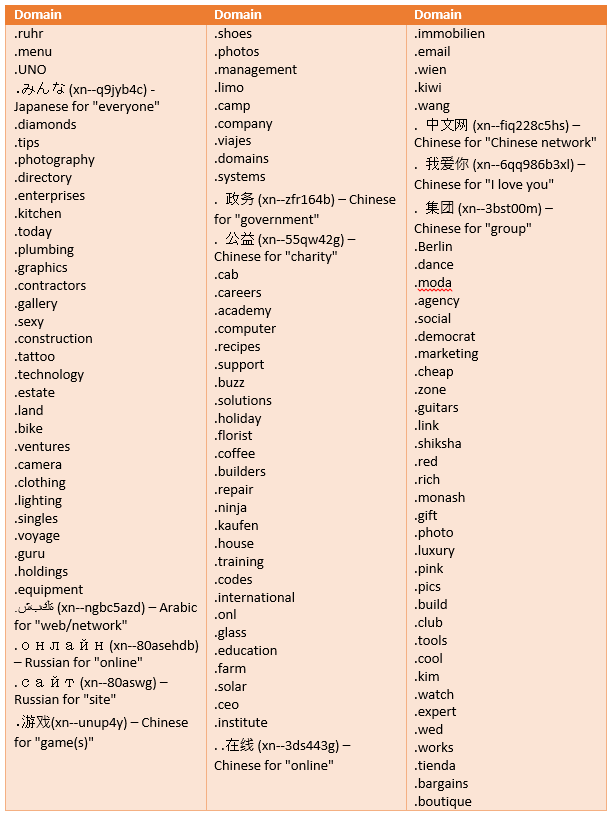
New Top Level Domains Announced To Date
Wow!
What is the reasoning behind the new top level domains?
Ok, so let’s take a step back again and look at why this change has happened. Again, without going too technical, a domain name is basically a signpost to a web server which runs a website. Imagine it in a similar way to your address is a signpost to a lat-long location as a nice comparison;
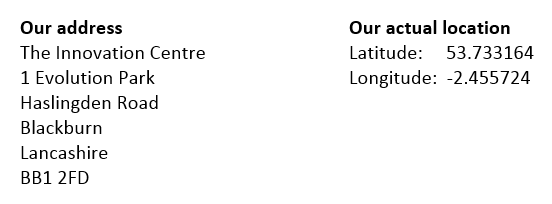
One of these above is a little easier to remember for people, while the other isn’t. This is the same as with domain names. Domain names are a user friendly way or referring to an IP address.
The graph below shows the growth for how many domains there are registered under the .uk top level domain which continues to grow around 5-10% per year and is currently almost at the 12 million mark;
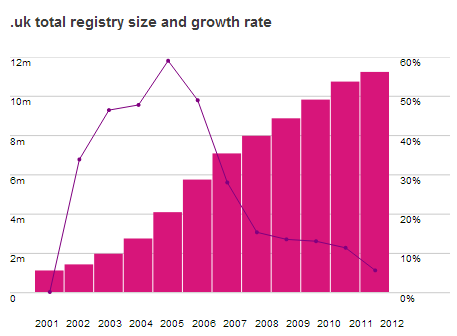
UK Top Level Domain Registry Size and Growth Rate
With almost an additional 2 million domain names registered under .co.uk in 2012 alone, this figure is likely to be similar again throughout 2013 and 2014;
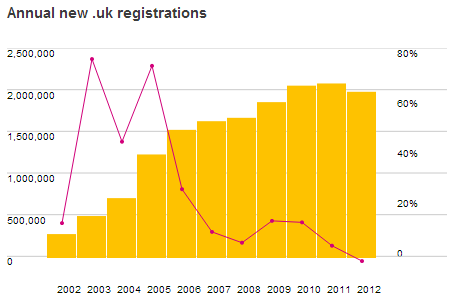
Annual New UK Domain Name Registrations
I’m sure that when you look at the graphs above it is clear why something had to be done. It’s because the memorable names are getting harder and harder to find for businesses starting up and looking to expand. If you want to look at buying a memorable domain name from someone, then you better get your cheque book ready as they don’t come cheap;
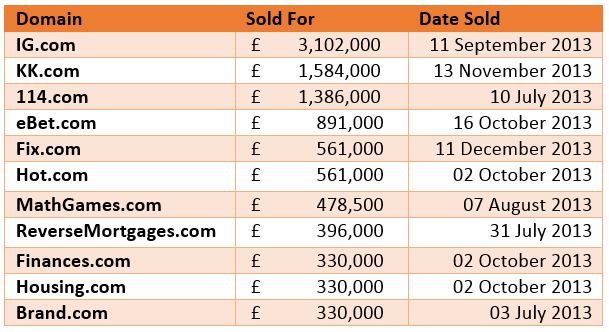
Cost for Premium Domains
Source: Domain Names Journal
Certainly not cheap for a memorable domain name. Hence one of the reasons for the change.
What does this mean for marketers and businesses?
The way domains were categorised was nice, it gave a bit of order to the web and helped users. New top level domains change everything.
Imagine;
This change has the potential to re-categorise how domains are used as availability increases throughout 2014 and beyond, especially as digital marketing agencies create innovative campaigns around the new domain names that become available. This is something to keep a close eye on as things develop which will give you a better understanding of any opportunities that come from this change.
If you are a large brand, then maybe this is something you want to think about registering to protect your brand. Looking through the list of almost 2000 applications, there are some large brands who have jumped on this opportunity. Some of the more notable branded top level domains include the following, and I’m guessing you can imagine who they could be owned by if their application goes through;

Brands with Top Level Domains (Click for full image)
One item to note is that just because a brand has applied for the domain name, doesn’t necessarily mean that they will be successful. It is an application process which can be challenged by other brands, so watch this space.
Do you want to register a new top level domain?
Then be prepared to go through a lengthy process and be aware that simply applying, not purchasing, will set you back a staggering $185,000 per application which is classified as a ‘gTLD Evaluation Fee’. If you are looking to go through the process of registering a new generic top level domain then follow all of the guidelines outlined on the website.
How to register a sub-domain from a new generic top level domain?
Ok, so let’s say you aren’t quite ready to splash out on your own generic top level domain, but would still like to use it in a way such as http://higfy.bbc then how would you go about purchasing this domain? At the minute, we will have to wait and see how registrars handle this, so your best bet at the minute it to contact your current registrar and speak with them about this. The availability all comes down to who owns the top level domain and if they are willing to share the love, or not.
For example the BBC aren’t likely to allow me to purchase my own http://michael.bbc, instead they are going to be more interested in using this for their own shows in some way. So keep an eye out for how your registrar is going to be making these available over time. The individual costs for these will depend on how much the owner of the new generic top level domain wants to charge.
Notable Locations
So moving away from brands and towards locations, what are the main location based generic top level domains which have been applied for?

Locations with Top Level Domains (Click for larger image)
This again will be interesting to see how these location based generic top level domains are used. Are they really that different than the abbreviated versions we have and use today though? Could they become trendier to have? Could they simply add more domains to the location in addition to the current setup? Who knows, but what we do know is that it is going to be an exciting time to see how these are used.
What about Google?
Where would we be without Google? And what is Google doing in this space? I’m sure it will come as no surprise to you here as Google has applied for a staggering 101 new generic top level domains which include the following (non-English ones excluded from this list);
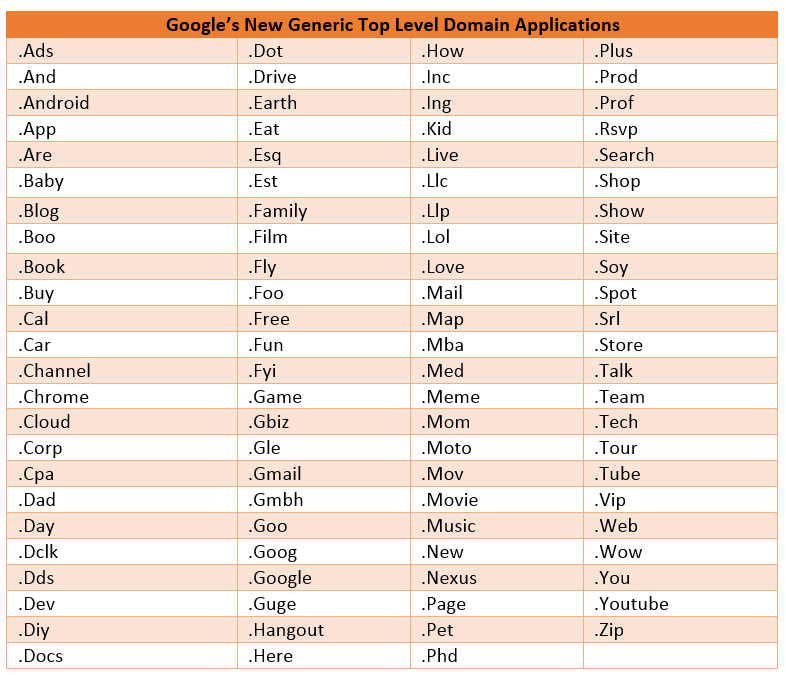
Google’s New Top Level Domain Names
Interesting that “.Live” is in the list above. Hmm. I think Microsoft may have a couple of concerns about that one….
Will Google treat new domain names differently with Search Engine Optimisation
In summary, probably not. Google has always stayed away from strict groupings in the traditional sense as different people can own different domain names on different generic top level domains. For example, a .co.uk domain can be owned by a valid UK based business, or a spammer. So it is not a valid signal to simply look at that and come to a conclusion on its own.
That said, does a new branded generic top level domain signify that you are a well-recognised brand? Maybe. Google hasn’t released any official guidelines on this at present as this is still really early days, so subscribe to our newsletter and follow us socially to stay up to date when this does happen as we will be informing you of the changes.
What about your current domain?
Should you be planning to move over to a new generic top level domain? Or should you run two separately? Or more? Well, this all comes down to how you want to be presenting your brand to the world. Careful consideration needs to be taken during any domain migration as it is a significant business decision that needs to be backed up with marketing collateral and campaigns, which have their own costs associated with them.
Our recommendations here would be to see how things play out. If you are a large domain and this is extremely important to you, then you may want to think about applying for your own branded generic top level domain.
Overall
Overall I’m sure you’ll agree that this is an enormous change to the internet and how brands and consumers are going to view and consume content on the web. This is clearly something that is going to take time to settle down and the applications have only allowed through around 30 new generic top level domains to date, so it may take a while to review all 2000 applications that are currently in the queue.
Stay tuned and watch this space! Do you have any thoughts on these changes? How do you think they will impact users and brands? Leave your comments and thoughts below.
by Michael Cropper | Feb 18, 2014 | SEO |
You may have heard recently that the internet is about to change, in a big way, with the launch of new top level domains. While I’m sure this is exciting news for people working in the digital industry, it may not mean much to people who are busy running their businesses. Once you have read over the blog post, you will understand what this change is all about and learn what this means for your business.
What are top level domains?
Firstly, let’s take a step back and ask what a top level domain is. The way the internet works is all powered by top level domains, we’ll leave all the really geeky bits for another post. The best way of understanding this is to look at a few different domains. Below highlights which part of the domain name is the top level bit;
- www.contradodigital.com
- www.google.co.uk
- www.number10.gov.uk
- www.facebook.com
- www.twitter.com
Hopefully it is clear to see above that the top level domain can be classified as ‘the last bit’ in layman terms. Following on from this, there are two basic categories of top level domains which are either Generic Top Level Domains (gTLDs for short) and Country Code Top Level Domains (ccTLDs for short).
A Generic Top Level Domain is one that doesn’t relate to a specific country, whereas a Country Code Top Level Domain is one that does relate to a specific country. If you want to see all of the different top level domains that are available, the best resource for this is to look through the official 362 top level domains within the Root Zone Database from IANA (the people who manage all this).
Ok, so what has all of this got to do with the new top level domains that are being launched? Well, in summary, everything. Currently the way domain names are structured is nice, simple(ish) and internet users are familiar with the setup.
What is changing?
Previously, the top level domains were restricted and new ones rarely got announced which made things easy for users. If a user knew the brand in a certain country but didn’t know the domain, it was likely to be www.brand.co.uk or www.brand.com for example.
The change that is happening now is that companies can apply to own new top level domains of their choosing which means the web could become a little bit like the wild west with domains appearing such as;
- www.contrado.digital
- http://michael-cropper.facebook
- www.google.search
- www.your-brand.shop
- www.bob.plumbers
The possibilities are endless, which creates a lot of confusion for people using the internet. What domain names are trust worthy? Which ones are official sources? As a business, do I need to secure all possibilities to protect my brand? This change raises a lot of questions. Not only this, but the rollout has started to happen with the following 35 new top level domains being announced within the past few months alone. For those of you good at maths, you will notice this is an almost 10% increase for the number of top level domains available….within the space of a few months! Below are the domains that have been announced to date;
New Top Level Domains Announced To Date
Wow!
What is the reasoning behind the new top level domains?
Ok, so let’s take a step back again and look at why this change has happened. Again, without going too technical, a domain name is basically a signpost to a web server which runs a website. Imagine it in a similar way to your address is a signpost to a lat-long location as a nice comparison;
One of these above is a little easier to remember for people, while the other isn’t. This is the same as with domain names. Domain names are a user friendly way or referring to an IP address.
The graph below shows the growth for how many domains there are registered under the .uk top level domain which continues to grow around 5-10% per year and is currently almost at the 12 million mark;
UK Top Level Domain Registry Size and Growth Rate
With almost an additional 2 million domain names registered under .co.uk in 2012 alone, this figure is likely to be similar again throughout 2013 and 2014;
Annual New UK Domain Name Registrations
I’m sure that when you look at the graphs above it is clear why something had to be done. It’s because the memorable names are getting harder and harder to find for businesses starting up and looking to expand. If you want to look at buying a memorable domain name from someone, then you better get your cheque book ready as they don’t come cheap;
Cost for Premium Domains
Source: Domain Names Journal
Certainly not cheap for a memorable domain name. Hence one of the reasons for the change.
What does this mean for marketers and businesses?
The way domains were categorised was nice, it gave a bit of order to the web and helped users. New top level domains change everything.
Imagine;
This change has the potential to re-categorise how domains are used as availability increases throughout 2014 and beyond, especially as digital marketing agencies create innovative campaigns around the new domain names that become available. This is something to keep a close eye on as things develop which will give you a better understanding of any opportunities that come from this change.
If you are a large brand, then maybe this is something you want to think about registering to protect your brand. Looking through the list of almost 2000 applications, there are some large brands who have jumped on this opportunity. Some of the more notable branded top level domains include the following, and I’m guessing you can imagine who they could be owned by if their application goes through;
Brands with Top Level Domains (Click for full image)
One item to note is that just because a brand has applied for the domain name, doesn’t necessarily mean that they will be successful. It is an application process which can be challenged by other brands, so watch this space.
Do you want to register a new top level domain?
Then be prepared to go through a lengthy process and be aware that simply applying, not purchasing, will set you back a staggering $185,000 per application which is classified as a ‘gTLD Evaluation Fee’. If you are looking to go through the process of registering a new generic top level domain then follow all of the guidelines outlined on the website.
How to register a sub-domain from a new generic top level domain?
Ok, so let’s say you aren’t quite ready to splash out on your own generic top level domain, but would still like to use it in a way such as http://higfy.bbc then how would you go about purchasing this domain? At the minute, we will have to wait and see how registrars handle this, so your best bet at the minute it to contact your current registrar and speak with them about this. The availability all comes down to who owns the top level domain and if they are willing to share the love, or not.
For example the BBC aren’t likely to allow me to purchase my own http://michael.bbc, instead they are going to be more interested in using this for their own shows in some way. So keep an eye out for how your registrar is going to be making these available over time. The individual costs for these will depend on how much the owner of the new generic top level domain wants to charge.
Notable Locations
So moving away from brands and towards locations, what are the main location based generic top level domains which have been applied for?
Locations with Top Level Domains (Click for larger image)
This again will be interesting to see how these location based generic top level domains are used. Are they really that different than the abbreviated versions we have and use today though? Could they become trendier to have? Could they simply add more domains to the location in addition to the current setup? Who knows, but what we do know is that it is going to be an exciting time to see how these are used.
What about Google?
Where would we be without Google? And what is Google doing in this space? I’m sure it will come as no surprise to you here as Google has applied for a staggering 101 new generic top level domains which include the following (non-English ones excluded from this list);
Google’s New Top Level Domain Names
Interesting that “.Live” is in the list above. Hmm. I think Microsoft may have a couple of concerns about that one….
Will Google treat new domain names differently with Search Engine Optimisation
In summary, probably not. Google has always stayed away from strict groupings in the traditional sense as different people can own different domain names on different generic top level domains. For example, a .co.uk domain can be owned by a valid UK based business, or a spammer. So it is not a valid signal to simply look at that and come to a conclusion on its own.
That said, does a new branded generic top level domain signify that you are a well-recognised brand? Maybe. Google hasn’t released any official guidelines on this at present as this is still really early days, so subscribe to our newsletter and follow us socially to stay up to date when this does happen as we will be informing you of the changes.
What about your current domain?
Should you be planning to move over to a new generic top level domain? Or should you run two separately? Or more? Well, this all comes down to how you want to be presenting your brand to the world. Careful consideration needs to be taken during any domain migration as it is a significant business decision that needs to be backed up with marketing collateral and campaigns, which have their own costs associated with them.
Our recommendations here would be to see how things play out. If you are a large domain and this is extremely important to you, then you may want to think about applying for your own branded generic top level domain.
Overall
Overall I’m sure you’ll agree that this is an enormous change to the internet and how brands and consumers are going to view and consume content on the web. This is clearly something that is going to take time to settle down and the applications have only allowed through around 30 new generic top level domains to date, so it may take a while to review all 2000 applications that are currently in the queue.
Stay tuned and watch this space! Do you have any thoughts on these changes? How do you think they will impact users and brands? Leave your comments and thoughts below.
by Michael Cropper | Feb 5, 2014 | SEO |
We are really excited to announce that we have got through to the finals in Lancashire’s most prestigious business awards, The Red Rose Awards within the Ecommerce category. This has come from achieving outstanding results with our clients, driving huge increases in traffic and sales through their websites.
To see the full list of finalists, head over to the Red Rose Awards website.
by Michael Cropper | Feb 5, 2014 | News |
We are really excited to announce that we have got through to the finals in Lancashire’s most prestigious business awards, The Red Rose Awards within the Ecommerce category. This has come from achieving outstanding results with our clients, driving huge increases in traffic and sales through their websites.
To see the full list of finalists, head over to the Red Rose Awards website.
by Michael Cropper | Jan 28, 2014 | SEO |
We are really pleased to announce that we are now an official HootSuite Solution Partner!


We believe social media is an integral part of any digital marketing strategy which is why we have become a HootSuite Solution Partner. This enables us to offer a best in class service for our clients with social media strategy and management to help your business grow online.
HootSuite is a social media management system for businesses and organizations to collaboratively execute campaigns across multiple social networks from one secure, web-based dashboard. Key social network integrations include Facebook, Twitter, LinkedIn, and Google+, plus a suite of social content apps for YouTube, Flickr, Instagram, Yammer, Tumblr and more.
In 2013 HootSuite surpassed 8 million users, including 750 of the Fortune 1000 companies. HootSuite is quite simply an extremely powerful tool that allows you to manage your social media channels effectively, leaving you more time to spend on creating some awesome content for your business.
Sign up for a 30-day free trial of HootSuite Pro now and see how valuable this tool can be within your business.
In addition to Contrado Digital becoming an official HootSuite Solution Partner, I have also passed all exams and become a Certified HootSuite Professional, so we are well placed to help with all your social media strategy needs. Get in touch if you would like to find out more about how we can help your business utilise HootSuite and the many social media platforms available.

Michael Cropper, HootSuite Certified Professional
We are now officially launching our social media strategy service to help grow business take advantage of one of the fastest growing channels in digital marketing. Finally, to celebrate we are already tucking into the delicious cake you can see below;

Contrado Digital HootSuite Solutions Partner
Om nom nom!
by Michael Cropper | Jan 28, 2014 | Digital Marketing, News |
We are really pleased to announce that we are now an official HootSuite Solution Partner!
We believe social media is an integral part of any digital marketing strategy which is why we have become a HootSuite Solution Partner. This enables us to offer a best in class service for our clients with social media strategy and management to help your business grow online.
HootSuite is a social media management system for businesses and organizations to collaboratively execute campaigns across multiple social networks from one secure, web-based dashboard. Key social network integrations include Facebook, Twitter, LinkedIn, and Google+, plus a suite of social content apps for YouTube, Flickr, Instagram, Yammer, Tumblr and more.
In 2013 HootSuite surpassed 8 million users, including 750 of the Fortune 1000 companies. HootSuite is quite simply an extremely powerful tool that allows you to manage your social media channels effectively, leaving you more time to spend on creating some awesome content for your business.
Sign up for a 30-day free trial of HootSuite Pro now and see how valuable this tool can be within your business.
In addition to Contrado Digital becoming an official HootSuite Solution Partner, I have also passed all exams and become a Certified HootSuite Professional, so we are well placed to help with all your social media strategy needs. Get in touch if you would like to find out more about how we can help your business utilise HootSuite and the many social media platforms available.
Michael Cropper, HootSuite Certified Professional
We are now officially launching our social media strategy service to help grow business take advantage of one of the fastest growing channels in digital marketing. Finally, to celebrate we are already tucking into the delicious cake you can see below;
Contrado Digital HootSuite Solutions Partner
Om nom nom!