by Michael Cropper | Feb 9, 2017 | Client Friendly, Security, WordPress |
Google Search Console, formerly called Google Webmaster Tools, has started to inform WordPress website owners when security updates are available. This is a great effort by Google to help website owners and businesses keep their websites safe and secure with regular WordPress security maintenance.
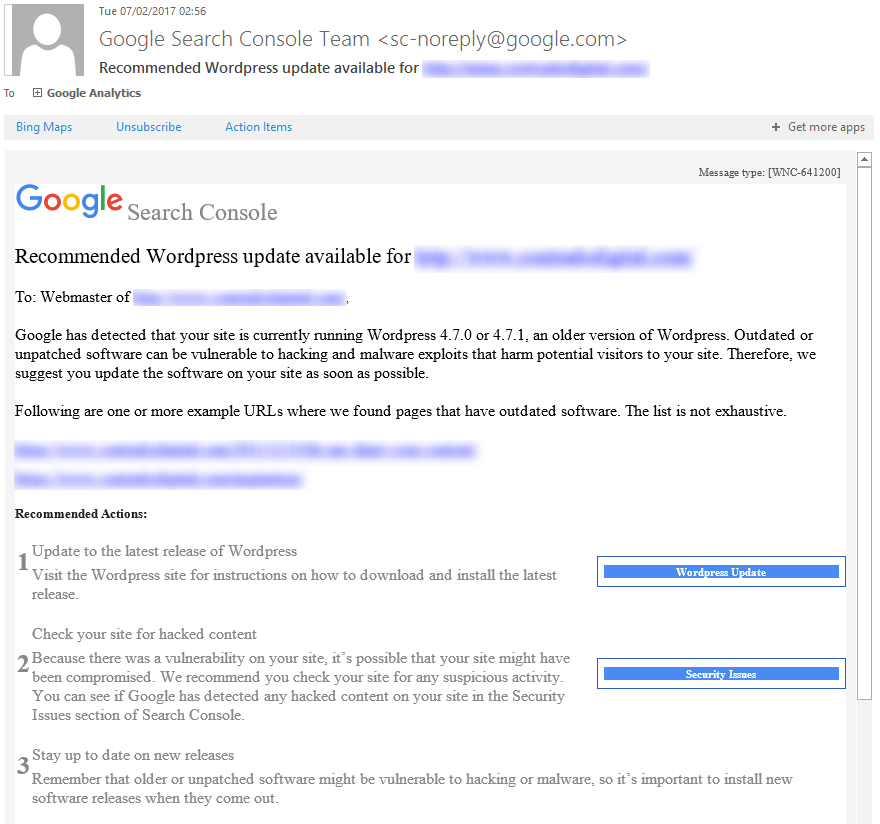
While this is a great step forward, as a business owner you must not wait until you see these kinds of messages from Google until you take action to update your WordPress website. These messages are purely focused at the WordPress Core files, which is only a small part of WordPress security. If you think of security like you would with a building, imagine WordPress Core files being your front door. Just because your front door is locked, it doesn’t mean that you haven’t left your windows, back doors, side doors and garage unlocked and open. It is the same concept with WordPress security. You must be taking proactive measures to protect your website against hackers.
If you aren’t sure how to go about dealing with WordPress security, then fear not, drop us an email and we can talk you through the options available.

by Michael Cropper | Feb 9, 2017 | Client Friendly, Security, WordPress |
WordPress 4.7.2 is now available. This is a security release for all previous versions and we strongly encourage you to update your sites immediately. If you are unsure how to deal with WordPress security updates, get in touch and we can manage your WordPress security updates for you.
WordPress versions 4.7.1 and earlier are affected by three security issues:
- The user interface for assigning taxonomy terms in Press This is shown to users who do not have permissions to use it. Reported by David Herrera of Alley Interactive.
WP_Query is vulnerable to a SQL injection (SQLi) when passing unsafe data. WordPress core is not directly vulnerable to this issue, but we’ve added hardening to prevent plugins and themes from accidentally causing a vulnerability. Reported by Mo Jangda (batmoo).- A cross-site scripting (XSS) vulnerability was discovered in the posts list table. Reported by Ian Dunn of the WordPress Security Team.
- An unauthenticated privilege escalation vulnerability was discovered in a REST API endpoint. Reported by Marc-Alexandre Montpas of Sucuri Security. *
Thank you to the reporters of these issues for practicing responsible disclosure.
Download WordPress 4.7.2 or venture over to Dashboard → Updates and simply click “Update Now.” Sites that support automatic background updates are already beginning to update to WordPress 4.7.2.
Thanks to everyone who contributed to 4.7.2.
* Update: An additional serious vulnerability was fixed in this release and public disclosure was delayed. For more information on this vulnerability, additional mitigation steps taken, and an explanation for why disclosure was delayed, please read Disclosure of Additional Security Fix in WordPress 4.7.2.
by Michael Cropper | Dec 3, 2016 | Developer |
This can be a fun one to deal with, particularly when working with scalable web applications. To keep things simple, remember that according to the W3C standards, the ID attribute on any element on a page should always be unique. This enables you to refer to this specific element whenever you want which is handy. This is perfect on simple web applications as you can just name everything as you wish. When working with scalable web applications, this becomes a little more challenging. Let’s keep things simple and use Twitter as an example. At any one point in time when a user searches for “Show me Twitter Accounts Matching ‘Michael'” for example. This will return an unknown number of results and the front end will loop through each of these accordingly. As part of this process, you are going to want to add relevant actions to each of the user accounts, such as Follow Account or Unfollow Account etc. Most scalable web applications these days will use jQuery to perform these kinds of actions on the front end which is perfect as within jQuery you can update the page content when a user does something such as clicking a button. And here’s the snag, the way all of this works is on the ID attribute for the relevant element.
So we need to implement a bit of clever technology to deal with unknown IDs to firstly identify the relevant ID that has been clicked, for example, and then use that ID to update something based on what the user has done. Let’s break this code down and provide a working example for how to do this;
$(document).ready(function () {
       //This line of code is telling jQuery to handle any actions when a user Clicks on an element
       //that has an ID attribute which starts with 'api-follow-button', i.e. 'api-follow-button-user-account-id-123'

       $(document).on('click', '[id^="api-follow-button"]', function followButton(e) {

                //This line of code prevents the element performing its default action, such as a link being clicked for example
                e.preventDefault();

                //This line below ensures that you can then use the ID selector to update the relevant part of the HTML as needed
                //This code is identifying the full ID attribute for the element that has been clicked
                var buttonID = $(this).attr("id");

                var buttonText = "Unfollow";
                var currentState = "Following";

                //Update Links
                //This line of code is allowing you to use a Variable in JavaScript to update the element using jQuery
                $("button[id=" + buttonID + "]")
                        .html(buttonText)
                        .attr("currentState", currentState);
       });
});
by Michael Cropper | Nov 29, 2016 | Client Friendly, Thoughts |
This is a question that has been bugging me for a while, and you know what, I still don’t have the answer to this fully. You see, working with technology and user experience on a daily basis while improving digital platforms for companies, I can’t help but get used to continually improving all aspects of a business. Yet when I look around at most companies, I see the same old companies doing the same old things time and time again, often getting busier and busier without being more efficient or growing. Now here’s the thing, it is not like there is a barrier to entry to using technology throughout a business. Costs have come down quite considerably over the last few years and there is now more than ever an enormous pool of digital expertise to tap into. Albeit, there is a hugely varying quality of digital expertise, but there is a lot available never the less. So why is it that companies fail to innovate?
I decided to write this blog post after seeing another “Look at how amazing our new website is, let us know what you think…” post on LinkedIn by a proud owner of a business. So I decided to chip in. The site was WordPress based, so far so good. Then it all kind of went to the usual problems, not using Child Themes and not using HTTPS, both of which are an absolute minimum when building WordPress websites. Yet still, the business owner shrugged off the feedback stating that they are working with a “world leading company, I’m sure they know what they are doing”. And in this case, I can honestly only say that this is purely ignorance that is leading this particular company not to innovate. Look, I’m not saying that building a website is in any way innovative, but it does tell you a lot about a company based on the way their website is built. Firstly, in this instance I can tell you that this website was put together on the cheap in an “all fur coat and no knickers” type of way. I see this a lot, and we generally work with companies around 2-3 years after they have gone down this route and realised that it doesn’t work. And what that tells me about companies who go down this approach is that they are still very much in the mindset of cost over value. Purchasing anything based on cost is a losing battle and one that will cause you no ends of problems in the long run, businesses who eventually realise this start to enormously innovate throughout their organisation which starts them on a path to significant growth as an organisation.
This is by no means a lone example though. I’d argue that most organisations fail to innovate throughout their organisation. And this is not because the innovative technology, processes or systems are either not available or expensive. I’d argue that it is because people are so busy doing what they have always done or busy talking about how busy they are that they fail to realise the opportunity that sits right next to them as a solution to their many problems. This clearly is not a technology problem, it is a people problem. It is the decisions that people make on a day to day and minute by minute basis which prevent their own organisation from innovating by keeping their self busy doing the same old same old. This is by no means a unique situation though, this is what is known as the productivity problem in the UK and something which the UK government is looking at as a priority to grow the economy. Businesses need to step up and as what one minister said “Stop being lazy”.
For anyone who is too busy to look at new opportunities, I wish you well, but for those smart enough to stop and take 5 minutes to look at new opportunities, you will be amazed about what is available when you open your mind a little and speak with companies who can help your organisation significant improve throughout. Happier, leaner and more innovative companies are the companies that people like to work with. What is clear to me on a regional basis is that cities like London and Manchester are clearly leading the way when it comes to implementing innovative solutions throughout their organisations, whereas non-city regions and counties are often much slower to adapt. I’ve come to the conclusion that this is due to the majority of businesses being run by small teams and/or families that they struggle to think differently because they make decisions purely based on their own personal past experiences, which limits their thinking. As the quote goes, “To the man with a hammer, the solution to every problem is a nail”. Often true innovation comes from talking with people who are significantly different to you, even if you completely disagree with their way of working and their beliefs. I know that personally, some of the more innovative solutions that we have implemented have been a direct result of the random conversations I have had with people who I normally wouldn’t connect with. Instead these ideas have come based on making time to speak with different people and learn from their experiences. You can learn an awful lot from others when you stop and think about a problem together.
Innovation is key throughout every aspect of your business and the more businesses I speak with I can guarantee that I could walk into any organisation and improve their efficiencies throughout their organisation, whether that is through digital solutions or process improvements. This is not being over confident, this is based on seeing so many problem which are blatantly obvious to me that never seem to get fixed or improved. Often its the simple things that make the biggest difference. The challenge is always getting companies to change. As they say, you can lead a horse to water…. To finish, I’d like to open this invitation to any businesses who is stuck in their ways and unsure what to do to grab a coffee with me. Let’s look at how we can re-shape your organisation to become more efficient whether that is through digital technologies or otherwise. We can’t do this for you, but we can help you open your mind. Let’s chat.
We’re working on exciting projects with forward thinking companies as always. Becoming a forward thinking company is simply a mindset change required from those at the top of the organisation.
by Michael Cropper | Nov 11, 2016 | Client Friendly, Security |
There has been a fix come out which patches a sever vulnerability in the OpenSSL technology in use on many Linux web servers. Be sure to update your web servers to prevent this vulnerability being exploited. For a full technical write up on the vulnerability, head over to Threat Post who have covered the topic in great detail.
The vulnerability was first identified by an information security engineer at Google.
What do you need to do?
Install the latest OpenSSL patches available on your Linux web server. Speak to your web hosting company to get this updated. Clients hosting with us, our web servers have been patched as soon as the vulnerability patch was made public.
We strongly recommend running a manual server check if an automatic patch isn’t available to you. If you have any questions regarding the vulnerability or your solution please contact me and I can talk you through the solution.